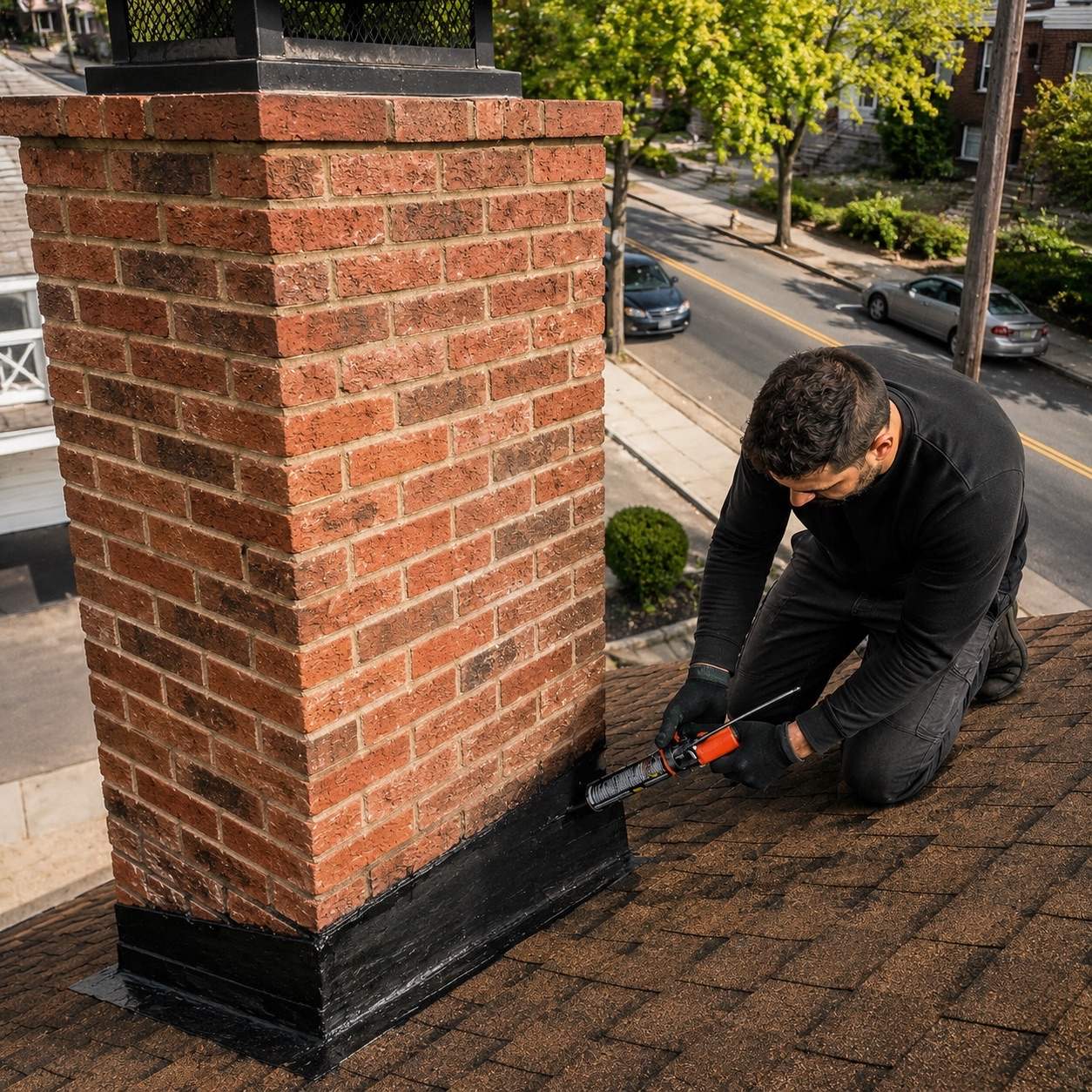
Chimney Leak Repair in Los Angeles
Water in the firebox after rain? Staining beside the chimney? Damp appearing around the fireplace?
Water near a chimney can arrive by several different paths, and the stain rarely marks the one it used. The source is worth identifying before any repair is recommended — including whether the chimney is the cause at all.
Los Angeles Area Pages
Los Angeles County
Free Estimate
Estimates at no charge
Estimate Requests
Submitted online
What Are You Seeing?
Start from the symptom. Each may be related to more than one path — the tags show which are worth considering, not which one you have.
Water in the firebox after rain
Water that reaches the firebox came in somewhere above it.
Staining on the wall or ceiling near the chimney
Often reads as a flashing issue, but the roof itself produces the same stain.
Damp or darkened masonry
Brick holding moisture when the wall around it has dried may point to absorption.
Water at the roof-to-chimney joint
Wetness, lifted metal or cracked sealant where the chimney passes through the roof.
White deposits on the brick face
Efflorescence — salts left as water moves through masonry. Evidence of movement, not of a location.
Cracked or crumbling crown
The surface at the top of the stack, cracked or built without an overhang.
Missing or damaged cap
An open flue takes rain directly down it, along with anything else that fits.
Moisture with no obvious rain entry
Damp that does not track with the weather can sometimes point to condensation rather than entry.
The Water-Entry Paths
Five ways water gets into or through a chimney. They fail independently, more than one is often active at once, and each leads to a different repair.
The chimney crown
- What it is
- The surface across the top of the stack, covering the gap between the flue and the outer edge of the masonry. Its job is to throw rain clear.
- How water gets in
- Cracks let water into the masonry below. A crown built flush with the brick, with no overhang or slope, sheds water down the chimney face rather than away from it.
- Visible clues
- Cracking across the top surface, crumbling material, or fragments at the base — often with staining or spalling below the crown line.
The flashing at the roof line
- What it is
- The metal detail sealing the joint where the chimney passes through the roof — two materials that move at different rates, joined by sealant that ages.
- How water gets in
- Lifted metal, corrosion, or sealant that has cracked and shrunk opens the joint, and water runs behind the flashing into the roof structure.
- Visible clues
- Staining on the ceiling or wall beside the chimney, or at the roof line. Note that the roof covering next to a chimney fails the same way and produces the same stain — see the next section.
The brick and mortar
- What it is
- The masonry itself. Brick is porous, and mortar joints are the sacrificial part of the wall — designed to wear before the brick does.
- How water gets in
- Once joints recede or go missing, the masonry stops shedding water and starts holding it. No single hole to point at; the chimney becomes the path.
- Visible clues
- Recessed or missing joints, efflorescence, spalled faces, masonry staying damp longer than the wall around it.
The cap and top opening
- What it is
- The cover over the flue opening, keeping rain, debris and animals out.
- How water gets in
- A missing, damaged or badly sized cap leaves the flue open to the sky. The most direct of the paths here.
- Visible clues
- Water in the firebox tracking closely with rainfall, rust at the damper, or nothing visible from the ground at all.
Internal and liner moisture
- What it is
- The surface inside the chimney. Moisture in a chimney is not always water that entered from outside.
- How water gets in
- Long-term entry from above can reach the liner. Separately, some internal damp is condensation forming inside the flue rather than rain getting in.
- Visible clues
- Odour that strengthens in damp weather, staining or tile fragments in the firebox. Liner condition is not something to infer from the hearth.
Chimney Leak, Roof Leak, or Condensation?
These three produce similar symptoms and have entirely different answers. It is the distinction most often skipped, because the chimney is the visible thing near the stain.
Chimney-related water entry
Water entering through the chimney system — crown, cap, flashing detail or the masonry itself. This is what the paths above cover.
What tends to separate it: Often tracks with rain, and the evidence is usually somewhere on the chimney: cracking, efflorescence, damp brick, a failing crown.
A roof leak near the chimney
The roof covering, a valley, a vent or the decking failing close to the chimney. The chimney is where the stain appears, not where the water arrives.
What tends to separate it: Also tracks with rain, and looks much the same from inside. If the chimney itself is in good condition, this becomes the more likely candidate.
Condensation or internal moisture
Moisture forming inside the flue rather than entering from outside — associated with appliance and venting conditions rather than with weather.
What tends to separate it: Tends not to track with rainfall. Damp or odour that appears in dry spells points away from an entry path.
Where we stop. We work on chimneys, and we are not going to tell you what your roof is doing beyond the chimney system. If the evidence points that way, a roofer is the appropriate next step, and we will say so rather than sell you chimney work that changes nothing.
Why the Source Is Identified First
Every repair below is reasonable work. Each is also useless against the other paths:
- ✕Sealing joints does nothing for a cracked crown
- ✕Coating masonry does nothing for failed flashing
- ✕A new cap does nothing for absorbent brickwork
- ✕Redone flashing does nothing for an open flue
So a repair chosen from the symptom rather than the source has a real chance of changing nothing — and because leaks are seasonal, you may not find out until the next wet spell.
Where Water May Show Up Inside
Water travels before it becomes visible — down the outside of a flue, along framing, or between masonry and plaster. So the stain is not always directly below where the water came in.
The firebox
Pooling or damp after rain. Do not use the fireplace while water is standing in it.
The chimney breast
Damp patches, discoloured plaster or paint lifting on the wall enclosing the chimney.
The ceiling beside the chimney
Staining spreading outward from the chimney line — often the first thing noticed.
The attic or roof-line area
Where the chimney passes through. Often the clearest view, and the least often looked at.
The masonry face outside
Damp, darkened or salt-stained brick, sometimes with faces flaking.
Where Waterproofing Fits
Waterproofing gets offered as a leak solution more often than it should be. It is a protective treatment for masonry already in sound condition, reducing how much water the brick absorbs.
It is not a substitute for repair. It does nothing for a cracked crown, failed flashing or a missing cap — none of those is an absorption problem. Applied over deteriorated joints or spalling brick it can make things worse, trapping moisture inside masonry that needs to release it.
Where it earns its place is after the system is understood and sound — chimney waterproofing covers when that applies.
Chimney Leaks in Los Angeles
Rain here reveals defects rather than causing them. Long dry stretches broken by intense wet periods mean a chimney can go months without anything showing, then leak on the first serious rain. The fault was usually there the whole time; the weather simply found it. That is also why leaks get reported in clusters after a storm.
Sealants age in the sun. Flashing sealant, crown coatings and mastic at the roof line dry out, shrink and crack under sustained exposure — and they sit at exactly the junction where water is most likely to get in. Exposure is not uniform either: a chimney near the coast contends with salt air and marine damp, one further inland with wider daily temperature swings that work at sealed junctions.
Cracking in masonry can have several causes — water, thermal movement, settlement, age — and in Southern California seismic movement is one factor that may warrant closer evaluation. Most cracking is not earthquake-related, but cracking that appeared or widened after felt shaking is worth looking at rather than watching.
Why Chimney Axis
Four things, each of which you can check on this site right now.
Problem-focused service information
Each water-entry path has its own page, so you can see what you are asking for before contacting anyone.
Related repair services
Crown, flashing, masonry, cap and liner work in one place, so a leak question does not stop at one job type.
Los Angeles County area pages
A local page for each city listed on this site, with the conditions that affect chimneys in that part of the county.
A simple estimate request
One form. Describe what you have seen and when, and we come back to you.
When another specialist may be needed
If the evidence points to roofing outside the chimney system — the covering, a valley, a vent or the decking — a roofer is the appropriate next step, and we would rather tell you that than sell you chimney work that changes nothing. If the damp does not track with rainfall at all, the question may be condensation and venting rather than water entry. And if you already know the chimney needs work but not what kind, chimney repair is the better place to start than this page.
Where to Go Next
Chimney Inspection
When the source is not established yet
Chimney Repair
The overview of every repair type
Crown Repair
When the top surface is cracked or flat
Flashing Repair
When the roof-line joint has opened
Masonry Repair
When brick and joints are the path
Waterproofing
After the masonry is sound, not before
Cap Installation
When the flue opening is uncovered
Liner Repair
When the flue surface is deteriorating
Nearby Los Angeles Area Pages
Local area pages for nearby cities, or Browse all Los Angeles County area pages.
Describe what you have seen
Tell us what service you need and request an estimate online.
The five paths
Each one leads to a different repair.
What helps us most
When the water appears, whether it tracks with rain, and a photograph of the chimney from the ground. Seasonal detail matters — damp in dry weather points somewhere different from damp that only follows a storm.
Prefer to write?
info@chimneycleaningla.comChimney Leak Questions
Tell us where the water is showing up
Describe what you have seen and when, and request an estimate. The source gets established before any repair is recommended.