Los Angeles County Service Areas · Chimney & fireplace services · Estimate requests online
Dryer Vent Cleaning in Los Angeles
Dryer vent cleaning clears the lint that gets past the lint trap and settles in the duct between the dryer and the outside wall. The whole run matters, not just the first few feet you can reach from behind the machine.
- Chimney & Fireplace ServiceCleaning, inspection & repair
- Los Angeles Service AreasCities & LA neighborhoods
- Free Estimates AvailableEstimates at no charge
- Easy to ReachCall or request online
Dryer Vent Cleaning Covers the Whole Duct Run
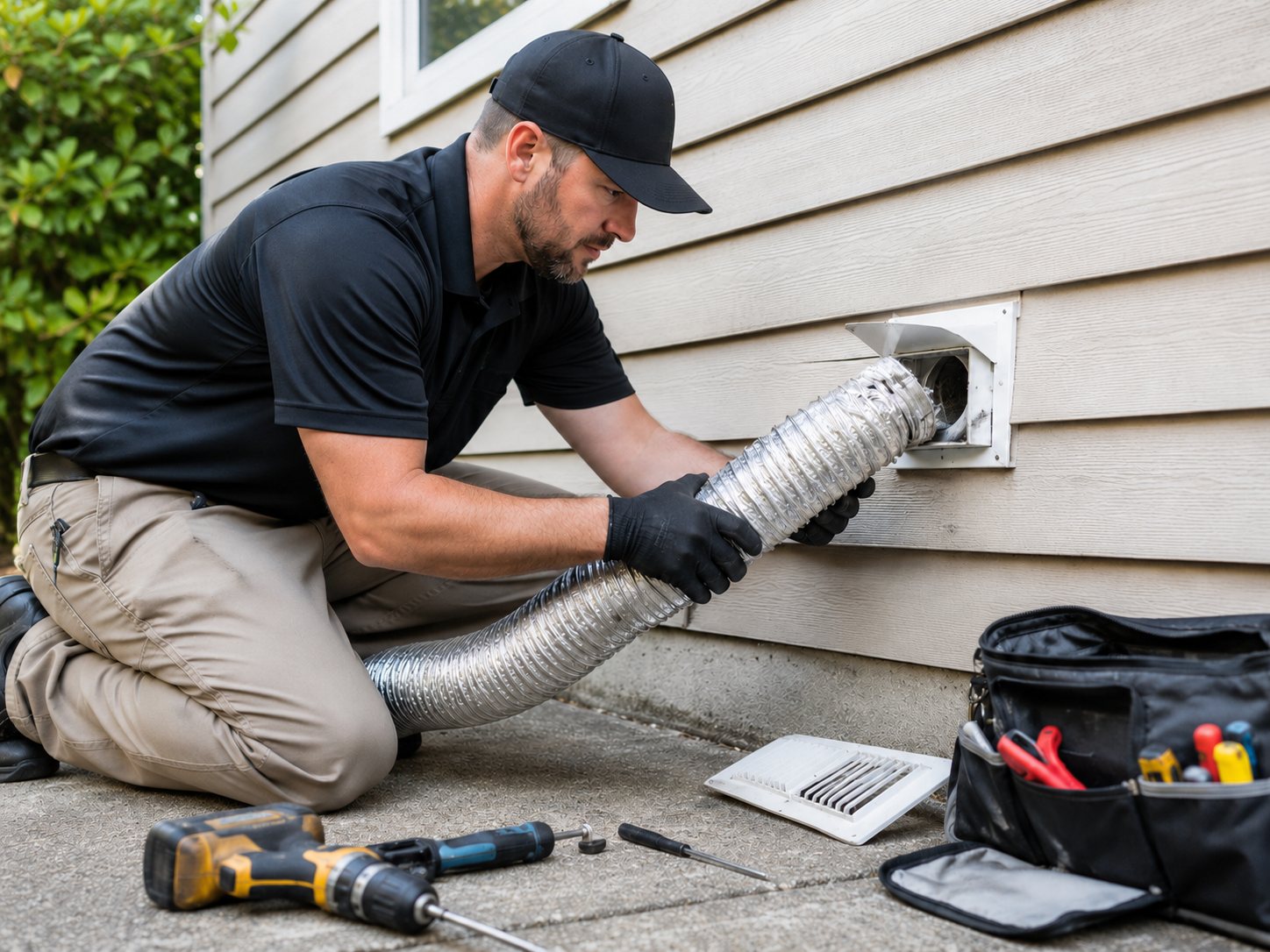
A dryer vent is three parts: the transition hose — the short flexible section behind the dryer — the fixed duct that runs through the wall, floor, ceiling or attic, and the termination, the hood on the outside wall or roof with a flap that opens when the dryer runs. Dryer duct cleaning means all three.
Cleaning only the part you can reach is the usual way this goes wrong. Lint does not collect evenly; it settles at bends and at the outside hood, which are the two places a brush from behind the dryer is least likely to reach.
Lint Gets Past the Trap and Settles in the Duct
The lint screen catches most of what comes off a load, not all of it. The fine fibers that pass it travel with warm, moist air down the duct. Where the air slows — at an elbow, in a sagging section, at the outside flap — the lint drops out and sticks.
Each layer narrows the duct a little. Less air moves, so the drum stays wetter for longer and the dryer runs hotter and longer to finish the same load. That extra heat is sitting next to a combustible deposit. The detail of where lint builds up, and why a clean screen does not prevent it, is on dryer vent lint removal.
This is not a theoretical risk. The US Fire Administration states that “failure to clean (31%) was the leading factor contributing to the ignition of clothes dryer fires in homes”, based on 2018–2020 data.
Signs the Dryer Vent Needs Attention
The symptom usually tells you which of three problems you have: general buildup, a blockage, or a duct that is wrong in itself.
| What you notice | What it usually is | Where it is covered |
|---|---|---|
| Loads taking a bit longer than they used to; lint around the outside hood | Gradual buildup through the run | This page |
| Dryer takes two cycles; top hot to the touch; outside flap barely moves | A full or near-full blockage | Clogged dryer vent |
| Burning smell during a cycle | Overheating — stop using the dryer first | Blockage and safety |
| Lint or damp in the laundry closet; duct flattened behind the dryer; plastic or foil duct | A disconnected, crushed or unsuitable duct | Dryer vent repair |
| Dryer runs but produces no heat | Often an appliance fault, sometimes caused by a restricted vent | Appliance repair, then check the vent |
What a Dryer Vent Inspection Checks
A dryer vent inspection is a look at the run before and during cleaning, to establish whether cleaning is the whole answer. These are the five things worth checking.
The connection at the dryer
Whether the duct is actually attached to the dryer outlet and clamped, or has slid off and is venting lint and moist air into the wall cavity or the laundry closet.
The transition hose
The short flexible section behind the dryer. It gets crushed when the dryer is pushed back against the wall, and a flattened transition hose restricts the whole run no matter how clean the rest is.
Run length and number of bends
Every elbow adds resistance, and the dryer manufacturer's installation manual sets a maximum equivalent length that bends count against. A run that is over that limit will load with lint faster however often it is cleaned.
The termination hood and damper flap
The fitting on the outside wall or roof. The flap should swing open when the dryer runs and close when it stops. A flap stuck shut, painted over, or packed with lint is a common restriction on the whole run.
Visible crush, sag or separation
Duct that has been flattened behind a stacked unit, has sagged between supports in an attic, or has pulled apart at a joint. These are repair findings, not cleaning findings.
If the duct itself is the problem, cleaning it only resets the clock. Dryer vent repair covers replacing, reconnecting and rerouting it.
How Often to Clean a Dryer Vent
There is no single interval that fits every house. A yearly check is a sensible starting point, and the first cleaning is what should set the schedule after that: if very little lint came out, the run can go longer; if the bends were packed, it needs to be sooner.
Three things shorten the interval. How many loads run through it — a household of five fills a duct faster than a household of one. How long the run is and how many bends it has. And what is being dried: towels, bedding and pet hair produce far more lint than a load of shirts.
Clean the lint screen before every load regardless. It does not make duct cleaning unnecessary, but a clogged screen pushes more lint around it and into the run.
How the Work Is Done
The dryer is pulled out and disconnected from the duct. On a gas dryer, the gas connector is moved with the machine rather than bent or strained. The transition hose is checked and, if it is crushed or split, set aside for replacement.
A rotary brush on flexible rods is run through the fixed duct, from the dryer end, the outside end, or both on a longer run. The loosened lint is pushed out through the termination or pulled back with a vacuum. The outside hood is cleared and the flap checked so it swings freely.
The dryer is reconnected and run on heat, and the airflow is checked at the hood. A strong, warm stream with the flap fully open is what a clear run looks like. Weak airflow after cleaning points to a problem cleaning does not fix.
The access equipment is close to what chimney cleaning uses — rods, brushes, a vacuum — but it is a different appliance with a different deposit, and how dryer vent and chimney cleaning compare covers the differences.
Clean, Clear, or Repair?
Cleaning is the right answer when the duct is sound and the dryer is slowing down gradually. That is the routine case and it is what this page is about.
Clearing a blockage is the right answer when the run has closed up — two cycles to dry, a hot cabinet, a flap that does not open. That needs a different approach, and clearing a clogged dryer vent covers it, including when to stop using the dryer.
Repair is the right answer when the duct itself is the problem: crushed, disconnected, plastic, or too long for the dryer. Replacing or rerouting the duct is what stops a run from clogging again a few months after it was cleaned.
When not to call us: if your dryer vents through a short, straight duct to an exterior wall you can reach from both ends, a brush kit from a hardware store will do the job. And if the dryer tumbles but stays cold, the fault is probably inside the dryer rather than the vent; the vent-or-dryer test tells the two apart.
What Drives Dryer Vent Cleaning Cost
No price is published here, because a short wall run and a long roof run are different jobs. These are the variables that move the estimate.
Length of the run and number of bends
A short straight run through an exterior wall is a different job from a long run with several elbows through a ceiling or up to the roof.
Where the run ends
A wall hood at ground level is reached from a step. A roof termination means roof access, and a second-story wall hood means a ladder or working from inside.
Getting to the dryer
A dryer in an open garage pulls out easily. A stacked washer-dryer in a closet, or a gas dryer with a short connector, takes more care to move and reconnect.
How compacted the lint is
Loose lint brushes out. Lint that has absorbed moisture and packed into a bend, or a run that is fully blocked, takes longer and is covered on the blockage page.
What turns up
A crushed section, a disconnected joint or a plastic duct changes the job from cleaning to repair. That should be explained before the scope changes, not after.
A short description, and a photo if you can take one safely, is a good start to an estimate request. It helps to say where the dryer is, where the vent comes out, and roughly how long a load takes to dry.
Dryer Vent Cleaning in Los Angeles Condos and Apartments
In a condo or apartment the dryer is often in an interior closet, and the vent runs through the building to an outside wall or the roof rather than straight out. The part you can reach is short; the part that loads with lint may be well out of sight. Where a run is long enough to be the cause of the problem, the fix is on dryer vent repair.
Before booking, check with the association who is responsible for which part of the duct. Buildings with shared laundry rooms are covered on multi-unit and commercial properties.
Dryer taking longer than it should?
Tell us where the dryer sits, where the vent comes out, and how long a normal load takes. That is usually enough to tell a cleaning from a repair.
Related chimney & fireplace services
Part of Dryer Vent Services — The other duct in the house that fills with something flammable. Same access equipment, same failure mode, very different appliance.
- lint built up inside the ductDryer Vent Lint Removal — Where lint collects, why it collects there, and what it does to airflow.
- a dryer that takes two cycles to dryDryer Vent Blockage Removal — Full blockages — crushed duct, bird nests, and the symptoms that give them away.
- dryer vent repairDryer Vent Repair — Crushed, disconnected or badly routed duct, and failed exterior hoods — repair and replacement.
- having the flue cleanedChimney Cleaning — Creosote, soot and debris removed from the flue, smoke shelf and firebox.
- chimney work on managed buildingsCommercial Chimney Services — Multi-unit, HOA and commercial properties, where access and scheduling differ.
Further reading: Dryer Vent Cleaning vs Chimney Cleaning: Why Both Matter
Nearby Service Areas
Request an Estimate
Tell us where the dryer vents and how long a load takes.
Quick check
Run the dryer on heat and go outside to the vent hood. The flap should open fully and you should feel a strong stream of warm air. A flap that barely lifts means the run is restricted somewhere between the dryer and the hood.
Dryer Vent Cleaning Questions
There are more answers on the Los Angeles homeowner FAQ.
Tell us what your chimney is doing
Call, or send a short description and request an estimate. Estimates cost nothing.