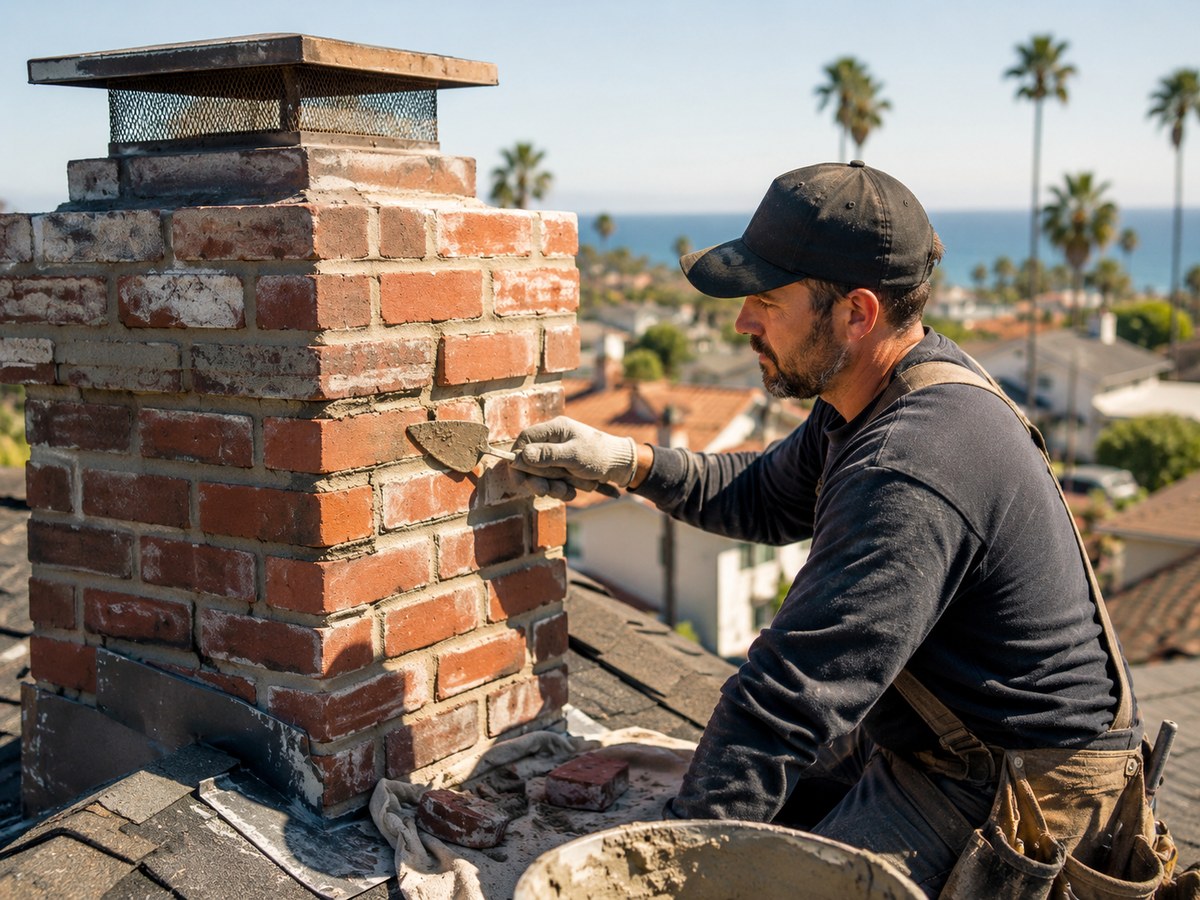
Chimney Masonry Repair in Los Angeles
Cracked brick, crumbling mortar, faces flaking away, joints that have receded behind the brick. Brick damage and mortar damage are different problems, and they lead to different repairs.
This page covers what each sign points to, and how repointing, brick replacement and rebuilding differ.
Los Angeles Area Pages
Los Angeles County
Free Estimate
Estimates at no charge
Estimate Requests
Submitted online
Signs Your Chimney Masonry May Need Repair
Each of these is a reason to have the masonry looked at. None settles what the repair should be on its own — several share the same underlying cause, and one sign can have several.
Cracked brick
Not every crack is structural. The pattern matters more than the presence of one — a crack through a single face reads differently from stepped cracking across several courses.
Deteriorated mortar
Joints that crumble under light pressure or rake out with a screwdriver. Usually the first thing to go.
Missing mortar
Joint sections gone entirely, leaving an open channel between bricks.
Spalling and flaking faces
Brick faces popping, flaking or shearing off — a sign of moisture moving through the masonry rather than a fault in the brick.
Loose masonry
Brick that moves when pressed, or top courses that feel unstable.
Leaning or displaced sections
A stack out of plumb, or courses shifted relative to those below. This changes the order of every other question.
Efflorescence
White powdery deposits on the brick face — mineral salts left as water moves through masonry and evaporates.
Visible gaps
Openings at joints, at the crown-to-brick junction, or at the roof line. Entry points whether or not anything has fallen out.
Recessed joints
Mortar sitting behind the plane of the brick face. Still there, but no longer shedding water off the wall.
Debris at the base
Sand, mortar crumbs or brick fragments in the gutter or at the foot of the chimney — material arriving from above.
If the chimney is leaning or masonry feels loose, stop using the fireplace until it has been evaluated.
Brick Damage vs Mortar Damage
This is the distinction that separates two repairs often spoken about as one. A chimney can have sound brick and failed joints, or sound joints and spalled brick.
Mortar damage
The joints between the bricks. Mortar is deliberately the softer material and is expected to wear first. Recessed, crumbling or missing joints are mortar damage.
Addressed by cutting the joint back to sound material and refilling it.
Brick damage
The units themselves — faces flaked or sheared away, bricks cracked through. Brick is the harder material, so damage here usually means something has been acting on it for a while.
Addressed by cutting out affected units and setting replacements.
In practice the two arrive together, because failed joints are what let water into the masonry that later damages the brick. That sequence is why order matters.
What Causes Mortar Joints to Deteriorate
Mortar failing is normal rather than exceptional. It is the part of the wall designed to give, doing that job in the most exposed position on the house.
Water, over years
The main agent. Repeated wetting washes the binder out of the joint, which is why joints recede rather than fail suddenly.
Exposure on every side
Unlike a house wall, a chimney takes weather from four directions and from above.
Thermal movement
Masonry expands and contracts with temperature, and the joint is where that movement is absorbed.
An earlier repair in the wrong mortar
Mortar harder than the surrounding brick will not give, so movement and salt damage transfer into the brick faces instead — a past repair causing brick damage.
Age
Older mortars were often softer by design, and joint deterioration can simply be the material reaching the end of its life.
On matching replacement mortar to the original, the National Park Service Preservation Briefs on repointing masonry set out why strength and profile matter. The principle applies to any older chimney, not only to historic buildings.
What Is Chimney Spalling?
Spalling is brick faces flaking, popping or shearing away from the surface. It shows up as patches of exposed, rougher brick where the outer face has come off, often with fragments collecting below.
Brick is porous. Masonry that has absorbed water releases it again, and that movement carries material out through the face. Anything that increases the wetting makes it worse — including a surface coating that traps moisture in rather than letting it out.
Which leads to the part worth keeping hold of: spalling is a symptom of a moisture path, not a defect in the brick. Replacing spalled units addresses the visible damage; if the reason the masonry is getting wet is still there, the new brick sits in the same conditions.
Guidance on brick durability and moisture behaviour is published by the Brick Industry Association's technical notes.
Repoint, Replace, or Rebuild?
Almost every masonry conversation ends up here. These are not a ladder from cheap to expensive — they address different conditions, and more than one can apply to the same chimney in different places.
Repointing
Joints only- Relates to
- Deterioration confined to the mortar, with the brick around it sound — recessed, crumbling or missing joints on a stack that is plumb and stable.
- What it involves
- Cutting failed mortar back to sound material and refilling the joint. The masonry is not taken apart.
- What it does not do
- Address damaged brick, a failing crown, or movement in the structure.
Brick replacement
Individual units- Relates to
- Damage in the brick rather than the joints — spalled, cracked or broken units, isolated within otherwise sound masonry.
- What it involves
- Cutting out affected brick and setting replacements, usually alongside repointing the joints around them.
- What it does not do
- Fix whatever caused the brick to fail. Where moisture is the driver, the replacement sits in the same conditions.
Partial or full rebuilding
Reconstruction- Relates to
- Deterioration widespread enough that little sound material is left to key into, or masonry that has shifted, leaned or lost stability.
- What it involves
- Taking the affected section down to sound material and rebuilding — commonly the courses above the roof line.
- What it does not do
- Follow automatically from bad-looking brick. Whether repair still has enough to work with is judged at the chimney, not from a photograph.
Which one applies is not decided here. The appropriate approach depends on how widespread the deterioration is and which parts of the masonry system are affected. Nothing on this page is a diagnosis of your chimney, and no approach above is being offered as the answer to what you have described. That comes from evaluating the chimney.
Where Masonry Damage Appears on a Chimney
Location carries information. The same crack means something different at a corner than mid-face, and deterioration below the roof line raises a different question from deterioration above it.
Above the roof line
The most exposed section. Usually the first to deteriorate, and the part most often rebuilt.
The crown junction
Where the crown meets the top course of brick — two materials with different movement, at a joint that has to stay watertight.
At the roof line
Masonry sitting against the flashing, which can stay wet longer than the rest of the stack.
Below the roof line
Less exposed, so damage here often means water tracking down from above.
The corners
Where stepped cracking shows if a chimney has moved — read differently from cracking mid-face.
The firebox side
Interior masonry subject to heat cycling rather than weather.
When Masonry Damage Is Actually Related to Water
A good deal of masonry deterioration traces back to water entry or prolonged moisture — but not all of it. Age, thermal movement, ground movement and an unsuitable earlier repair all damage masonry with no water problem at all, so water is a strong candidate rather than an automatic explanation.
Where it is the driver, the water often arrives from a specific fault above or beside the masonry rather than through the brickwork. Repairing the masonry without finding that fault treats the damage and leaves the mechanism running.
Chimney Leak Repair→
Where water is reaching the firebox or the wall beside the chimney, and the entry point has not been established.
Chimney Crown Repair→
Where the surface at the top of the stack is cracked or was built without an overhang, sending water into the masonry below.
Chimney Flashing Repair→
Where the joint at the roof line has opened, and masonry around it is staying wet.
Chimney Waterproofing→
Prevention rather than repair — reducing how much water sound masonry absorbs, once it is sound.
One note on waterproofing: applied over failed joints or spalling brick, it can trap moisture in masonry that needs to release it. It follows repair rather than substituting for it.
Chimney Masonry Repair in Los Angeles
Rain arrives concentrated. A brick chimney here is not weathering in the mild conditions the climate's reputation suggests. Long dry stretches broken by intense wet periods are harder on masonry than steady drizzle: dry brick absorbs heavily when the rain finally comes, and the damage surfaces in the seasons afterwards rather than during the storm. Sustained sun followed by cool nights adds wide daily temperature swings, and it is the joints that absorb the movement.
Exposure varies sharply by location. A chimney in Santa Monica contends with salt air and marine damp; one in Santa Clarita with a wider daily temperature range; one in Pasadena often with age.
Seismic movement, stated carefully. Cracking can have several causes — water, thermal movement, settlement, age — and in Southern California seismic movement is one factor that may warrant closer evaluation. Chimney damage was widely reported across the region after the 1994 Northridge earthquake. That does not make any particular crack earthquake-related, and most are not. It does mean cracking that appeared or widened after felt shaking is worth looking at rather than watching.
Why Chimney Axis
Four things, each of which you can check on this site right now.
Clear service information
Masonry work, joint work, rebuilding and waterproofing each have their own page, so you can see the difference before contacting anyone.
Los Angeles County area pages
A local page for each city listed on this site, with the conditions that affect chimneys in that part of the county.
Related chimney and fireplace services
Inspection, leak work, crown and flashing repair alongside masonry, so the question does not stop at one job type.
A simple estimate request
One form. Describe what you can see, and we come back to you about it.
When not to call us
If the only problem is deteriorated mortar joints and the brick is sound, what you want is tuckpointing rather than a broader masonry job. If the masonry is in good condition and you are trying to keep it that way, that is waterproofing, not repair. And if cracking in the chimney is part of wider movement in the building, that is a question for a structural engineer before it is a question for a mason. We would rather say so than sell you the wrong job.
Related Chimney Services
Chimney Repair
The hub — how all the repair types differ
Chimney Inspection
Establish condition before choosing an approach
Chimney Tuckpointing
Mortar joint work in depth
Chimney Rebuilding
Reconstruction where repair has too little to key into
Chimney Waterproofing
Protection for masonry already in sound condition
Chimney Crown Repair
The surface at the top of the stack
Nearby Los Angeles Area Pages
Chimney pages for nearby cities, or Browse all Los Angeles County area pages.
Describe the masonry damage
Tell us what service you need and request an estimate online.
Which page do I want?
Masonry repair is the overview. These go deeper on one thing each.
Before choosing an approach
Repointing, brick replacement and rebuilding address different conditions, and it is common for more than one to apply in different places on the same chimney. An inspection is what establishes which.
Prefer to write?
info@chimneycleaningla.comChimney Masonry Repair Questions
Tell us what the masonry is doing
Describe what you can see on the chimney and request an estimate. No approach is committed to before the masonry has been looked at.