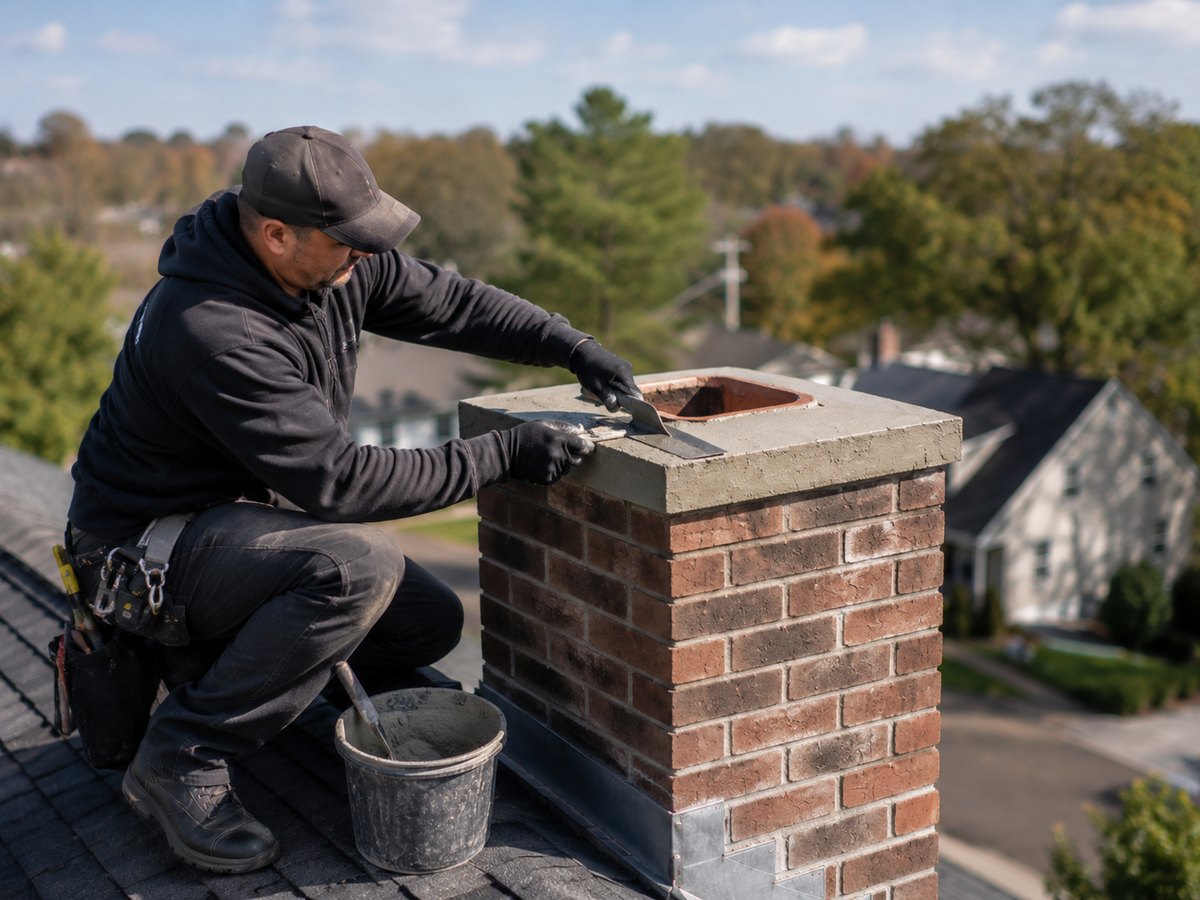
Chimney Crown Repair in Los Angeles
Cracked or failed chimney crowns repaired or rebuilt — before water reaches the liner and masonry below.
- Chimney & Fireplace ServiceCleaning, inspection & repair
- Los Angeles Service AreasCities & LA neighborhoods
- Free Estimates AvailableEstimates at no charge
- Easy to ReachCall or request online
About Chimney Crown Repair
The chimney crown is the concrete or mortar surface at the very top of a masonry chimney — the flat or sloped section that covers the gap between the flue liner and the outer edge of the chimney. Its job is to shed rain and snowmelt away from the flue and the surrounding masonry. When it cracks or deteriorates, it does the opposite: it channels water directly into the liner and down through the masonry.
A well-built crown overhangs the chimney face on all sides and has a slight downward slope from the flue toward the edges. A crown that sits flush with the chimney top, or one without adequate slope, will allow water to pool and infiltrate the mortar joint where the crown meets the brick — typically the first place to fail. This is a design issue, not just age.
Los Angeles' concentrated winter rainfall, and colder nights in the high desert and the foothills, work on a crown harder than the region's mild reputation suggests. A crown that looked fine a few years ago may have developed cracks that are difficult to see from ground level.
Crown Repair vs. Crown Replacement
Repair is appropriate when the crown has the correct geometry (proper overhang and slope) and the cracks are narrow, stable and have not opened a path through the slab. A crown coating on a sound substrate can extend its life; it does not rescue a crown that has already failed.
Replacement is required when the crown is undersized (no meaningful overhang), improperly sloped (flat or pitched toward the chimney), structurally crumbling, or cracking through its full depth. A patch on a bad foundation fails quickly. The only durable fix is removing the existing crown to sound material and rebuilding it correctly.
Signs Your Chimney Crown Needs Repair
Visible cracks in the crown
Hairline to wide cracks across the crown surface, visible from binoculars at ground level or confirmed during a rooftop inspection.
White staining on exterior brick (efflorescence)
Mineral deposits left on the brick face when water moves through the masonry and evaporates. The stain is evidence — the problem is what's making the water move.
Water in the firebox after rain
Water entering through a cracked crown runs down the flue and pools in the firebox. Never use the fireplace when there is water in the firebox.
Spalled brick below the chimney top
Brick faces popping or flaking directly below the crown line indicate water is entering there and saturating the masonry from above.
Crown flush with chimney top
A crown with no overhang and no downward slope was built incorrectly and will allow water in at the joint between the crown and the outer brick. This is a design defect, not age — it was wrong from day one.
Previously patched with surface caulk
A surface sealant applied over a cracked crown buys time, not a fix. If an earlier repair used caulk alone without addressing the underlying crack depth, it will fail.
Why Crown Repair Is Masonry Work
- Crown geometry — overhang, slope and liner clearance — is what makes a crown shed water, so a repair that ignores it does not hold
- Removing a crown without damaging the flue liner or surrounding masonry requires controlled cutting technique
- Concrete mix proportions for a durable crown differ from standard mortar — wrong mix fails in the first winter
- Matching existing mortar color and joint profile when repointing around the new crown requires material selection
- Working at chimney height means rooftop access and fall protection, which is why crown condition is not a ladder-and-binoculars job
- Crown work sits directly above the flue, so removing material without damaging what is below is part of the job, not an afterthought
How Crown Repair Works
Look at the crown
The crown is assessed from the roof — its condition, whether it has an overhang and a slope, and whether repair or recasting is the applicable route.
Options explained
What was found, which approaches apply to it, and how they differ in scope — discussed before anything is agreed.
Remove deteriorated material
For replacement jobs, the existing crown is cut back to sound material. Loose or crumbling sections are removed before new material is placed.
Rebuild to spec
A properly built crown overhangs the brick on all sides so water drips clear of the face, and slopes down from the flue liner to the outer edge. Hairline cracks in a sound crown can be sealed with an elastomeric crown coating.
Curing and waterproofing
New concrete is allowed to cure before rain exposure. A vapor-permeable masonry sealer is applied to the crown and surrounding brick to reduce water absorption.
Crown Work and the Rest of the Chimney
A crown sits on the top course of masonry, so its condition and the condition of the brick beneath it are related questions. Where the joints below have gone as well, the conversation widens into masonry repair; where there is too little sound material left for the new crown to bear on, it widens further into rebuilding the stack, with the crown reformed as part of that work.
On waterproofing: a vapour-permeable masonry treatment reduces how much water sound brick absorbs, and it is sometimes applied to the masonry around a crown once that work is done. It is not a crown repair and not a substitute for one — over a cracked crown it changes nothing, and over deteriorated masonry it can trap moisture that needs to leave. Chimney waterproofing covers when it applies.
A crown is also one of four independent ways water reaches a chimney, alongside the cap, the flashing at the roof line and the masonry itself. If you know water is getting in but not from where, chimney leak repair works through the paths in turn rather than assuming the crown.
Not every chimney has a crown. A framed or factory-built chimney, a wood-framed chase around a metal flue, is topped with a metal chase cover instead, and a rusted or dished one is covered on chimney chase cover repair. The metal hood over the flue opening is the cap, a separate part again — chimney cap installation covers it, and the crown, cap and chase cover compared sets the three side by side.
Related Guides
Related chimney & fireplace services
Part of Leaks & Water Damage — Water is the single most common cause of chimney damage in Los Angeles. These pages cover where it gets in and what stops it.
- getting a leaking chimney repairedChimney Leak Repair — The repair page for water coming in — crown, flashing, cap, masonry or liner.
- repairing lifted or rusted flashingChimney Flashing Repair — The metal seal at the roof line — the most common single source of chimney leaks.
- chimney waterproofingChimney Waterproofing — Vapour-permeable repellent on sound masonry. Prevention, not a leak fix.
- repairing damaged brick and mortarChimney Masonry Repair — Brick replacement, spalling, cracked faces and structural masonry damage.
- putting a rain cap on an open flueChimney Cap Installation — Fitting a cap where there is none, and choosing a material that lasts in LA.
- chase cover replacementChase Cover Repair & Replacement — The sheet-metal top of a framed, factory-built chimney — rust, pooling and replacement.
Further reading: Chimney Crown vs Chimney Cap: What's the Difference? · Chimney Leaks: Where the Water Usually Comes From
Request a Crown Repair Estimate
Tell us what service you need and request an estimate online.
Related Services
When to call someone else
If the crown looks intact but you're seeing water in the firebox, the problem is more likely the cap or flashing. Start with a chimney inspection to identify the correct entry point before committing to any repair.
Have a question?
info@chimneycleaningla.comChimney Crown Repair FAQ
Not the question you had? The full FAQ covers more ground.
Seeing cracks at the top of your chimney?
Call, or send a short description and request an estimate. Estimates cost nothing.