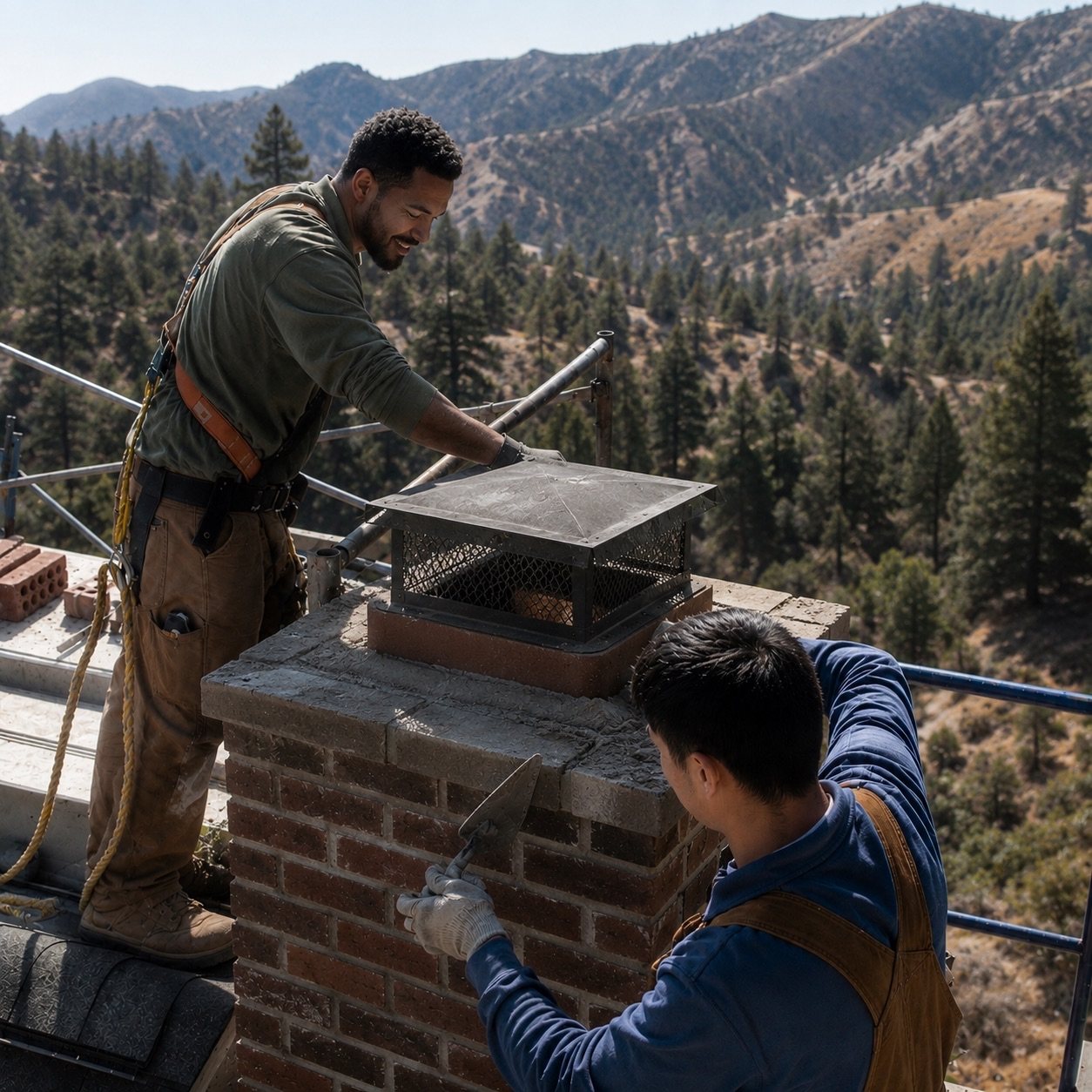
Chimney Repair in Los Angeles
Cracked brick, failing mortar, water reaching the firebox, a broken crown, lifted flashing, a deteriorating liner. Different faults, different repairs — and the symptom rarely names the cause.
Tell us what you can see. The chimney gets evaluated, the options get explained, and you decide from there.
Los Angeles Area Pages
Los Angeles County
Free Estimate
Estimates at no charge
Estimate Requests
Submitted online
Signs Your Chimney May Need Repair
These are the things people notice from the ground, from the roof, or from the living room. Each is a reason to have the chimney looked at. None is a diagnosis on its own — several unrelated faults produce the same visible symptom, and telling them apart is what an evaluation is for.
Cracked or broken brick
A crack running through a brick face, or through several bricks in line, is structural information. A single hairline crack and a stepped crack across a corner are different problems with different answers.
Crumbling or missing mortar
Mortar that can be raked out with a screwdriver, or joints that have receded behind the brick face, has stopped doing its job. Water goes where mortar used to be.
Spalled or flaking brick faces
Brick faces popping, flaking or shearing off usually mean water has been absorbed into the masonry and is working its way back out. Spalling is a symptom of a water path, not the cause of one.
Water in the firebox after rain
Water reaching the firebox came in somewhere above it — crown, cap, flashing, or through the masonry itself. Which one decides the repair, and it is rarely obvious from inside.
Staining on the ceiling or wall beside the chimney
A damp patch on the chimney breast often points at the flashing where the chimney passes through the roof. The same stain can also come from the roof itself.
White powdery deposits on the brick
Efflorescence — mineral salts left behind when water moves through masonry and evaporates at the surface. The deposit is evidence that water is moving through the chimney.
A cracked, crumbling or flat crown
The crown is the surface at the top of the chimney that sheds rain away from the flue. Cracked, or built without an overhang, it channels water in rather than off.
Rust at the damper, firebox or chase cover
Steel components inside a chimney rust when they are getting wet. Rust is a dated record of a leak that has been running for a while.
Loose, leaning or shifted masonry
A chimney that has moved out of plumb, or where the top courses feel loose, needs evaluating before anything else is done to it. Stop using the fireplace until it has been looked at.
A deteriorating or missing flue liner
Fragments of clay tile in the firebox, or a flue that looks pitted and broken up, indicate liner damage. This is one to have evaluated rather than diagnosed from the hearth.
Smoke coming back into the room
Draft problems have several causes and only some of them are repairs. A blockage, a damaged smoke chamber and a cracked liner all present the same way from the sofa.
Gaps where the chimney meets the roof
Lifted metal, cracked sealant or a visible gap at the roof line is a flashing problem. It is one of the most common water entry points on any chimney.
If the chimney is leaning, if masonry is loose, or if there is water sitting in the firebox, stop using the fireplace until it has been evaluated.
Chimney Repair Services
“Chimney repair” covers six fairly different jobs. Which one you need depends on where the fault is, not on what it looks like from inside the house. Each has its own page.
Chimney Leak Repair→
The problem: Water reaching the firebox, damp on the wall beside the chimney, or staining that appears after rain.
What it covers: Finding the entry point before fixing anything — the leak is rarely where the stain is.
Chimney Masonry Repair→
The problem: Cracked brick, failing mortar joints, spalled faces and loose masonry.
What it covers: Repointing failed joints, replacing damaged brick, and rebuilding sections that have gone past repair.
Chimney Crown Repair→
The problem: Cracks across the top surface of the chimney, or a crown built flush with no overhang.
What it covers: Sealing sound crowns and recasting the ones that are undersized, unsloped or breaking up.
Chimney Flashing Repair→
The problem: Water getting in where the chimney passes through the roof — the joint between two different materials.
What it covers: The metal and sealant detail at the roof line, which moves and fails independently of the masonry.
Chimney Liner Repair→
The problem: Cracked or deteriorating flue liner, tile fragments in the firebox, or an unlined flue.
What it covers: The inside of the chimney — the surface separating combustion products from the house.
Chimney Rebuilding→
The problem: Masonry that has deteriorated past the point where patching it is worth doing.
What it covers: Taking the chimney down to sound material and rebuilding, in part or in full.
Not sure which applies? That is the usual position, and it is fine. A chimney inspection establishes what the fault actually is before anything is committed to.
How a Chimney Repair Starts
Nobody can tell you what your chimney needs from a description. What a description does is decide what to go and look at.
Describe what you have noticed
When it started, where you see it, whether it changes with rain, and whether the fireplace is in use. A photograph of the chimney from the ground helps more than most descriptions.
The chimney is evaluated
Repair scope comes from looking at the chimney, not from the symptom. The same water stain can come from a crown, a flashing detail, an unsealed masonry face, or the roof next to it.
Repair options are discussed
Most chimney faults have more than one reasonable answer, and they differ in scope. Seal or recast. Repoint or rebuild. Which apply depends on what the evaluation finds.
You request an estimate
Send the form on this page with what you know. Nothing here is a quote, and no repair is committed to before someone has looked at the chimney.
Masonry Damage: Brick, Mortar and Spalling
Masonry chimneys fail from the joints inward. Mortar is deliberately the softer material in the wall — it is meant to take the wear so the brick does not — and on a chimney it takes more weather than anywhere else on the house, from four sides and from above.
Once joints recede or crumble, water gets into the masonry rather than running off it. Absorbed water is what produces spalling: brick faces flaking, popping or shearing away as moisture moves back out through them. Spalling is almost always a downstream symptom, which is why replacing spalled brick without dealing with the water path buys a few seasons at best.
Repointing — commonly called tuckpointing — is the standard repair for failed joints: the old mortar is cut back to sound material and the joint refilled. The mortar itself matters. New mortar harder than the surrounding brick will not give, so movement and salt damage transfer into the brick faces instead of the joint. The National Park Service Preservation Briefs on repointing masonry set out why matching the original mortar matters, and the principle applies to any older chimney, not only to historic buildings.
Loose or shifted masonry is a separate category. Where courses have moved, where the chimney is out of plumb, or where the top section feels unstable, the question is not which joints to repoint but whether that section still has anything sound to build on.
This is the overview. Chimney masonry repair goes into brick replacement and joint work in detail, and chimney tuckpointing covers the repointing side on its own.
Water and Leak Damage
Most chimney repair work traces back to water. A chimney is the one part of the house exposed on every side and open at the top, and it has four independent places where water can get in.
The crown
The surface across the top of the chimney. Its job is to throw rain clear of the flue and the brick below. Cracked, or built without an overhang, it does the opposite.
Crown repair →The flashing
The metal detail where the chimney passes through the roof. Two materials that expand at different rates, joined by sealant that ages — a common and often-missed leak point.
Flashing repair →The masonry
Brick and mortar absorb water. Once joints have failed or faces have spalled, the chimney itself becomes the path, with no single hole to point at.
Masonry repair →The cap
The cover over the flue opening. Missing or damaged, rain goes straight down the flue — along with anything else that fits.
Cap installation →More than one of these is often active at the same time, and the stain on your ceiling does not tell you which. Nor does every leak near a chimney come from the chimney — roof coverings, valleys and vents fail beside chimneys too, and a damp patch on the chimney breast has been caused by all of them. Establishing the entry point first is the difference between one repair and a sequence of them.
Chimney leak repair covers that process. If you want the background first, where chimney leaks actually come from walks through each source in turn.
Liner and Internal Damage
The flue liner is the surface inside the chimney that separates combustion products from the structure of the house. In most older Los Angeles chimneys it is clay tile, laid in sections. It is also the part of the chimney you cannot see from the ground, from the roof, or from the firebox.
Liners deteriorate. Tiles crack, the joints between sections open up, and long-term water entry from a failed crown accelerates both. Fragments of clay tile in the firebox are a common first sign, but a good deal of liner damage announces itself in no way at all from inside the house.
That matters because exterior condition is a poor predictor of internal condition. Masonry can look sound with a damaged flue behind it, and a weathered chimney can have an intact liner. The two are assessed separately. Guidance for homeowners on chimney and venting condition is published by the Chimney Safety Institute of America, and the construction and maintenance of chimneys is governed by NFPA 211.
Chimney liner repair covers what can be done about a damaged liner. For what the liner is and why it exists, what a chimney liner actually does is the plainer explanation.
Chimney Repair in Los Angeles
A great deal of the Los Angeles housing stock is old enough that its chimneys are unreinforced masonry — brick and mortar, built before reinforcement was standard practice. Those chimneys age in a particular way here.
Rain arrives concentrated. The Southern California pattern is long dry stretches broken by intense wet periods, which is harder on masonry than steady drizzle. Dry masonry absorbs heavily when the rain finally comes, and the damage tends to show up in the seasons afterwards rather than during the storm.
Exposure varies enormously across the county. A chimney in Santa Monica deals with salt air and marine damp; one in Santa Clarita deals with wide daily temperature swing; one in Pasadena is often simply older. The same brick fails differently depending on which of those it has been sitting in.
Seismic movement is worth naming. Cracking can have several causes — water, thermal movement, settlement, age — and in Southern California seismic movement is one factor that may warrant closer evaluation. Unreinforced masonry chimneys are among the more shake-sensitive parts of a house, and the 1994 Northridge earthquake damaged chimneys widely across the region. That does not make every crack earthquake damage, and most are not. What it does mean is that cracks which appeared or widened after a felt earthquake are worth having looked at rather than watched, and that a chimney repaired at the exterior after a quake has not necessarily had its flue assessed.
Why Chimney Axis
Four things, each of which you can check on this site right now.
Repair-focused service information
Each repair type has its own page explaining what it addresses, so you can see what you are asking for before contacting anyone.
Los Angeles County area pages
A local page for each city listed on this site, with the conditions that affect chimneys in that part of the county.
A simple estimate request
One form. Describe the problem, and we come back to you about it.
Related chimney and fireplace services
Cleaning, inspection, fireplace work and dryer vents alongside repair — so a repair question does not stop at the edge of one job type.
When not to call us
If the damp beside your chimney only appears where the roof itself is failing, the repair you need is a roofer's, not ours. If your fireplace is a gas appliance that will not light and the masonry is sound, that is an appliance fault rather than a chimney repair — start with gas fireplace repair. And if nothing is visibly wrong and the chimney has simply not been used in a while, what you want is an inspection, not a repair. We would rather say so than sell you the wrong job.
Related Chimney & Fireplace Services
Chimney Inspection
Establish the fault before choosing a repair
Chimney Waterproofing
Reduce absorption into repaired masonry
Chimney Cleaning
Deposit removal, separate from structural work
Smoke Chamber Repair
Where a draft problem turns out to be structural
Fireplace Repair
Faults inside the firebox rather than the flue
Chimney Cap Installation
Close the flue opening to rain and animals
Background reading: signs your chimney needs repair, not just cleaning.
Nearby Los Angeles Area Pages
Chimney repair pages for nearby cities, or Browse all Los Angeles County area pages.
Describe the chimney problem
Tell us what service you need and request an estimate online.
Repair services
Before you book a repair
If you are not sure which fault you have — and most people are not — an inspection comes before the repair. Booking a crown recast for what turns out to be a flashing leak fixes nothing.
Have a question?
info@chimneycleaningla.comChimney Repair Questions
Tell us what your chimney is doing
Describe what you have noticed and request an estimate. No repair is committed to before the chimney has been looked at.