Los Angeles County Service Areas · Chimney & fireplace services · Estimate requests online
Chimney Cap Installation in Los Angeles
An uncapped flue is a vertical pipe pointed at the sky. A cap is the cheapest component on a chimney and it prevents several of the most expensive problems — which is an unusual thing to be able to say about anything.
- Chimney & Fireplace ServiceCleaning, inspection & repair
- Los Angeles Service AreasCities & LA neighborhoods
- Free Estimates AvailableEstimates at no charge
- Easy to ReachCall or request online
What a Cap Actually Does
Five jobs, in rough order of how much they save you.
Keeps rain out of the flue
An open flue is a vertical pipe pointed at the sky. Everything that falls into it lands on the smoke shelf or in the firebox, and everything that soaks into the masonry from the inside has no way to dry out. This is the job that pays for the cap.
Keeps wildlife out
Birds, squirrels and raccoons use uncapped flues, and a nest is a blockage before it is anything else. It is also a nuisance that is far more expensive to resolve than to prevent.
Keeps embers in
Where the cap includes a mesh screen, it also stops embers leaving the flue. That is the spark arrestor function, and in the hillside parts of Los Angeles it is the part that matters most.
Stops downdraft in some conditions
A cap with the right profile can reduce wind-driven downdraft — the gust that pushes smoke back into the room on a windy evening. It is not a cure for every draft problem, and it is worth being sceptical of anyone who says it is.
Keeps leaves and debris out
Less dramatic than the rest, but it is why chimneys under mature trees fill up. Anything that falls in has to be taken out again.
How to Tell If You Have One
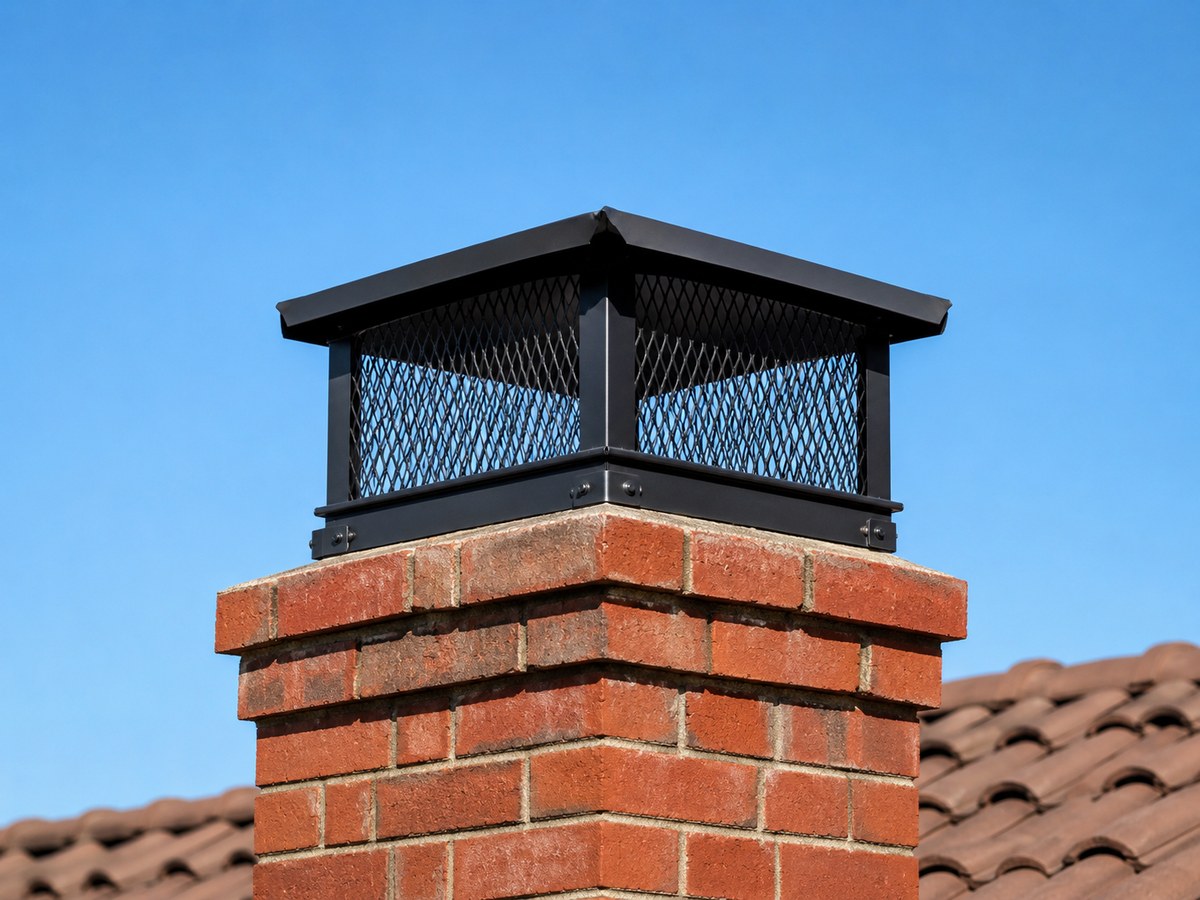
You do not need to get on the roof. From the ground with binoculars, or from an upstairs window with a view of the chimney, look at the top of the stack. A cap reads as a metal hood or a mesh box sitting above the flue opening, usually on short legs. No cap reads as an open pipe — you can see straight down it.
Three other signals suggest the flue is open even when you cannot see it:
- Leaves, twigs or nesting material turning up in the firebox
- Water or damp ash in the firebox after rain, with no other explanation
- Scratching, fluttering or chirping from inside the chimney
A photograph taken from the ground is usually enough for someone to tell you what is up there, and it costs nothing to send one.
Choosing a Material
In Los Angeles this is mostly a question about how much salt air reaches the house, not a question about budget.
Galvanised steel
Shortest life, lowest costThe default on most builder-grade installations. It is the material that rusts, and near the coast it rusts quickly — a galvanised cap in Venice, Santa Monica or the South Bay can be visibly corroded within a few years.
Stainless steel
The usual sensible answerSubstantially better corrosion resistance for a moderate premium. On anything within reach of salt air — which in Los Angeles is a wide band — this is generally where the conversation should start.
Copper
Longest life, highest costVery long-lived, and it weathers to a patina that suits period and historic-district properties. It is a genuine choice on a Craftsman or Spanish Revival chimney rather than an upsell, and it is priced accordingly.
Cap, Screen or Arrestor?
These three words describe three jobs, and one component frequently does two or all of them. It is worth knowing which job you are actually buying, because the words get used loosely.
| Term | The job it does | Page |
|---|---|---|
| Cap | Keeps rain and debris out of the flue | This page |
| Spark arrestor | Mesh that keeps embers inside the flue | Spark arrestor |
| Animal screen | Mesh sized to keep birds and wildlife out | Animal screen |
| Chase cover | The metal lid over a factory-built chimney chase — a different component entirely | Chase cover replacement |
A mesh-sided cap does all three of the first jobs at once, which is why most people only ever buy one thing. Where ember containment specifically matters — the canyons, the foothills and anywhere near wildland — the mesh specification is worth raising explicitly. Requirements differ by jurisdiction and by fire-hazard severity zone, so your local fire authority is the right source for what applies at your address rather than any contractor's website.
Fit, and Why It Matters
A cap is a simple object fitted in an awkward place, and almost everything that goes wrong with one is a fitting problem rather than a product problem.
It has to be the right size for the flue. Caps clamp to the outside of the flue tile or bolt to the crown. A cap that is close enough rather than correct works loose, and a cap that works loose ends up on the roof or in the garden after the first serious wind.
There has to be something sound to fix to. If the top course of flue tile is cracked or the crown has broken up, there may be nothing to clamp to. That turns a straightforward cap fitting into crown repair first, which is worth finding out before the day rather than on it.
Multi-flue chimneys need a decision. Individual caps on each flue, or one multi-flue cover over the whole crown. Both are legitimate; they cost differently and they look very different from the street, which matters on a period property.
What Drives the Cost
Capping a flue is one of the lower-cost things done to a chimney, but the range is still wide enough that a headline number would mislead.
How many flues the chimney has
A single flue takes one cap. A chimney serving a fireplace and a furnace has two or more, and they may need different sizes. This is the variable people are most often surprised by.
Flue size and shape
Standard round and rectangular clay flues take stock caps. Unusual sizes, oval flues and multi-flue chimneys often need a custom or multi-flue cover, which is a different product.
Material
Galvanised, stainless and copper differ substantially, and the right answer depends more on where the house is than on budget.
Roof access and pitch
Everything at the top of a chimney is priced partly by how hard it is to stand next to. A steep hillside roof with no truck access changes the job.
The condition of the crown underneath
A cap fits to the flue tile or the crown. If the crown has deteriorated, there may be nothing sound to fix to — which turns a cap job into a crown job, and it is better to know that before rather than after.
Tell us what service you need and request an estimate online.
Chimney Caps in Los Angeles
Two things about Los Angeles change the cap conversation from the national default.
Salt air. The marine layer reaches a long way inland, and it works on galvanised steel continuously rather than seasonally. Along the coast — the South Bay, Santa Monica, Venice, the Palos Verdes Peninsula, Long Beach — a galvanised cap has a noticeably shorter life than the same cap in Pasadena. This is the single most common reason a cap here gets replaced rather than installed.
Wildland fire exposure. Across the canyons, the Santa Monica Mountains, the Verdugo and San Gabriel foothills, a flue open to the sky is an ember question as well as a rain question. That pushes the specification towards a mesh-sided cap rather than a solid hood, and it is worth being explicit about when the work is scoped.
The long idle season matters too. Most fireplaces here sit unused from March to November, which is exactly the window in which birds nest and a failed cap goes unnoticed until the first cold evening.
Not sure whether your flue is capped?
Send a photograph of the chimney taken from the ground. That is usually enough to tell you what is up there and whether it needs anything.
Related chimney & fireplace services
Part of Caps, Screens & Chimney Top — Everything fitted to the top of the stack: rain caps, spark arrestors and animal screens. The cheapest place to stop the most expensive problems.
- chimney cap replacementChimney Cap Replacement — Replacing a cap that has rusted through, blown off or been crushed.
- the ember screen at the top of the flueSpark Arrestor Installation — The mesh screen that keeps embers inside the flue. Relevant across the LA hills.
- keeping animals out of the chimneyChimney Animal Screen — Mesh screening that stops birds and wildlife getting into an open flue.
- chase cover replacementChase Cover Repair & Replacement — The sheet-metal top of a framed, factory-built chimney — rust, pooling and replacement.
- repairing a cracked crownChimney Crown Repair — The slab that sheds rain off the top of the chimney, and what happens when it cracks.
- tracing and repairing water entryChimney Leak Repair — The repair page for water coming in — crown, flashing, cap, masonry or liner.
Further reading: Chimney Spark Arrestors and Wildfire Risk in Los Angeles · Sealing a Chimney You Don't Use: Options and Trade-offs
This service, city by city
The same work, explained for local conditions.
Nearby Service Areas
Request an Estimate
Tell us what is at the top of your chimney.
Quick check
Look at the top of the chimney from the ground with binoculars. A metal hood or mesh box means you have a cap. An open pipe you can see down means you do not.
Chimney Cap Questions
Have a question this page does not cover? Try the chimney and fireplace FAQ.
Tell us what your chimney is doing
Call, or send a short description and request an estimate. Estimates cost nothing.