Los Angeles County Service Areas · Chimney & fireplace services · Estimate requests online
Chimney Sweep in Los Angeles
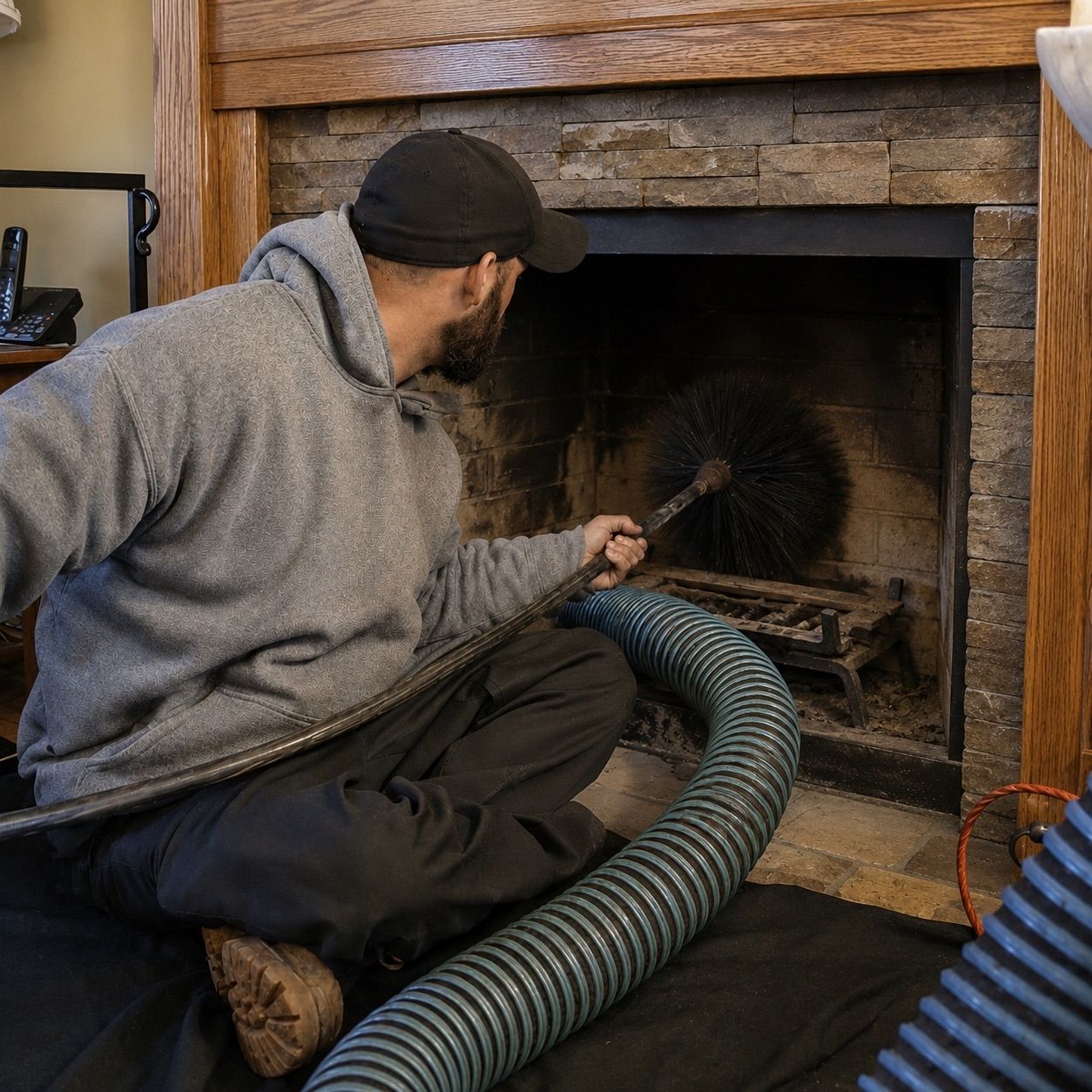
A sweep is the visit: the flue swept out, the firebox and smoke shelf cleared, and the accessible parts of the system looked over while the equipment is already there. This page is about what actually happens on the day.
- Chimney & Fireplace ServiceCleaning, inspection & repair
- Los Angeles Service AreasCities & LA neighborhoods
- Free Estimates AvailableEstimates at no charge
- Easy to ReachCall or request online
What a Chimney Sweep Is
"Chimney sweep" is the older name for the trade and it is still the word most people reach for. It describes a person and a visit rather than a single operation — which is the useful distinction, because the brushing is only part of what the appointment is for.
The value of a sweep is that someone is at the chimney with the equipment already set up. The deposits come out, and while they are coming out, the accessible parts of the system are visible in a way they are not at any other time. Cracked firebrick, an open mortar joint, a damper that will not seal, a fragment of clay tile sitting on the smoke shelf — all of that is buried under soot until the soot is removed.
That is why a sweep tends to be the appointment people book when they are not sure what is wrong. It is the cheapest way to find out.
How the Visit Runs
Six steps, in this order. The order matters more than it looks.
- 1
Before anyone arrives
Let the fire go completely out at least 24 hours ahead — a warm firebox cannot be worked in. Clear a metre or so in front of the fireplace and move anything fragile off the mantel. Nothing else is needed at your end.
- 2
The fireplace opening is sealed
Sheeting over the opening and drop cloths on the floor, with a vacuum running behind the seal. This is the step that decides whether the visit is clean or memorable, and it happens before any brush goes near the flue.
- 3
The system is looked at before it is touched
Firebox, damper, smoke shelf and as much of the flue as can be seen from the accessible openings. Brushing first destroys the evidence — deposits that have fallen, fragments of tile, nesting material and staining all mean something, and once they are in a vacuum they mean nothing.
- 4
The flue is swept
Rods and brushes sized to the flue, worked from whichever end gives better control. Rotary tooling where deposits have hardened past what a brush will move.
- 5
The smoke shelf and firebox are cleared
The ledge behind the damper collects everything that falls, and on a chimney that has gone years without attention it holds more volume than the flue walls do. It is also the part a DIY kit never reaches.
- 6
You get told what was found
What came out, what was visible while the work was being done, and anything worth looking at further. If nothing needs doing, that is the answer — and it is a legitimate outcome of a sweep rather than a failed upsell.
What Gets Looked Over
Six things, as far as each is accessible on your particular chimney. This is a look while the work is being done — it is not the same as a full chimney inspection, which is a separate and more thorough exercise.
The firebox
Brick and mortar joints, refractory panels if it is a factory-built unit, and the condition of the grate. Open joints and cracked panels are visible once the soot is off.
The damper
Whether it opens fully, closes fully, and seals when closed. A damper that has seized part-open is one of the more common findings and one of the cheaper fixes.
The smoke shelf and smoke chamber
What has collected there, and whether the transition above the firebox is smooth or rough. A badly formed smoke chamber is a draft problem hiding in plain sight.
The flue, as far as it is visible
From the accessible openings. Cracked tiles, open joints and missing mortar between tiles are all things deposits hide.
The top of the stack
Cap, spark arrestor and crown, where they can be reached. Whether the flue is open to the sky is the single most useful thing to establish, because almost every other problem follows from it.
Signs of anything living in it
Nesting material, droppings, or the smell. Birds and wildlife in a flue are a blockage before they are anything else.
Mess, Protection and Access
This is the question people actually want answered and the one they are least likely to ask, so: a sweep should not leave a mark on the room. The fireplace opening is sealed before anything happens, a vacuum runs behind the seal for the whole visit, and drop cloths cover the hearth and the floor in front of it.
Where sweeps go wrong is almost always at that first step rather than at the brush. If the opening is not sealed properly, no amount of care afterwards recovers it — fine ash gets into soft furnishings and stays there.
Access varies more in Los Angeles than in most places. A single-storey chimney on a low-pitch roof is straightforward. A stack on a steep hillside roof with no truck access — common through the Santa Monica Mountains, the Verdugo foothills and the canyons — needs different equipment and more setup. It is worth mentioning the roof when you call, because it changes what turns up.
When to Book One
- Before the first fire of the season. Especially if the fireplace has sat idle since spring, which in Los Angeles is most of them.
- After buying the house. You have no record of the chimney's history, and that is reason enough on its own.
- Before using a fireplace that has been unused for years. A chimney that has stood idle may have taken on a nest, a blockage, or deterioration nobody has had reason to notice.
- When there is a smell and you do not know why. A smoky or sour smell with nothing lit is usually deposits, and a sweep both confirms it and fixes it.
- When fires will not draw properly. A restricted flue is one of the more common causes, and it is the cheapest one to rule out.
- Before selling. Chimney condition comes up in most transactions, and finding out on your own schedule is better than finding out on someone else's.
When a sweep is not what you need: if water is coming into the firebox, a sweep will not change that — the water is entering above and the answer is leak repair. If the masonry outside is visibly deteriorating, that is masonry work. Booking a sweep to address either is a wasted visit.
Sweep or Cleaning?
The two words mean the same thing in normal conversation. This site keeps two pages because they answer two different questions, and people arrive asking one or the other.
This page — the sweep
What the visit involves, what gets looked over, what you need to do at your end, and when it is worth booking.
Chimney cleaning →
What builds up inside the flue, the three stages of creosote, why deposits form, and how often removal is actually warranted.
Longer answer: chimney sweep vs chimney cleaning.
Questions Worth Asking Anyone
These apply to whoever you call, us included. A company that is uncomfortable answering any of them is telling you something.
- ?How will the fireplace opening be sealed, and will a vacuum be running?
- ?Will the smoke shelf behind the damper be cleared, or only the flue?
- ?What happens if you find something that needs repair — is that quoted separately?
- ?Will I be told what was found even if nothing needs doing?
- ?Who is coming, and what will they cover?
Chimney Sweeps in Los Angeles
Sweeping in Los Angeles is a seasonal business compressed into a short window. Most fireplaces here are lit between November and February and ignored for the other eight months, which means demand arrives all at once in autumn and the chimneys being swept have usually had a long idle period behind them.
That idle period is what produces the findings. Dampers seize when nothing moves them. Birds nest in flues that are open at the top. A cap that rusted through in March is not discovered until someone lights a fire in December. A sweep booked in October finds problems that had ten months to develop unobserved — which is an argument for booking before the season rather than during it.
Booking a sweep
Tell us whether it burns wood or gas, roughly when it was last done if you know, and anything you have noticed — a smell, a draft problem, a noise. If the roof is steep or hard to get to, mention that too.
Tell us what service you need and request an estimate online.
Further reading: what to check before the first fire of the season and what chimney work costs in Los Angeles.
Related chimney & fireplace services
Part of Chimney & Fireplace Cleaning — Removing what builds up inside a chimney or fireplace — creosote, soot, debris and nesting material — and the blockages that stop a flue venting properly.
- having the flue cleanedChimney Cleaning — Creosote, soot and debris removed from the flue, smoke shelf and firebox.
- what to do about stage 3 creosoteCreosote Removal — Glazed and stage 3 creosote that a standard brushing will not shift.
- chimney inspectionChimney Inspection — Masonry, crown, cap, flashing, firebox and flue condition, and what it means.
- sweeping a wood stove flueWood Stove Cleaning — Wood and pellet stove flues, which foul faster than an open fireplace.
- cleaning an insert and its linerFireplace Insert Cleaning — Gas and wood inserts, including the liner run behind them.
Further reading: Chimney Spark Arrestors and Wildfire Risk in Los Angeles · Before You Use Your Fireplace This Winter: A Homeowner Checklist
This service, city by city
The same work, explained for local conditions.
- chimney sweeping in Arcadia
- chimney sweeping in Beverly Hills
- chimney sweeping in Burbank
- chimney sweeping in Calabasas
- chimney sweeping in Carson
- chimney sweeping in Culver City
- chimney sweeping in Glendale
- chimney sweeping in Long Beach
- a chimney sweep in Pasadena
- chimney sweeping in Rancho Palos Verdes
- chimney sweeping in Santa Monica
Nearby Service Areas
Request an Estimate
Tell us what the chimney is doing.
Before the visit
Let the fire go out at least 24 hours ahead, clear a metre in front of the fireplace, and take anything fragile off the mantel. That is all that is needed.
Chimney Sweep Questions
Not the question you had? The full FAQ covers more ground.
Tell us what your chimney is doing
Call, or send a short description and request an estimate. Estimates cost nothing.