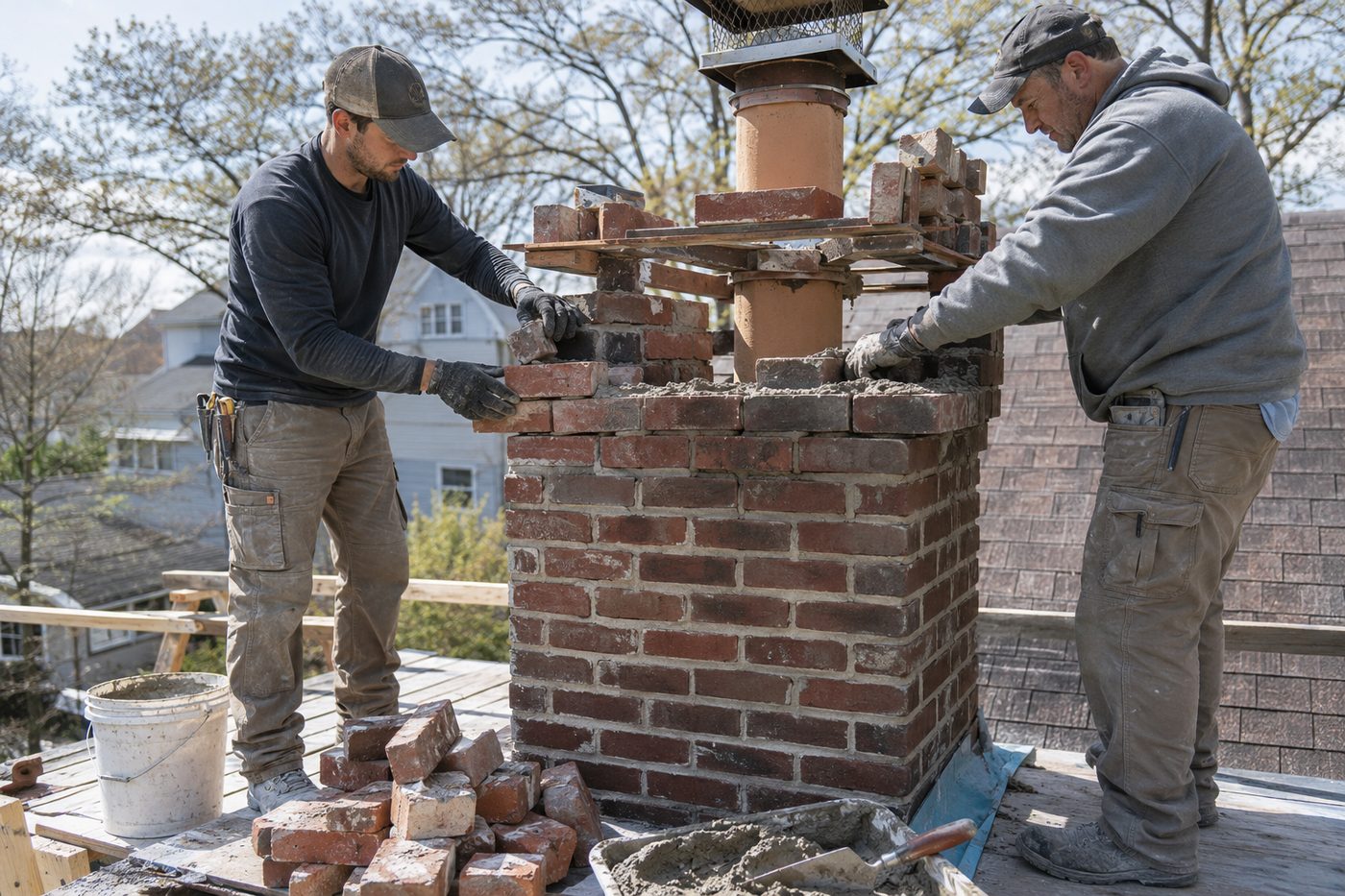
Chimney Rebuilding in Los Angeles
Reconstruction is what comes up when there is too little sound masonry left for a repair to key into — or when the structure has moved rather than simply worn.
This page covers what a rebuild involves, how partial and full differ, and where the line sits between reconstruction and repairing the chimney as it stands.
Los Angeles Area Pages
Los Angeles County
Free Estimate
Estimates at no charge
Estimate Requests
Submitted online
When Localized Repair May Not Be Enough
Masonry repair works on the chimney as it stands — repointing refills failed joints, brick replacement swaps out damaged units. Both need the same thing: sound material around the repair for it to key into.
Reconstruction starts when that is no longer met — deterioration covering an area rather than appearing in spots, earlier repairs failing again in the same place, or a structure that has moved rather than simply worn.
Which means separating two things often treated as one: how a chimney looks and how much intact material it has left. A photograph does not settle that.
Signs That May Point Toward Reconstruction
None settles the question on its own — these are what make reconstruction worth discussing rather than assuming.
Masonry out of plumb
A stack that leans, or courses shifted relative to those below. This changes the order of every other question.
Brick that moves
Units that shift under hand pressure, or a top section that feels unstable. Stop using the fireplace until it has been evaluated.
Deterioration across an area, not in spots
Where failed joints and damaged faces cover a whole section rather than appearing here and there, repair has less to key into.
Repairs that have not held
Repointing or patching that failed again in the same place can indicate the substrate is no longer sound.
Missing or displaced courses
Brick that has come away entirely, or gaps where units used to sit — particularly near the top.
Deep, widespread spalling
Faces lost across a region rather than on isolated units, leaving little intact material at the surface.
Partial vs Full Chimney Rebuild
Two different scopes, not two grades of the same job. The distinction is how much of the structure comes down.
Partial rebuild
One section- What it refers to
- A defined section rather than the whole structure — most often the exposed stack above the roof line, sometimes a face or corner where deterioration is concentrated.
- What may lead there
- Deterioration confined to one area, with sound masonry below or beside it for the new work to key into — commonly where weather has worked on the exposed section while the enclosed part stayed intact.
- What it does not mean
- That the rest of the chimney is sound; only that it was not part of this scope. Nor does it address the flue, crown or cap — separate questions.
Full rebuild
Whole structure- What it refers to
- The chimney taken down and rebuilt through its height rather than in one section.
- What may lead there
- Deterioration or movement running through the structure rather than sitting in one part, or too little sound material at any level for partial work to build on.
- What it does not mean
- That every badly weathered chimney needs one. Appearance and structural condition are different things.
Which one applies is not decided here. The extent of reconstruction depends on how much sound masonry remains and which parts of the chimney are affected. Neither scope above is being put forward as the answer to what you have described — that follows from evaluating the chimney.
Rebuilding Above the Roof Line
The section standing clear of the roof is in a different situation from the rest of the chimney. It takes weather on four sides and from above, with no building around it to shelter or warm it, and it carries the crown at the top.
That exposure is why deterioration often concentrates there, and why reconstruction of that section comes up as its own discussion. The work takes the exposed courses down to sound material and rebuilds from there, usually with the crown reformed as part of the same job.
It depends on one condition: there has to be sound masonry below for the new work to build on. Where deterioration carries on beneath the roof line, rebuilding the top alone leaves what is underneath as it was.
How Mortar Failure Can Progress to Reconstruction
Chimneys rarely arrive at reconstruction in one step. The sequence explains why the same chimney can be a repointing job one decade and a rebuild the next.
- 1
Joints recede
Water washes the binder out over years, and joints sit back behind the brick face.
- 2
The masonry starts holding water
With joints open, the chimney stops shedding water and absorbs it. Repointing still has sound brick to work between.
- 3
Brick faces begin to fail
Moisture moving back out through the face takes material with it. Damage moves from the joints into the units.
- 4
Sound material runs short
Once faces have gone across an area, there is progressively less intact material to key into.
- 5
The structure loses cohesion
With enough of both gone, courses can shift. The question is no longer which repair, but how much needs rebuilding.
Not every chimney travels the whole sequence, and none of it runs on a timetable.
Rebuild, Repointing, or Brick Replacement?
Three different scopes, in one line each.
Repointing
Individual brick replacement
Rebuilding
Choosing between them is a masonry-condition question rather than a reconstruction one, and it is set out properly on the chimney masonry repair page. Start there if you do not yet know which of the three you are looking at.
Where Crown and Liner Issues Fit
Rebuilding is masonry work. What that does and does not take in:
The crown is usually reformed as part of rebuilding the top section, since the courses it bears on are coming down anyway. Where only the crown has failed, that is its own job — crown repair covers it.
The flue liner is a separate system inside the masonry. Rebuilding around it does not establish or resolve its condition, and a chimney can need one without the other. Liner work is assessed on its own terms.
Water entry is worth settling first — otherwise new masonry goes back into the conditions that damaged the old. Leak repair covers finding it.
Why Condition Is Evaluated First
Reconstruction is the largest option on the table. Three things are established by looking, and none can be settled from a description:
How much sound material remains
which decides whether repair has anything to key into
Whether the structure has moved
which is a different question from how worn it looks
How far the deterioration runs
which sets whether partial work has a base to build on
Committing to a scope before those are known risks both directions — rebuilding what could have been repaired, or repairing what will not hold.
Chimney Rebuilding in Los Angeles
Exposure does the work here, not cold. Long dry stretches broken by intense wet periods are harder on masonry than steady drizzle: dry brick absorbs heavily when the rain arrives, and the damage surfaces in the seasons afterwards. Sustained sun and cool nights add wide daily movement, absorbed at the joints — and an exposed stack gets all of it.
Exposure is not uniform across the county. A chimney in Santa Monica contends with salt air and marine damp; one in Santa Clarita with a wider daily temperature range; one in Pasadena often with age. The same masonry reaches this conversation at different rates.
Seismic movement, stated carefully. Cracking can have several causes — water, thermal movement, settlement, age — and in Southern California seismic movement is one factor that may warrant closer evaluation. It does not follow that cracking after felt shaking means a chimney must be rebuilt — most cracking does not lead to reconstruction, and what does is determined by evaluation rather than by the earthquake. What is fair to say is that cracking which appeared or widened after shaking is worth looking at.
Why Chimney Axis
Four things, each of which you can check on this site right now.
Clear service information
Reconstruction, masonry repair and joint work each have their own page, so you can see which conversation you are having.
Los Angeles County area pages
A local page for each city listed on this site, with the conditions that affect chimneys in that part of the county.
Related chimney services
Inspection, crown, leak and liner work alongside masonry, so the question does not stop at one job type.
A free estimate request
One form, and estimates cost nothing. Describe what you can see and we come back to you.
When not to call us for a rebuild
If the joints have failed but the brick is sound, what you want is repointing rather than reconstruction. If damage is confined to a handful of units, masonry repair covers it. And if cracking in the chimney is part of wider movement in the building, that is a question for a structural engineer before it is one for a mason. We would rather talk you out of a rebuild you do not need.
Related Chimney Services
Chimney Masonry Repair
The repoint / replace / rebuild decision in full
Chimney Tuckpointing
Mortar joint work on its own
Chimney Inspection
Establish condition before choosing scope
Chimney Repair
The overview of every repair type
Chimney Crown Repair
The surface at the top of the stack
Chimney Leak Repair
Where water is reaching the masonry
Chimney Liner Repair
The flue surface inside the chimney
Nearby Los Angeles Area Pages
Local area pages for nearby cities, or Browse all Los Angeles County area pages.
Describe the chimney damage
Tell us what service you need and request an estimate online.
Before a rebuild
Three pages worth reading first.
What helps us most
Photographs from the ground and, if you can see it safely, from a window at roof level. Whether anything has moved, whether previous repairs were done, and when you first noticed it.
Prefer to write?
info@chimneycleaningla.comChimney Rebuilding Questions

Tell us what the masonry is doing
Describe what you can see on the chimney and request an estimate. Scope follows from the condition, established at the chimney.