Los Angeles County Service Areas · Chimney & fireplace services · Estimate requests online
Firebox Repair in Los Angeles
Firebox repair depends on what cracked. Open joints are repointed in refractory mortar, broken firebrick is replaced, and failed panels in a factory-built fireplace are swapped for the part listed for that model. Fine surface crazing usually needs nothing at all.
- Chimney & Fireplace ServiceCleaning, inspection & repair
- Los Angeles Service AreasCities & LA neighborhoods
- Free Estimates AvailableEstimates at no charge
- Easy to ReachCall or request online
A Firebox Is Built From Refractory Materials, Not Ordinary Brick
The firebox is the chamber the fire sits in: the floor, back wall and side walls of the fireplace. In a masonry fireplace it is lined with firebrick, a dense brick made from refractory (heat-resistant) clay, laid in refractory mortar with thin joints. Ordinary face brick and ordinary mortar do not survive direct fire for long, which is why fireplace brick repair inside the firebox uses different materials from the brick outside it.
In a factory-built fireplace, the firebox is a metal box lined with refractory panels, molded slabs that often have a brick pattern pressed into them. The panels were tested with that unit as part of its listing, and they are a manufactured part with a specific replacement.
Behind either kind of firebox is the structure of the house. In a masonry fireplace that may be more masonry; in many houses, framing is not far away. The firebox lining is what keeps the heat of the fire where it belongs.
Heat Cycling Is What Cracks a Firebox
Every fire heats the firebox and every night it cools. Firebrick and refractory panels expand and contract with each cycle, and over years that movement works the joints loose and opens fine cracks in the surface. The back wall, which takes the most direct heat, usually goes first.
Three things speed it up. Thermal shock: a very large fire in a cold firebox, or water hitting hot brick. Impact: logs thrown against the back wall, or a collapsed grate letting the fire sit on the floor. Water: rain coming down the flue soaks the firebrick, and the next fire drives it out, flaking the brick face as it goes. Water in the firebox is a sign of a chimney leak above, and repairing the firebox without fixing that means repairing it twice.
Why a gap matters: an open joint or a crack right through a panel is a path for heat to reach whatever sits behind the firebox. Where that is combustible framing, repeated heating can char it over time without anything showing in the room. That is the reason open gaps are a stop-using-it condition and surface crazing is not.
Which Repair Does a Cracked Firebox Need?
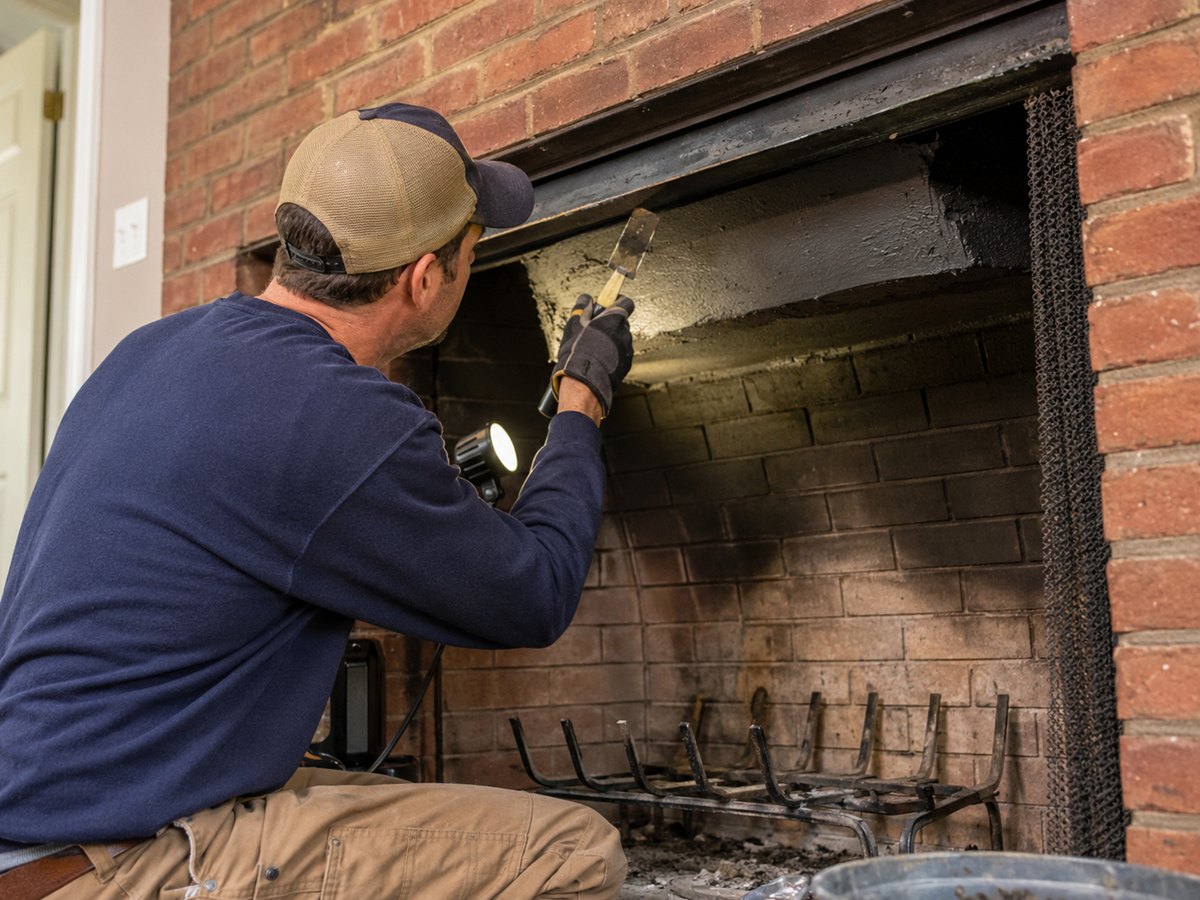
Look at the firebox cold and clean, with a flashlight held low so it rakes across the surface. Then find the row that matches.
| What you see | What it usually is | What it needs |
|---|---|---|
| Fine hairline crazing across the surface, nothing loose, nothing behind it visible | Normal thermal wear | Watch it. Photograph it now and compare next season. |
| Mortar joints between firebricks open, sandy or missing | Heat cycling has broken down the joint | Repoint with refractory mortar (Repointing) |
| Firebrick loose, cracked through, or with its face flaking away | Brick failure from thermal shock, impact or water | Replace the affected firebrick (Firebrick replacement) |
| Many loose bricks, a bulging back wall, or repeated repairs failing | The firebox wall itself has failed | Rebuild the back wall or the firebox (Firebox rebuild) |
| Refractory panel cracked wide, crumbled through, or showing metal behind | Panel failure in a factory-built unit | Replace the panels with the listed part (Panel replacement) |
| A gap where the top of the firebox meets the throat or smoke chamber | Separation above the firebox; cause not visible from below | Have the fireplace inspected before use (Chimney inspection) |
When not to call us: fine surface crazing on refractory panels or firebrick is normal thermal wear. If it has not changed since you last looked and nothing is exposed behind it, watching it is a legitimate decision. Take a photo now so you have something to compare against next season.
What Masonry Firebox Repair Involves
Repointing, firebrick replacement and a firebox rebuild are steps on the same scale. The condition of the firebox decides how far along it a job goes.
- 1
The firebox is cleaned and assessed
Soot hides cracks. A clean firebox shows which joints are open, which bricks are loose, and whether the damage stops at the firebox or continues above it.
- 2
Failed joints are cut out and repointed
Spent mortar is raked or cut out and the joints are refilled with refractory mortar, the heat-resistant kind made for fireboxes. Ordinary mortar in a firebox breaks down quickly.
- 3
Damaged firebrick is removed and replaced
Individual bricks are cut out without disturbing their neighbors and new firebrick is set in refractory mortar with thin joints, matched in size to the surrounding course.
- 4
Where the wall has failed, it is rebuilt
A back wall or a whole firebox that has lost its structure is taken down to sound material and relaid. The shape of the back wall affects how the fireplace draws, so a rebuild follows the original geometry unless there is a reason to change it.
- 5
The mortar is cured before a full fire
Refractory mortar products set out their own curing instructions, often a series of small fires first. Following them is what keeps new joints from cracking straight away.
The Brick Industry Association technical notes include guidance on residential fireplace construction and the materials a firebox is built from. Some repairs also apply a refractory coating over sound firebrick; that can seal fine surface cracks, but it is not a fix for loose brick or open joints underneath.
Refractory Panel Replacement in Factory-Built Fireplaces
A factory-built fireplace is only as safe as the combination it was tested in. Its refractory panels are part of that combination, so refractory panel replacement means the panels the manufacturer lists for that model, not a generic slab cut to fit. The rating plate, usually inside the opening or behind a lower grille, gives the make and model.
Panels are held in by clips or screws and usually come out as a set: back, two sides and sometimes a floor. A panel that is cracked wide, crumbling at the edges, or showing the metal shell behind it is replaced rather than patched.
For some older units the panels are no longer made. When no listed replacement exists, improvising one is the wrong answer, and the realistic options become a listed fireplace insert or a replacement unit through fireplace installation.
Hearth, Tiles and the Parts Next to the Firebox
Cracked fireplace tiles and hearths outside the opening are not firebox repair. They are finish work, covered on fireplace restoration, with one safety exception: a hearth cracked through can let embers reach the floor structure, and that should be dealt with before the next fire.
Above the firebox sit the damper and the smoke chamber, which fail in their own ways and are often repaired in the same visit. Outside it, the brick face and the chimney are ordinary masonry, covered by chimney masonry repair. If the problem is less a crack than a fireplace that smokes, start with wood fireplace repair, and for the full symptom list, the fireplace repair overview.
What Drives the Cost
A few joints and a full firebox rebuild are both firebox repair. These are the variables that decide where a job sits between them.
Masonry or factory-built
Masonry is repaired in place with firebrick and refractory mortar. A factory-built firebox needs the panels listed for that model, and their availability decides the job.
How much of the firebox is affected
Repointing a few joints, replacing a handful of firebricks and rebuilding the back wall are the same kind of work at very different scales.
Whether the damage continues above
A firebox separating from the smoke chamber, or water getting in from above, adds work outside the firebox.
Access and size
A large or unusually shaped firebox, or one behind an insert that has to be removed first, takes longer to reach and work in.
Cleaning first
A firebox with years of deposits has to be cleaned before it can be assessed or repaired.
Tell us what you are seeing and ask for an estimate.
Firebox Repair in Los Angeles
Which kind of firebox you have depends a good deal on when the house was built. Where a house is part of a tract built from the 1970s onward, the fireplace is more likely to be factory-built, with refractory panels rather than firebrick, and a unit of that age raises the parts question sooner than a masonry firebox does. Where a house is older, a firebrick firebox that can be repaired in place is more likely.
Earthquake movement can crack a firebox along with the chimney above it. If cracks appeared after a quake, treat them as a reason for a chimney inspection rather than a firebox-only repair. NFPA 211, the national standard for chimneys and fireplaces, recommends an annual inspection in any case; cracks that appeared after a quake are a reason not to wait for the next scheduled one.
Cracks in the firebox?
Send a photo of the firebox taken with a flashlight held low across the surface, and tell us whether the walls are brick or panels. That usually shows which row of the table you are in.
Related chimney & fireplace services
Part of Fireplace Repair — The appliance rather than the stack — fireboxes, gas, wood and electric fireplaces, doors, glass and older hearths.
- what fireplace repair coversFireplace Repair — The hub page: firebox, refractory, damper, draft and appliance faults.
- wood fireplace repairWood Fireplace Repair — Firebox brick, refractory panels, grates and draft problems on wood fireplaces.
- parging a rough smoke chamberSmoke Chamber Repair — The transition between firebox and flue — corbelled brick, parging, draft.
- damper and top-seal optionsChimney Damper Repair — Throat and top-sealing dampers — seized, warped, missing or leaking.
- fireplace restorationFireplace Restoration — Older and disused fireplaces returned to a usable, presentable state.
- repairing damaged brick and mortarChimney Masonry Repair — Brick replacement, spalling, cracked faces and structural masonry damage.
Request an Estimate
Tell us whether the firebox is brick or panels, and what the cracks look like.
Quick check
With the firebox cold, press a screwdriver tip into a joint. If mortar crumbles out, the joint has failed. If you can see metal or a dark void behind a crack, stop using the fireplace until it is repaired.
Firebox Repair Questions
Not the question you had? The full FAQ covers more ground.
Tell us what your chimney is doing
Call, or send a short description and request an estimate. Estimates cost nothing.