Los Angeles County Service Areas · Chimney & fireplace services · Estimate requests online
Chimney Tuckpointing in Los Angeles
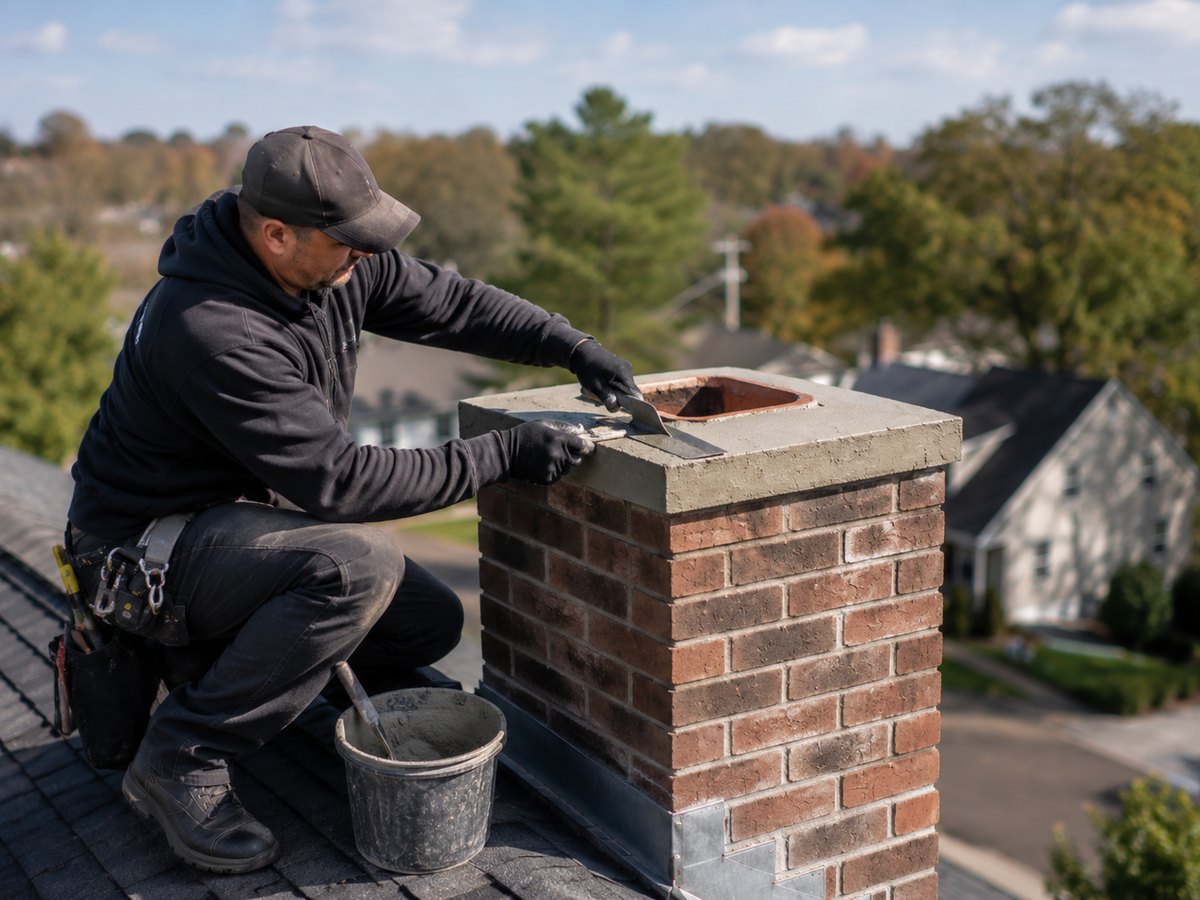
Tuckpointing cuts failed mortar out of the joints between bricks and replaces it. It repairs the joints, not the bricks — and knowing which of the two has actually failed is the part that decides whether this is the right repair at all.
- Chimney & Fireplace ServiceCleaning, inspection & repair
- Los Angeles Service AreasCities & LA neighborhoods
- Free Estimates AvailableEstimates at no charge
- Easy to ReachCall or request online
What Chimney Tuckpointing Actually Is
A brick chimney is two materials doing two jobs. The brick carries the load. The mortar joints hold the bricks apart at a consistent spacing, absorb small movements, and — the part people forget — act as the sacrificial layer. Mortar is meant to be softer than the brick around it, so that when something has to give, it is the joint and not the brick face.
That is why joints fail first, and why failing joints are normal rather than alarming. Tuckpointing is the maintenance that follows from it: the spent mortar is cut out to a consistent depth, new mortar is packed in, and the joint is tooled back to a profile that sheds water.
What tuckpointing does not do is repair brick. If the brick faces themselves are flaking, popping or shearing away, that is a different failure with a different answer — covered on chimney masonry repair. Telling the two apart is the first useful thing to do, and the next section is about exactly that.
Signs the Mortar Joints Have Failed
Most of these are visible from the ground with binoculars, or from a ladder at the roof line. None of them requires getting onto the roof.
Joints you can rake out with a key
If the point of a house key or a screwdriver pulls mortar out as sand or crumbs, the binder has gone. Sound mortar resists a key. This is the single most reliable field test there is, and you can do it from a ladder without any equipment.
Joints that have receded behind the brick face
Look along the face of the chimney rather than straight at it. Where joints sit back in shadow rather than flush with the brick, material has been lost. A quarter of an inch of recession is usually the point at which repointing stops being optional.
Gaps you can see daylight or sky through
Open joints near the top of the stack, particularly on the weather side. These are a direct water path into the masonry core, and they tend to appear at the top first because that is where exposure is worst.
Sand collecting on the roof or at the base
A small heap of grey sand on the flashing, in a gutter, or on the ground beside the chimney is mortar that used to be in a joint. It is easy to miss and it is a clear signal.
Hairline cracks running along the joints
Cracks that follow the mortar lines rather than crossing the brick usually mean movement the joints have absorbed. That is what joints are for, but once they have cracked they are no longer sealed.
Efflorescence — white powder on the brick
Mineral salts left behind when water passes through masonry and evaporates at the surface. It is not damage in itself. It is evidence that water is moving through the chimney, and failed joints are the most common route.
Joint Failure or Brick Failure?
This distinction decides the repair, and it is the thing most often got wrong before anyone is called out. Repointing a chimney whose brick has spalled is money spent on the wrong half of the problem.
| What you see | What it usually is | Where it is covered |
|---|---|---|
| Mortar comes out as sand; joints recessed | Joint failure | This page |
| Brick faces flaking, popping or shearing off | Spalling — a water and freeze cycle in the brick | Masonry repair |
| Cracks crossing brick and joint together in a stepped line | Movement in the structure, not surface wear | Inspection first |
| Stack visibly leaning or pulling from the wall | Structural — stop and get it looked at | Rebuild |
| Cracking across the slab at the very top | Crown failure, not joint failure | Crown repair |
More than one of these is often true at once on a chimney that has gone a long time without attention. Signs your chimney needs repair walks through the full set.
How the Work Is Done
Repointing is slow, repetitive work, and almost all of its quality is decided in the preparation rather than in the pointing.
- 1
The joints are assessed first
Not every joint on a chimney fails at the same rate. The weather side and the top courses usually go first, and the sheltered side can still be sound. Repointing everything when a third of it needs it is a common way to overpay.
- 2
Failed mortar is cut out to depth
Typically to around two and a half times the joint width, so the new mortar has something to key into. Cutting too shallow gives a skim that falls out in a few seasons; cutting too deep or too aggressively damages the brick arris, which cannot be undone.
- 3
The joints are cleaned and dampened
Dust left in the joint stops the new mortar bonding. Dry brick pulls water out of fresh mortar faster than it can cure, which is what produces weak, sandy joints that fail early. In LA summer heat this step matters more than it does in most climates.
- 4
New mortar is packed in and tooled
Packed in layers rather than filled in one pass, then tooled to a profile matching the existing joints. The tooling is not decorative — the profile determines how the joint sheds water.
- 5
The work is cleaned down
Mortar smears left on the brick face are difficult to remove once cured, and on a historic chimney they are the difference between repair and damage.
Why the Mortar Has to Match
This is the part of tuckpointing that separates a repair from a problem, and it matters more in Los Angeles than people expect, because a great deal of the city's most attractive housing stock predates the mortar most contractors reach for by default.
Brick laid before roughly 1930 was generally bedded in a lime-rich mortar that is soft, flexible, and deliberately weaker than the brick. Modern Portland-cement mortar is considerably harder. Put hard mortar into a soft-brick chimney and the sacrificial relationship inverts: the joint stops giving, and the brick face takes the stress instead. The damage that follows is spalling — and it is not reversible, because a brick face does not grow back.
The US National Park Service Preservation Brief on repointing historic masonry is the standard reference on this, and the Brick Industry Association technical notes cover mortar selection for the same reasons.
Matching also means colour, aggregate and joint profile. On a Craftsman chimney in a designated historic district, a visibly wrong joint is not a cosmetic complaint — it can be a compliance one. If your property sits in a landmark or historic overlay district, that is worth raising before the work is scoped rather than after.
Repoint, Rebuild, or Neither
Repointing is the right answer when the bricks are sound and the joints are not. That covers most chimneys that have simply been left alone for thirty years.
Partial rebuild is the right answer when the courses above the roof line have deteriorated past the joints — brick faces gone, courses loose, the stack out of plumb at the top — but the chimney below the roof is sound. Rebuilding the exposed section and repointing the rest is a common combination. Chimney rebuilding covers that.
Neither is the right answer when the problem is somewhere else. If water is getting into the house and the joints are merely tired rather than open, repointing may not change anything — the crown, the cap or the flashing is more often the path. Establishing which one is open comes first, and chimney leak repair covers what follows from it.
When not to call us: if the only thing you can see is a thin crack in one or two joints on the sheltered side of a chimney you still use, that is worth watching rather than repairing. Look again after the next wet season. Mortar that is tired is not the same as mortar that has failed, and there is no advantage in repointing early.
What Drives the Cost
We do not publish a price for this, because the range between a spot repair and a full stack is wide enough that a headline figure would mislead more often than it helped. These are the variables that move it.
How much of the chimney needs it
Spot repointing a failed section and repointing a whole stack are different jobs. This is the largest single variable and it is why an estimate follows a look rather than a phone call.
Roof access and pitch
A single-storey chimney on a low-pitch roof is straightforward. A stack on a steep hillside roof with no truck access — common across the Santa Monica Mountains and the Verdugo foothills — needs different equipment and more setup time.
Chimney height above the roof line
The exposed portion above the roof takes the most weather and is the most awkward to reach. Height above the roof line often matters more to the cost than the total height of the chimney.
Whether the mortar has to be matched
On a pre-1930 chimney the existing mortar is usually softer than modern mix, and matching it is skilled work rather than a bag off a shelf. On a 1970s stack it is generally straightforward.
What else is found once work starts
Cutting out joints sometimes reveals brick that has failed behind them, or a crown that is in worse condition than it looked from the ground. Scope that changes should be explained before it changes, not after.
Tell us what service you need and request an estimate online. Related reading: what chimney work costs in Los Angeles.
What Happens Afterwards
Fresh mortar needs time to cure before anything is applied over it. Sealing green mortar traps water in the joint, which is the opposite of the intended effect.
Once cured, a vapour-permeable water repellent is worth considering where the brick itself is porous — older soft-fired brick especially. The word that matters is permeable: a film-forming sealer keeps water in as effectively as it keeps water out, and a chimney needs to breathe.
It is also a sensible moment to look at the top of the stack, since the equipment is already there. The crown and the cap are the two components that do most to keep water out of joints in the first place, and both are far cheaper to deal with during a visit than on their own.
Tuckpointing in Los Angeles
Los Angeles does not have the freeze-thaw cycle that destroys mortar joints across most of the country, and that leads people to assume joints here last indefinitely. They do not — they fail differently, and more slowly, which mostly means the failure is further advanced before anyone notices it.
What works on mortar here is a concentrated wet season against masonry that spends the rest of the year drying out hard, a wide day-to-night temperature swing through the Valley and the foothills, and — in the older parts of the city — a century of seismic movement that joints have been quietly absorbing. The neighbourhoods where this matters most are the ones with the oldest masonry: Pasadena, South Pasadena, San Marino, Hancock Park, and the pre-war parts of Glendale and Culver City.
That same age profile is why mortar matching is not an academic point in this market. A Craftsman chimney built in 1915 and repointed in Portland cement in 2015 is a chimney with a new problem.
Seeing crumbling or missing mortar on your chimney?
Tell us what the joints look like — whether mortar comes away with a key, and which side of the chimney is worst. A photograph from the ground helps more than most descriptions.
Related chimney & fireplace services
Part of Chimney Repair & Masonry — Structural work on the chimney itself — brick, mortar joints, the smoke chamber, and the point at which repair becomes rebuild.
- spalled or cracked brickworkChimney Masonry Repair — Brick replacement, spalling, cracked faces and structural masonry damage.
- chimney repairChimney Repair — The hub page: brick, mortar, crown, flashing, liner and how scope is set.
- when a stack has to come down and go back upChimney Rebuilding — When repair is no longer the right answer and the stack is rebuilt.
- a breathable water repellent on brickChimney Waterproofing — Vapour-permeable repellent on sound masonry. Prevention, not a leak fix.
- chimney leak repairChimney Leak Repair — The repair page for water coming in — crown, flashing, cap, masonry or liner.
Further reading: Historic Chimney Masonry in Los Angeles: HPOZs and Landmark Districts
This service, city by city
The same work, explained for local conditions.
Nearby Service Areas
Request an Estimate
Describe the masonry damage you are seeing.
Quick check
Take a house key to a mortar joint on the weather side of the chimney. If it pulls out sand, the joints have failed. If the key skates off, they have not.
Chimney Tuckpointing Questions
More chimney and fireplace questions are answered on the main FAQ page.
Tell us what your chimney is doing
Call, or send a short description and request an estimate. Estimates cost nothing.