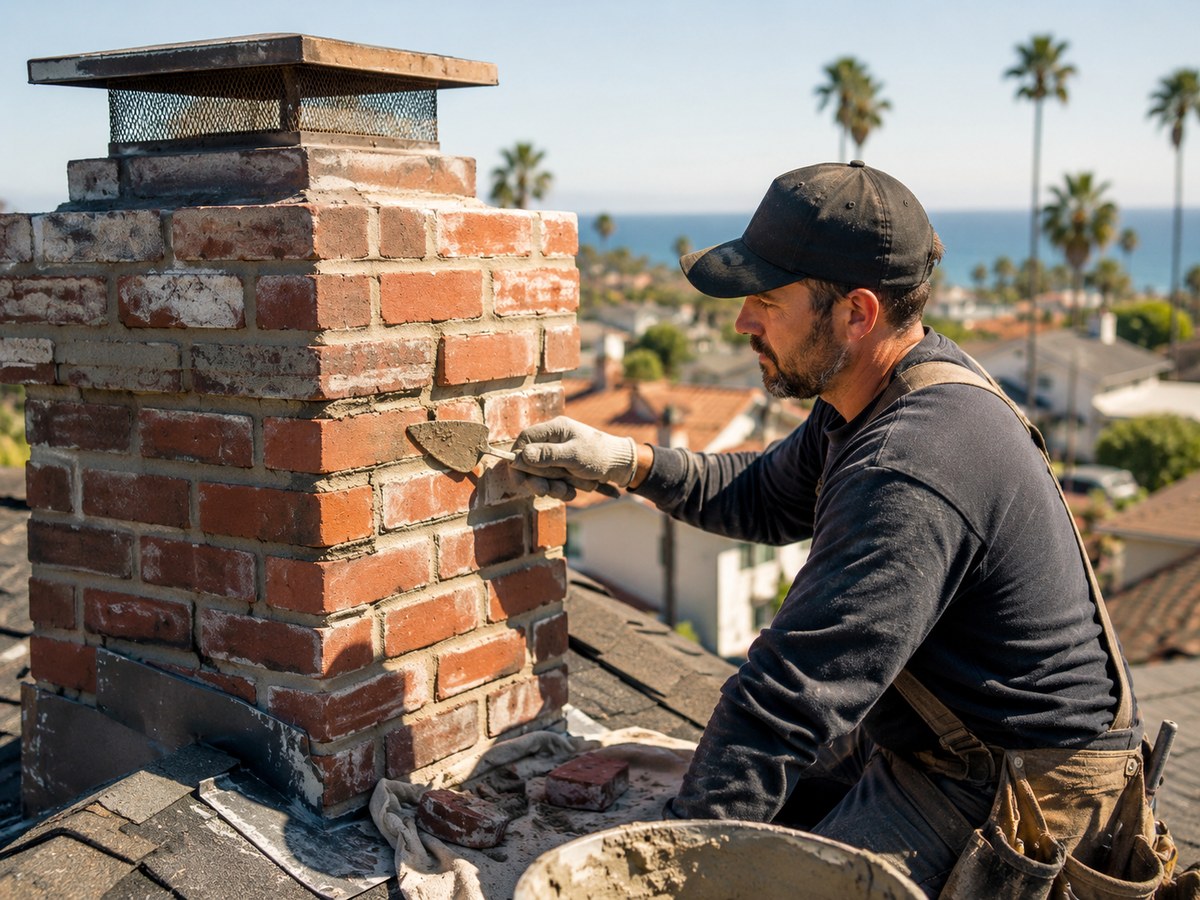
Hard repointing on soft period brick
Mortar is meant to be the sacrificial part of a masonry wall. The National Park Service's guidance on repointing historic masonry sets out why: when the joint is the weaker material, movement and moisture damage the joint, which is easy to renew, rather than the brick.
Where an older chimney has been repointed with a modern, cement-rich mix, the joints can look perfect while the brick edges beside them crumble. The repair is to remove that mortar without cutting into the brick and repoint with a compatible mix.
Raking too deep, or running a grinder carelessly along the joint, chips the brick edges, and that damage is permanent.
Finding brick that matches an older Beverly Hills chimney
Replacement brick has to match in size, color, texture and hardness. Modern brick is often a different size from older brick, and a dense unit set among soft ones behaves differently in wet weather.
Salvaged brick is a common source for a period stack. Where part of a chimney is being taken down anyway, sound bricks from the removed courses can be cleaned and reused on the faces that show.
Mortar color is judged after it cures, not while it is wet. A small test area on a hidden face shows how the finished joint will read from the street.
Send a photo close enough to show the joints on the damaged face, and we'll come back to you with what the masonry repair is likely to involve. Estimates cost nothing — describe the job and we will come back to you.
Corbels, shaped caps and ornamental brickwork
Period stacks often have projecting courses (corbels), shaped caps or patterned brick near the top. Their upper surfaces catch water, and they are often the first courses to lose mortar.
Rebuilding an ornamental course means recording the pattern before anything is taken down, then relaying it to the same profile. Simplifying it during a repair is a permanent change to the look of the house. If the property has any historic designation, ask the City of Beverly Hills whether the work needs review before it starts.
Repointing, brick replacement or partial rebuild
Eroded joints across a whole face, with sound bricks, call for repointing. Individual spalled or cracked bricks are cut out and replaced. Loose courses, a stack that moves when pushed, or damage through the full thickness mean a partial rebuild, and that is where masonry repair hands over to a rebuild decision.
Earthquake Country Alliance describes inadequately braced chimneys as a common problem. If a stack is being rebuilt above the roofline, that is the moment to discuss reinforcement, because it cannot be added later without taking the brick down again.
What the price of masonry repair depends on
Extent and matching drive the number more than anything else.
- 1How much of the chimney is affected, and on which faces.
- 2Removing hard mortar without damaging the brick.
- 3Sourcing matching or salvaged brick.
- 4Rebuilding decorative courses to their original profile.
- 5Scaffolding and roof protection around a tall stack.