Why cold foothill evenings change how much builds up
Inland Los Angeles County gets cooler winter nights than the coast, and where a Pasadena house sits up toward the foothills, the fireplace tends to be lit more often and kept going longer. Long, low fires are the ones that make creosote. A log banked to smoulder overnight sends cool, slow smoke up the flue, and cool smoke condenses.
Interrupted use adds to it. The South Coast AQMD can declare no-burn days from November through February, so a season of burning often comes in short runs. Each fire lit on a cold flue spends its first stretch smoking against cold tile, which is exactly where the first layer of deposit forms.
How the deposit is taken out, and what a brush cannot shift
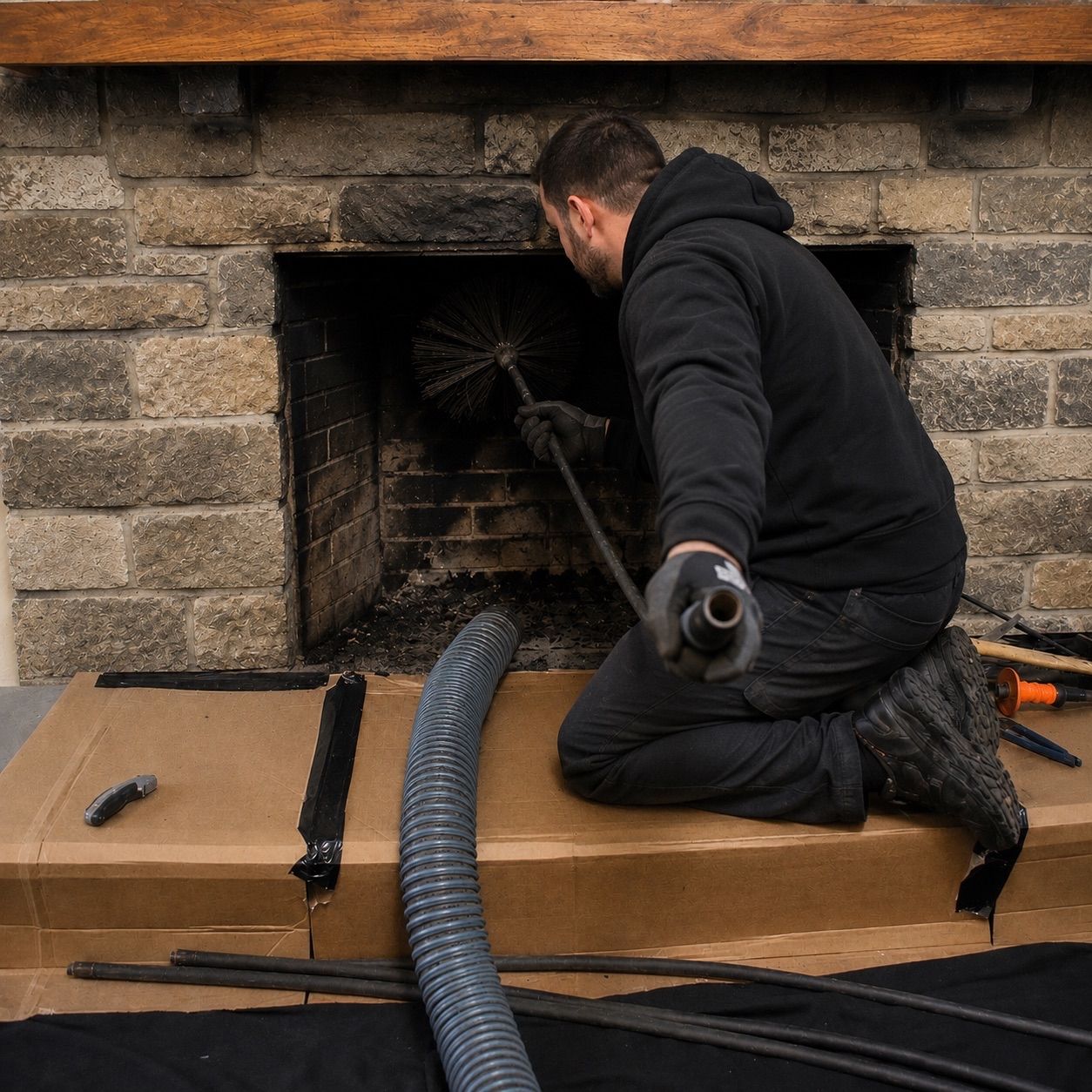
The fireplace opening is sealed and a vacuum runs behind the seal, so the dust goes into the machine and not into the room. The flue is then brushed with a head sized and shaped to it; a round brush in a rectangular clay flue misses the corners, and the corners are where creosote collects.
The smoke shelf, the ledge behind the damper, catches whatever falls and is cleared by hand. A factory-built fireplace with a metal flue is cleaned with brushes that suit the metal, following the manufacturer's instructions.
Glazed creosote does not brush off. If the flue has reached that stage, removal needs chemical treatment or rotary tools, which is a separate job with its own page.
Tell us roughly how many fires the fireplace saw last winter and when the flue was last cleaned. Describe the problem and request an estimate.
When the debris points to a different job
Pieces of clay in the catch are a reason not to relight until the liner has been looked at, because a cracked tile lets heat and flue gas reach the brick behind it. Heavy mortar grit points the same way, at the joints between tiles. Neither is fixed by cleaning.
Nesting material and leaf litter point to the top of the chimney. On a lot with mature trees over the roof, a missing or torn cap lets debris in every autumn, and the cap is the fix rather than more frequent cleaning.
If the cap turns out to need replacing and the house is a designated Pasadena landmark or sits in a landmark district, a new cap is an exterior change. The City's historic preservation staff can say whether that needs review before one is ordered.
What sets the price of cleaning a Pasadena chimney
The estimate follows the chimney. The variables that move it are the stage of creosote (loose soot is quick, glaze is not), the number of flues to clean, the height and pitch of the roof, how much has settled on the smoke shelf, and whether a fixed cap has to be unbolted to reach the flue from above.
Anything the debris reveals, such as liner damage or a failed cap, is priced separately once someone has looked at it.