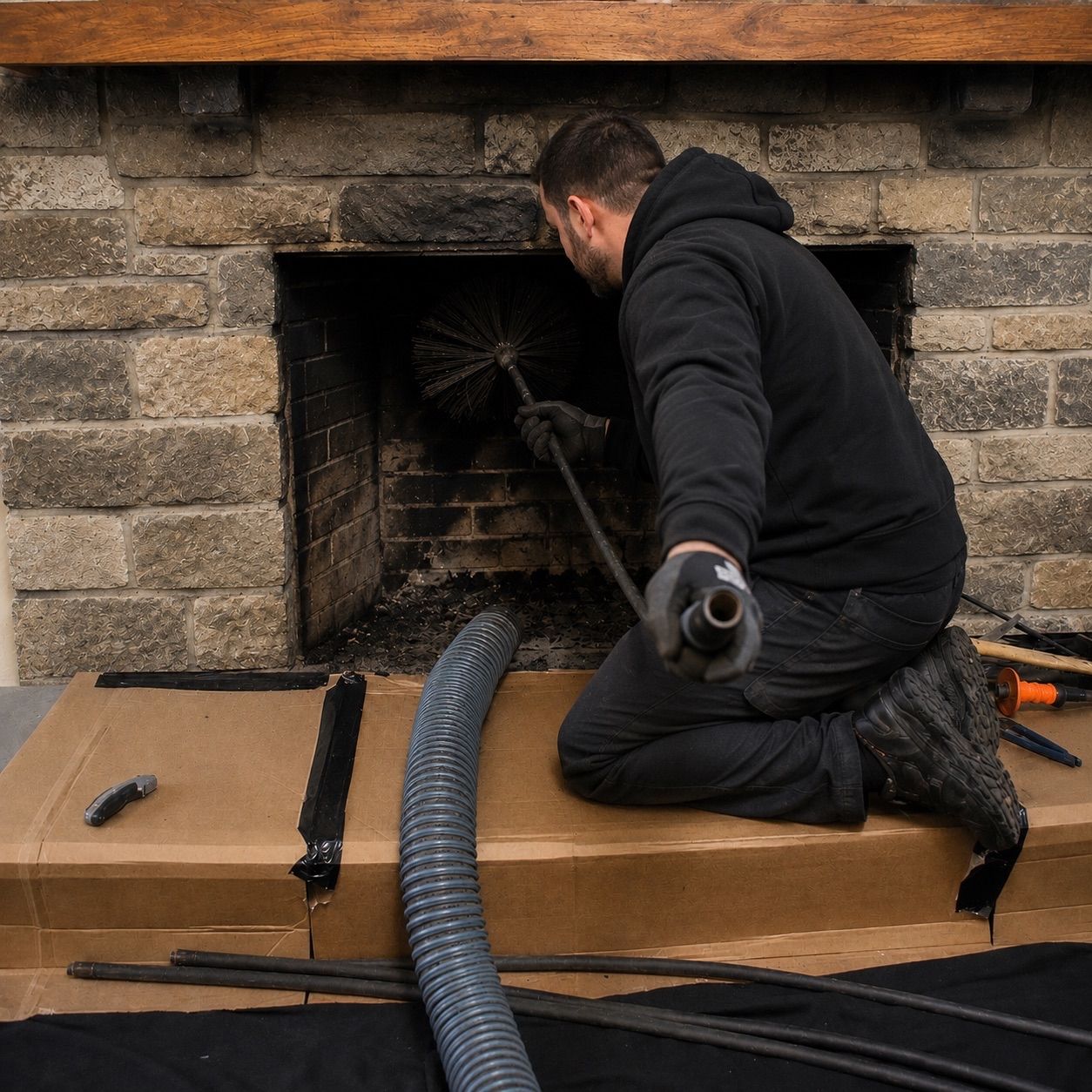
Wood inserts and stoves: the part that has to come out
A fireplace insert sits inside the firebox and normally vents through a stainless liner running up the old flue. Cleaning it properly usually means drawing the insert forward, disconnecting it from the liner, and brushing the liner from the chimney outlet down.
Some inserts were fitted with only a short connector into the damper area and no full-height liner. That arrangement leaves the smoke chamber collecting deposits out of sight, and if the insert was installed that way, the cleaning report should say so.
The insert's own baffle and flue collar hold fine ash and creosote and are cleared in the same visit.
Overnight burns and the creosote they leave
Arcadia sits inland under the San Gabriels, where winter nights can be cold enough that an insert is kept going after bedtime. A stove or insert turned down low to burn through the night spends long hours smoldering, and slow burning leaves the most creosote. That pattern, more than the number of fires, is what moves a liner from dry soot to flaky or glazed deposits.
Glazed creosote on clay tile or a steel liner does not brush off. It has to be softened before it can be removed, and finding it is a sign the burning habit is working against the chimney.
Tell us whether there is an insert or stove in the fireplace, and roughly how often it ran last winter. Describe the problem and request an estimate.
Certified stoves still stop on no-burn days
SCAQMD Rule 445 does not exempt EPA-certified or pellet devices when a no-burn day is declared; from November through the end of February, a declared day stops all wood burning. Gas devices sit outside the restriction.
EPA says certified stoves burn cleaner and more efficiently than older ones. Cleaner burning means less deposit in the liner, not none, so a certified insert still needs its chimney cleaned.
What changes the cleaning estimate on an Arcadia chimney
An insert adds more to the job than anything else on this list.
- 1Whether an insert or stove has to be pulled out and reconnected.
- 2The stage of the deposits: dry soot, flaky, or glazed.
- 3The shape and condition of the smoke chamber.
- 4How many flues the chimney holds.
- 5Roof height and pitch, particularly on a two-storey house.