Los Angeles County Service Areas · Chimney & fireplace services · Estimate requests online
Chimney Cap Replacement in Los Angeles
Chimney cap replacement is for a cap that is already there and has stopped working: rusted through, crushed, or blown off. A cap that is only loose often needs refastening rather than replacing, and telling the two apart is the first step.
- Chimney & Fireplace ServiceCleaning, inspection & repair
- Los Angeles Service AreasCities & LA neighborhoods
- Free Estimates AvailableEstimates at no charge
- Easy to ReachCall or request online
This Page Is About a Failed Cap, Not a Missing One
If your flue has never had a cap, you want chimney cap installation, which covers what a cap does, the types available and which material to choose. This page starts from the other position: a cap exists, it has failed, and the question is whether it can be put right or has to come off.
The distinction matters because a replacement has an extra constraint an installation does not. Something already failed at the top of this chimney, and unless the reason is understood, the new cap tends to fail the same way.
Signs the Chimney Cap Has Failed
Most of these can be seen from the ground with binoculars. None of them is a reason to climb onto the roof yourself.
Rust holes in the top plate
Surface rust is a stain. Rust you can see sky through, or flakes that come away in layers, means the metal has lost thickness and the lid is letting rain into the flue it was put there to protect.
Mesh that has rusted away or torn
The mesh is thinner than the frame, so it usually goes first. Broken wires at the corners or a gap where the mesh meets the frame is enough for a bird or a squirrel to get in.
A cap that rocks, tilts or rattles in wind
Most flue-mounted caps are held by set screws bearing on the outside of the flue tile. When those screws rust or back off, the cap sits loose and starts to walk. A rattle on a windy night is often the first sign.
The cap is in the yard or the gutter
A chimney cap blown off in a storm usually left because its fixings had already failed. Check whether it came off whole or tore away, because that tells you what the new one needs to be fixed to.
Crushed, dented or bent
Falling branches, a ladder, or a raccoon working at the lid can flatten the hood onto the mesh or push the mesh into the flue. A crushed cap restricts the draft as well as letting water in.
Rust streaks, damp ash or animals inside
Orange streaks running down the crown or the flue tile, wet ash in the firebox after rain, or nesting material turning up below a cap you thought was sound all point to a cap that is no longer doing its job.
If an animal is already inside the flue, deal with that first: chimney animal removal explains what to do before anyone fits a new cap over it.
Repair or Replace the Cap?
Chimney cap repair is worth doing when the metal is sound and only the fixing or the mesh has let go. Once the metal itself has failed, repair is money spent on a part that is still on its way out.
| What you see | Usual answer |
|---|---|
| Cap loose or tilted, metal sound, flue tile intact | Refasten: new or re-tightened set screws |
| Frame and lid sound, mesh torn or rusted in places | Re-screen, if the frame will take new mesh |
| Mesh plugged with soot or glazed creosote | Clean it and the flue; see spark arrestor |
| Top plate perforated, frame rusting through | Replace |
| Hood crushed onto the mesh or bent out of shape | Replace |
| Cap gone entirely | Replace, after checking why it came off |
| Cap fine, but the crown under it is cracked or broken | Crown repair first |
When not to call us: brown or rainbow discoloration on a stainless steel cap is a surface stain, not failure. If you cannot see a hole and the metal is not flaking, it does not need replacing. A cap that is loose but otherwise sound needs its set screws tightened or renewed, not a new cap. And if water is coming in around the chimney rather than down the flue, the cap is probably not the cause; start with chimney leak repair.
Why Chimney Caps Rust, Loosen and Blow Off
Galvanized steel runs out of zinc. Galvanizing is a zinc coating that corrodes in place of the steel underneath. It is sacrificial by design, so the cap is sound for as long as the zinc lasts and then rusts quickly. Cut edges, screw holes and the thin wire of the mesh lose their coating first, which is why a rusted chimney cap usually fails at the mesh and the corners before the lid.
The underside works harder than the top. On a wood-burning flue, the inside of the cap sits in the exhaust. Moisture and acidic combustion by-products condense on the cooler metal, and creosote builds on the mesh. A cap can look fine from the street and be thin underneath.
Fixings fail before the cap does. Set screws rust, the clay flue tile they bear on can crack, and a cap that is slightly the wrong size never grips evenly. Every gust then rocks the cap a little further until it lifts off.
Physical damage. Branches, roof work and wildlife all bend caps. Raccoons in particular will pull at a lightweight cap, and bent mesh is how many animals end up in a flue that was supposedly capped.
What Chimney Cap Replacement Involves
Fitting the cap is quick. Most of the care goes into what it is being fixed to.
- 1
The existing cap and its fixings are assessed
Whether the cap is flue-mounted or crown-mounted, what it is fastened with, and whether those fasteners will come out cleanly. Seized set screws and old adhesive are the usual complications.
- 2
The fixing surface is checked
The top of the flue tile and the crown around it. A cap is only as secure as what it clamps or bolts to. Cracked flue tile or a broken crown has to be dealt with first, or the new cap will fail the same way the old one did.
- 3
The flue is measured
Outside dimensions of the flue tile for a flue-mounted cap, or the crown footprint for a crown-mounted cover. Guessing from the size of the old cap is how an undersized cap ends up on the roof again.
- 4
The new cap is fitted and fastened
Set screws tightened evenly against the tile, or brackets anchored to the crown, depending on the type. The mesh is checked for clearance from the flue opening so it does not restrict the draft.
- 5
The rest of the chimney top gets a look
Crown, flashing and flue tile are visible from the same position. If a cap has failed, the components around it have had the same weather, and it is worth knowing their condition while someone is up there.
NFPA 211, the national standard for chimneys and vents, recommends an annual inspection, and that is the usual point at which a failing cap gets noticed before it comes off. If the chimney has not been looked at in a while, a chimney inspection alongside the cap work makes sense.
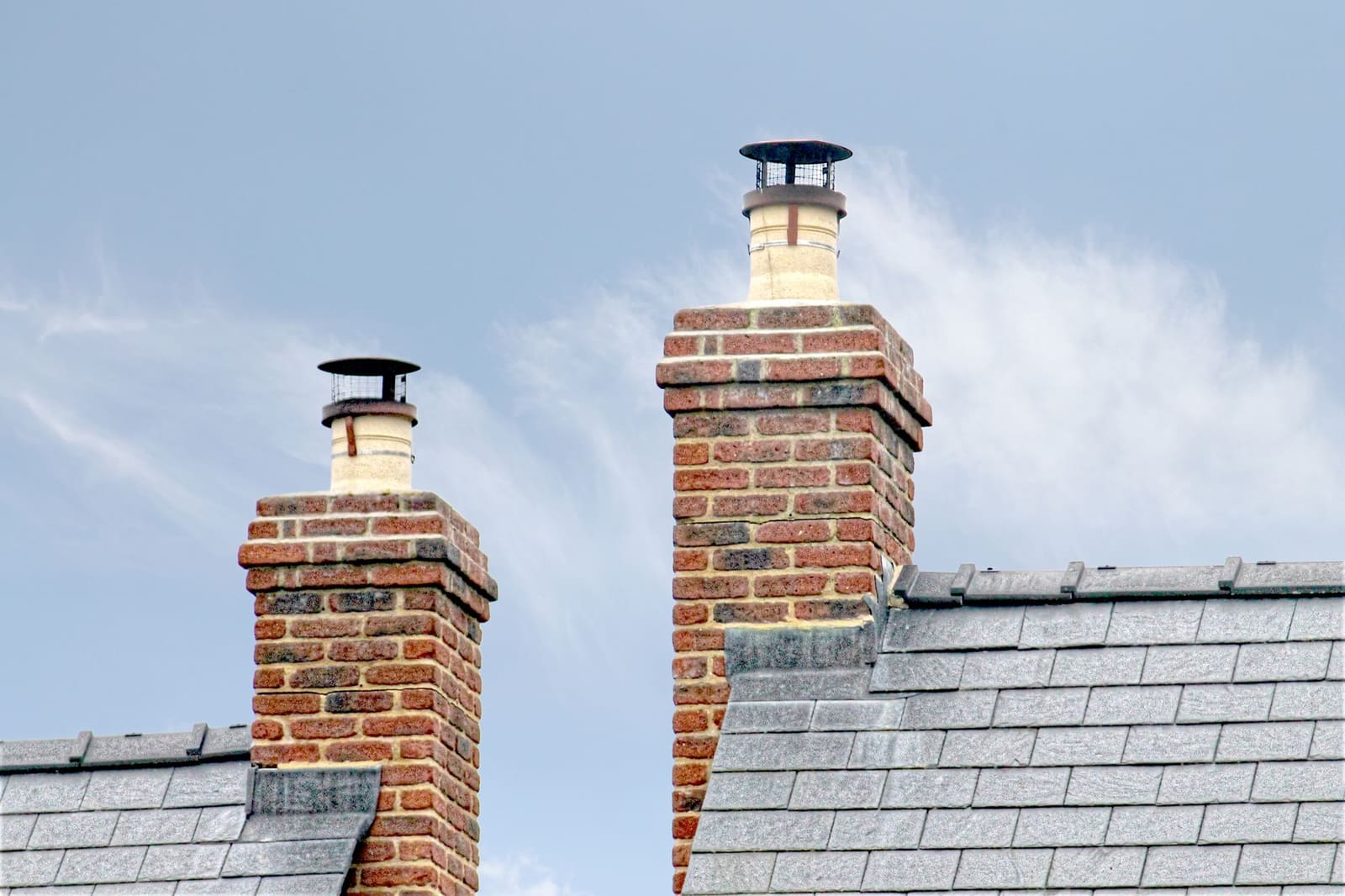
Replacing Caps on a Multi-Flue Chimney
A chimney serving a fireplace and a furnace or water heater often has two or more flues, and the caps on them rarely fail at the same time. Replacement is the moment to decide whether to match what is there or change the approach.
Individual caps keep each flue separate and let you replace one without touching the others. A single multi-flue cover sits over the whole crown and deals with every flue at once, but it depends on the crown being sound enough to anchor to, and it changes how the chimney looks from the street.
Where one of the flues serves a gas appliance, the cap on that flue has to suit the appliance's venting, and the appliance manufacturer's instructions govern that, not the choice made for the fireplace flue. Fine mesh that suits a wood-burning flue is not automatically right on a gas vent.
What Drives the Cost of a Replacement Chimney Cap
No price is published here, because a single stock cap and a custom cover over a damaged crown are different jobs. These are the variables that move the number.
How many flues there are
One flue, one cap. Two or three flues can mean several caps of different sizes, or one multi-flue cover, and that is usually the biggest single variable.
Flue size and shape
Standard round and rectangular clay flues take stock caps. Oval flues, unusual sizes and flues set flush with the crown often need a custom or crown-mounted cover.
Material
Galvanized steel, stainless steel and copper are priced very differently, and replacing like-for-like is not always the right call if the old cap rusted early.
How the old cap comes off
A cap held by four set screws lifts off. A cap bedded in adhesive or anchored through a crumbling crown takes longer and can reveal damage.
Condition of the flue tile and crown
If there is nothing sound to fix to, the job becomes crown or flue-tile work first. That is better found before the day than during it.
Roof access and height
A steep or tall roof, or a chimney that stands well above the roof line, takes more setup.
Send the details of the issue and request an estimate for the specific work. For the material comparison, see choosing a chimney cap.
Salt Air and Wind: Why Caps Fail in Los Angeles
Salt air. Within a few miles of the ocean, galvanized steel tends to lose its zinc coating faster than it does inland, because airborne salt keeps the surface damp and speeds up corrosion. A galvanized cap on a coastal house can rust through while the same cap in the Valley still looks serviceable. If your old cap was galvanized and failed early, that is the likely reason, and it argues against replacing like-for-like.
Wind events. Strong offshore winds, the Santa Anas in particular, are when caps with tired fixings come off. A cap that has been rocking quietly for months can be in the yard after one windy night. If you find one, look at how it came away: a clean lift-off points to loose set screws; torn metal points to corrosion.
Salt corrosion on the sheet-metal lid of a framed chimney is a related problem with its own page: chimney chase cover repair.
Is your chimney cap rusted, loose or gone?
Send a photograph of the chimney top taken from the ground, and tell us whether the cap is still there. We can help you work out whether it needs refastening or replacing.
Background reading: the difference between a crown, a cap and a chase cover.
Related chimney & fireplace services
Part of Caps, Screens & Chimney Top — Everything fitted to the top of the stack: rain caps, spark arrestors and animal screens. The cheapest place to stop the most expensive problems.
- putting a rain cap on an open flueChimney Cap Installation — Fitting a cap where there is none, and choosing a material that lasts in LA.
- chase cover replacementChase Cover Repair & Replacement — The sheet-metal top of a framed, factory-built chimney — rust, pooling and replacement.
- repairing a cracked crownChimney Crown Repair — The slab that sheds rain off the top of the chimney, and what happens when it cracks.
- tracing and repairing water entryChimney Leak Repair — The repair page for water coming in — crown, flashing, cap, masonry or liner.
- spark arrestor installationSpark Arrestor Installation — The mesh screen that keeps embers inside the flue. Relevant across the LA hills.
- getting a bird or animal out of the chimneyChimney Animal Removal — Birds, squirrels and raccoons in the flue — removal, the nesting-season rules, and sealing it after.
Request an Estimate
Tell us what has happened to the cap.
Quick check
Look at the cap with binoculars. Holes or flaking metal mean replace. A cap that is tilted but solid usually means the fixings, not the cap. No cap at all? See cap installation.
Chimney Cap Replacement Questions
Not the question you had? The full FAQ covers more ground.
Tell us what your chimney is doing
Call, or send a short description and request an estimate. Estimates cost nothing.