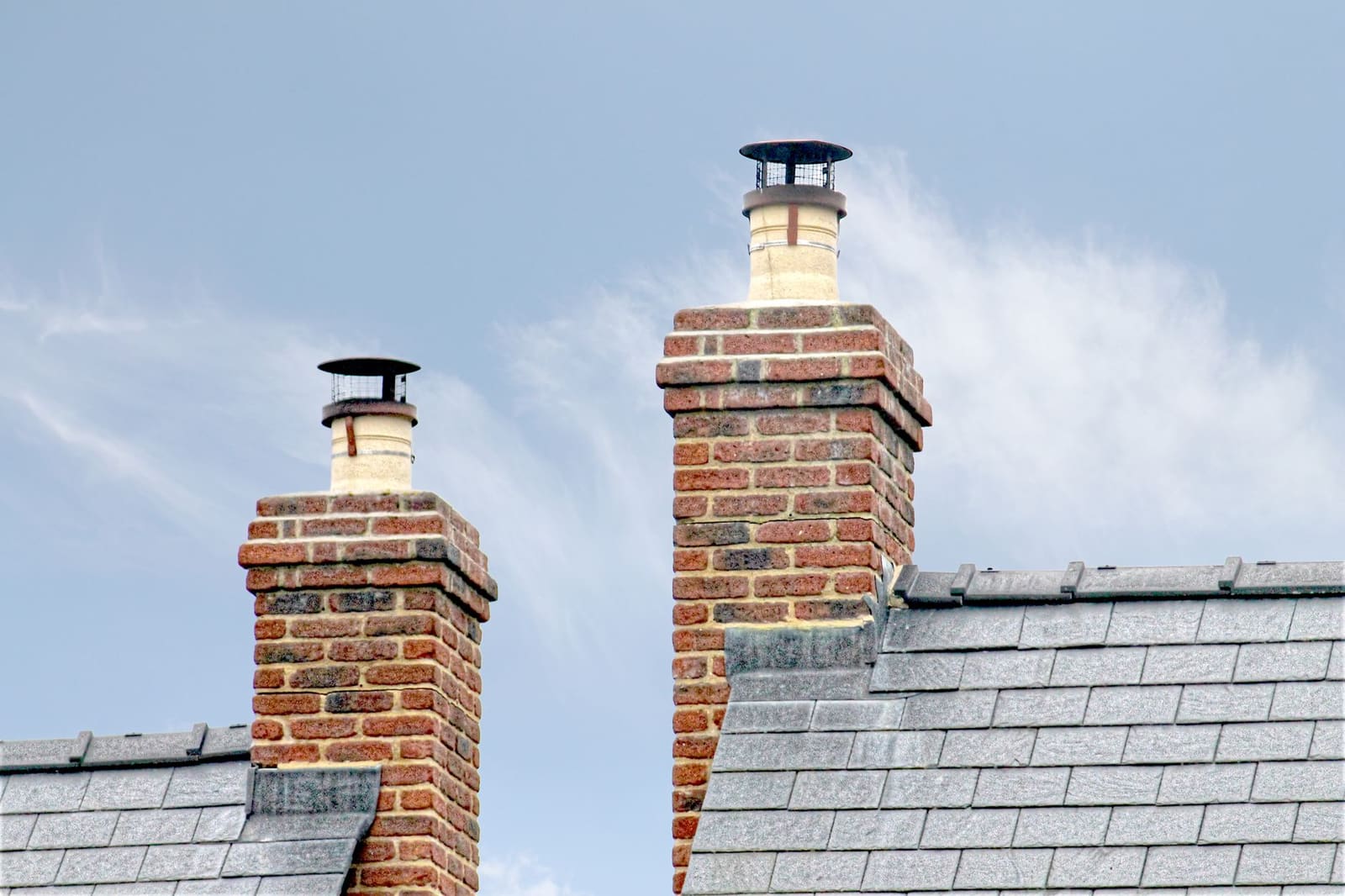
Single-flue, multi-flue and top-mount damper caps
A single-flue cap fits over one clay tile and is held by a band clamp or by screws bearing on the tile, so it needs enough tile above the crown to hold on to. A multi-flue cap covers the whole crown and every flue on it, and is anchored into the crown itself.
A top-mount damper cap seals the top of the flue when the fireplace is not in use and opens with a cable from the firebox. It is a more involved fitting, and it is a common answer where the original throat damper has rusted beyond use.
A factory-built chimney takes a cap made or approved for that chimney system. The code requires factory-built chimneys to be installed and terminated to the manufacturer's instructions, so a generic cap is not a substitute.
The arrestor mesh the California code asks for
The California Residential Code requires every chimney attached to a solid-fuel fireplace or appliance to have an approved spark arrester. On a masonry chimney the screen openings must not pass a sphere larger than 1/2 inch or block one smaller than 3/8 inch, the screen's open area must be at least four times the net free area of the flue outlet, and the screen has to be reachable for cleaning.
Those limits have a practical reason. Mesh that is too fine clogs with soot and chokes the draft; mesh that is too coarse lets embers through. A cap sized to the flue with compliant mesh does both jobs at once.
Say how many flues the chimney has and whether there is any cap on it now. Tell us what you are seeing and ask for an estimate.
Fasteners that last in Long Beach's salt air
Close to the shore, the fixings often fail before the cap does. A stainless cap held down with plain steel screws still works loose once the screws rust, and pairing metals such as a copper cap with steel fasteners speeds corrosion where they touch. Clamps and screws should match the cap metal or be compatible with it.
Long Beach reaches a fair way inland from the shoreline, and for houses at that end of the city the salt load is lighter. There, a well-fixed cap in a standard material may never give trouble, and the choice can lean more on appearance and budget.
Cap, crown or chase cover: which part is going on
The words get mixed up, the code included. The California Residential Code uses 'cap' for the concrete, metal or stone top of a masonry chimney, with a drip edge and a bond break around the flue liner; most homeowners call that the crown. The cap in everyday use is the metal hood above the flue.
Adding a cap does not fix a cracked crown, and the flat metal lid on a framed factory-built chimney is a chase cover, a separate part. If the crown is breaking up, it is repaired first so the new cap has something sound to anchor to.
What changes the price of fitting a cap
The cap is only part of the estimate. The rest depends on:
- 1Single-flue, multi-flue or top-mount damper design.
- 2Cap material and fastener metal.
- 3Flue size and shape, and whether a stock size fits or one has to be made.
- 4Roof height and access.
- 5Crown condition, since a cap cannot be anchored to a crown that is falling apart.