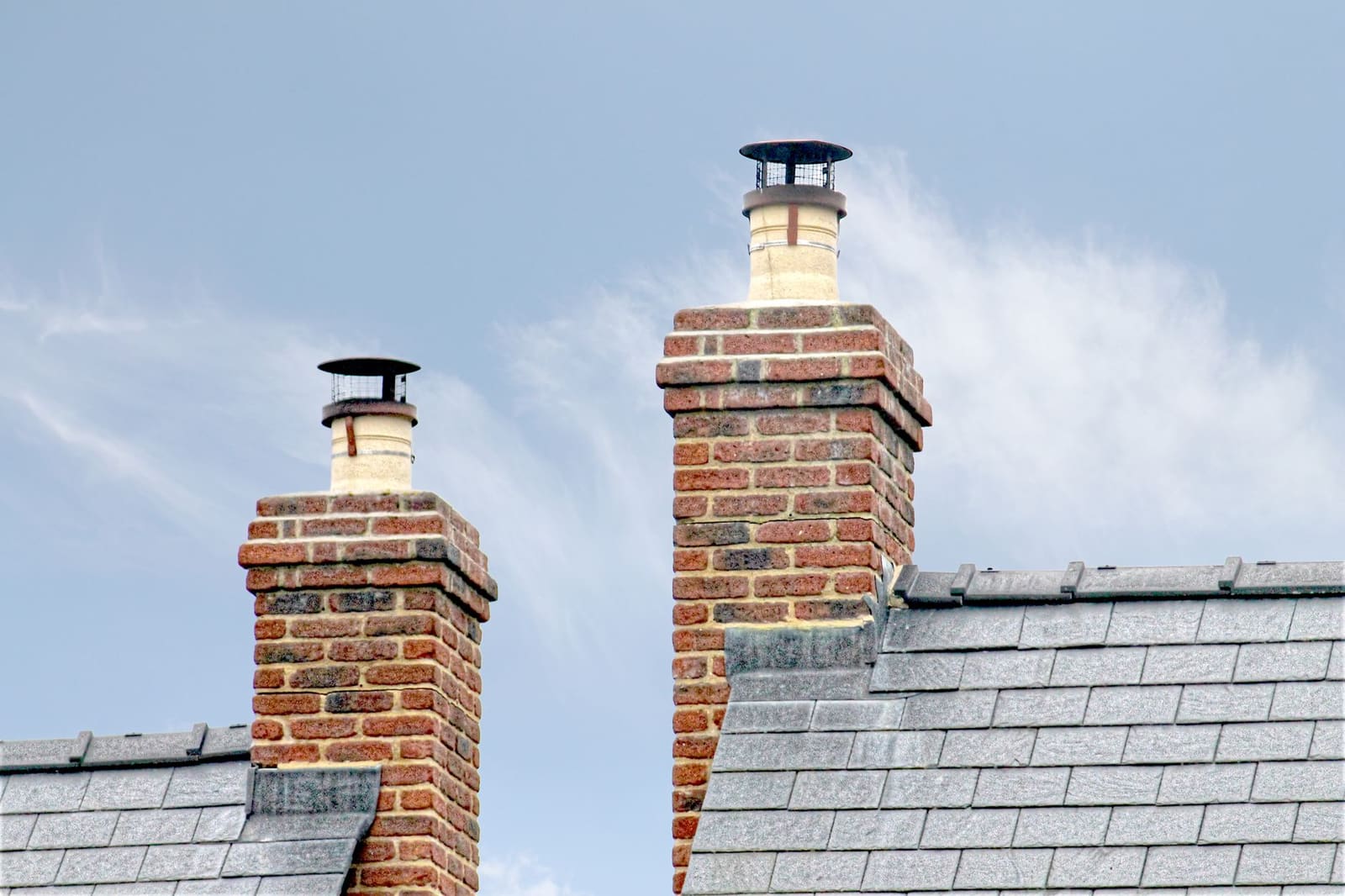
Picking a cap metal that marine air will not eat
Galvanized steel is a zinc coating over ordinary steel. Salt settles on it, holds moisture, and wears through the coating fastest at bends, welds and screw holes; once the steel underneath is exposed, rust spreads along the mesh and the hood.
Stainless steel and copper cost more and last considerably longer near the coast. Fasteners matter as well: a stainless cap held on with plain steel screws, or two different metals touching, can corrode at the joint even when the cap itself is sound.
Single-flue, multi-flue and oversized openings
A single-flue cap clamps to the liner that sticks up above the crown. Where an older chimney has two or three flues side by side, one for a fireplace and others for a furnace or a second fireplace, the options are a cap on each flue or one multi-flue cover that sits over the whole crown.
A multi-flue cover is bolted to the crown, so the crown must be solid enough to hold it. If the crown is cracked or crumbling, the cover is planned together with crown repair rather than fixed onto failing concrete.
Tell us how many flues the chimney has, what fuel the fireplace uses, and whether there is an old cap on it now. Describe the problem and request an estimate.
Screen rules when the fireplace burns wood
The California Residential Code requires every chimney connected to a solid-fuel fireplace or appliance to have an approved spark arrester. For a masonry chimney, the screen openings may not pass a sphere larger than 1/2 inch or block one smaller than 3/8 inch, and the screen's free area must be at least four times that of the flue outlet.
Tighter mesh stops more embers but clogs faster with soot, and a clogged screen chokes the draft. The mesh size is chosen to meet the code range, not to go as fine as possible, and the cap has to allow access for cleaning.
What decides chimney cap installation cost in Santa Monica
The price is driven by the cap and the roof, not by the time spent bolting it on.
- 1Material: galvanized, stainless steel or copper.
- 2Single-flue cap or a custom-sized multi-flue cover.
- 3Whether the liner or crown needs work before a cap can be attached.
- 4Roof type and pitch; clay tile roofs need careful footing.
- 5Removing an old rusted cap whose fasteners have seized.