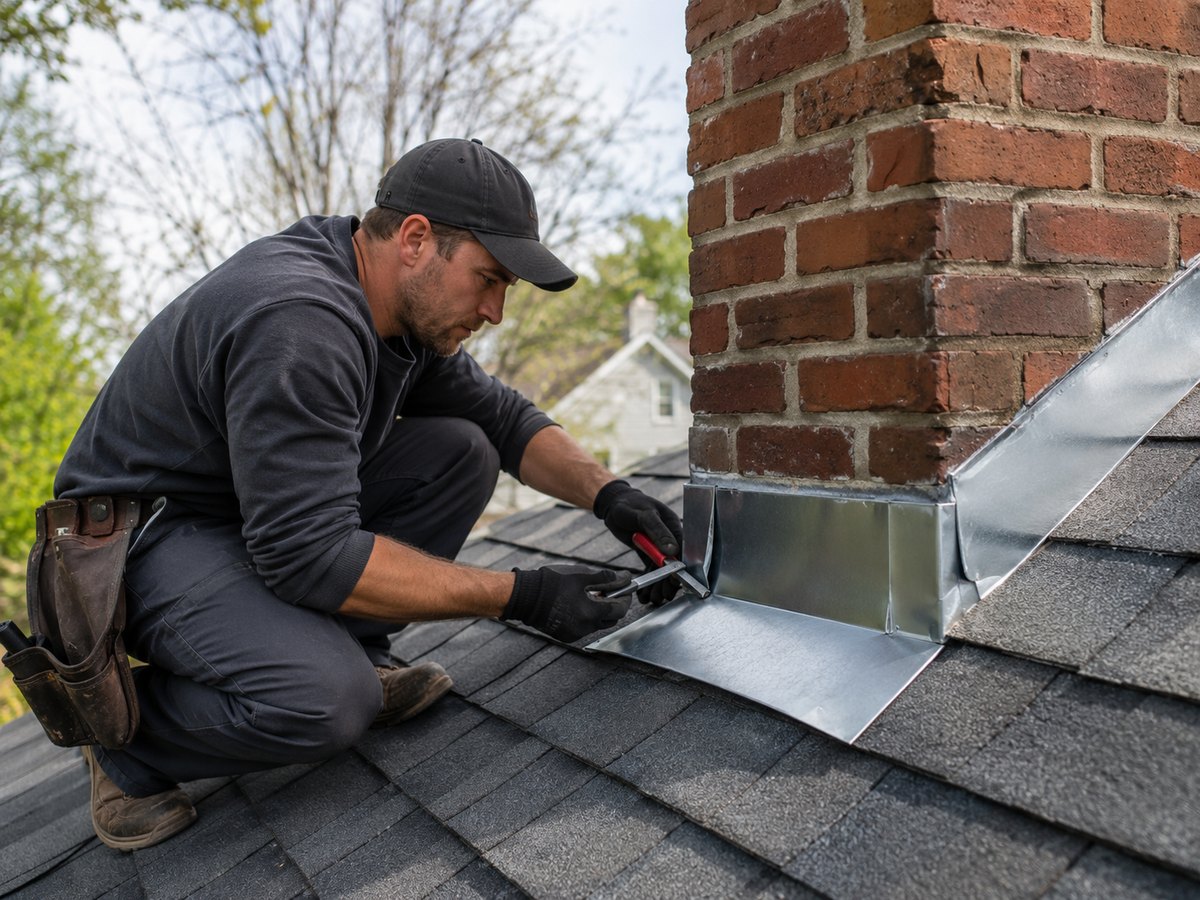
Symptoms that point at the flashing
Flashing leaks leave a fairly consistent trail:
- 1A stain on the ceiling or wall that touches the chimney line rather than spreading out from the firebox.
- 2Wet framing in the attic beside the chimney while the inside of the flue stays dry.
- 3Sealant smeared along the top edge of the flashing, a sign of an earlier quick fix.
- 4Counter-flashing pulled out of its mortar joint or lifted at the corners.
- 5Rust streaks on the roof just below the chimney.
Tile, shingle and flat roofs each change the repair
On composition shingle, the shingles beside the chimney are lifted, the step flashing replaced piece by piece, and the shingles relaid. Where the roof is clay or concrete tile, the tiles come off and go back on, and the flashing beneath includes a pan or apron that has to shed water under the tile as well as over it.
On a flat or low-slope roof, the flashing is part of the membrane: the membrane turns up the chimney and ends beneath a counter-flashing. A roofer and a mason sometimes both have a hand in that detail.
The simplest time to replace flashing is during a re-roof. If one is planned soon, a careful temporary repair can be the sensible call until then. Whether the combined work needs a permit is a question for the City of Long Beach, which runs its own building department.
Tell us what the roof is covered with and exactly where the water shows on the ceiling or wall. Call or send the details, and ask for an estimate for the work.
Salt air, mortar and the metal in the joint
Near the Long Beach shoreline, flashing sits in the same damp, salty air as the chimney cap, and galvanized steel flashing corrodes along its bends and where it meets the mortar. Aluminum can react with fresh mortar and with fasteners of a different metal. Copper and stainless steel hold up better on the coast, and fasteners should match the flashing so corrosion does not start at the screw.
In the parts of the city further from the water, flashing more often fails because its sealant has dried out or because the mortar joint holding the counter-flashing has eroded. That second case is partly a masonry job: the joint is repointed so it can grip the counter-flashing again.
The variables in a flashing repair estimate
The roof covering is usually the biggest factor. After that:
- 1How much roofing has to be lifted and relaid.
- 2Chimney width, and whether a cricket has to be built or rebuilt.
- 3Resealing versus full replacement of step and counter-flashing.
- 4The flashing metal chosen.
- 5Repointing where the counter-flashing is set.