Why Burbank burning habits build deposit faster than you would expect
Inland Burbank tends to have warm afternoons and cool evenings through much of the burning season. That pattern invites a particular kind of fire: lit after dinner, kept small, left to die down by bedtime. The flue never gets properly hot, so the smoke cools on the way up and leaves more of itself behind.
Two other habits make it worse. Wood that has not been seasoned long enough burns cool and wet; a damper closed partway to stretch a fire slows the smoke and gives it longer to condense. A fireplace used a handful of times like this can collect more deposit than one used twice as often with hot, well-fed fires.
No-burn alerts and the Burbank burning season
Burbank falls under the South Coast AQMD residential wood-burning programme. The curtailment season runs from November through the end of February, and on a mandatory no-burn day no wood-burning device may be used. That includes EPA-certified inserts and stoves and pellet heaters; only gas-fuelled fireplaces fall outside the alerts.
The status for a given day can be checked on the district's map by address or ZIP code, through its Air Alerts e-mail, or by calling 866-966-3293. Households that rely on wood as their only heat, low-income households and homes without natural gas service are exempt.
A no-burn day does not stop a cleaning. The alert restricts lighting a fire, not work on the chimney, and a day the fireplace cannot be used anyway is a reasonable day to have it cleaned.
Tell us roughly how many fires the fireplace had last winter and what the deposit looks like on the damper. A short description, and a photo if you can take one safely, is a good start to an estimate request.
How deposit comes out without spreading through the house
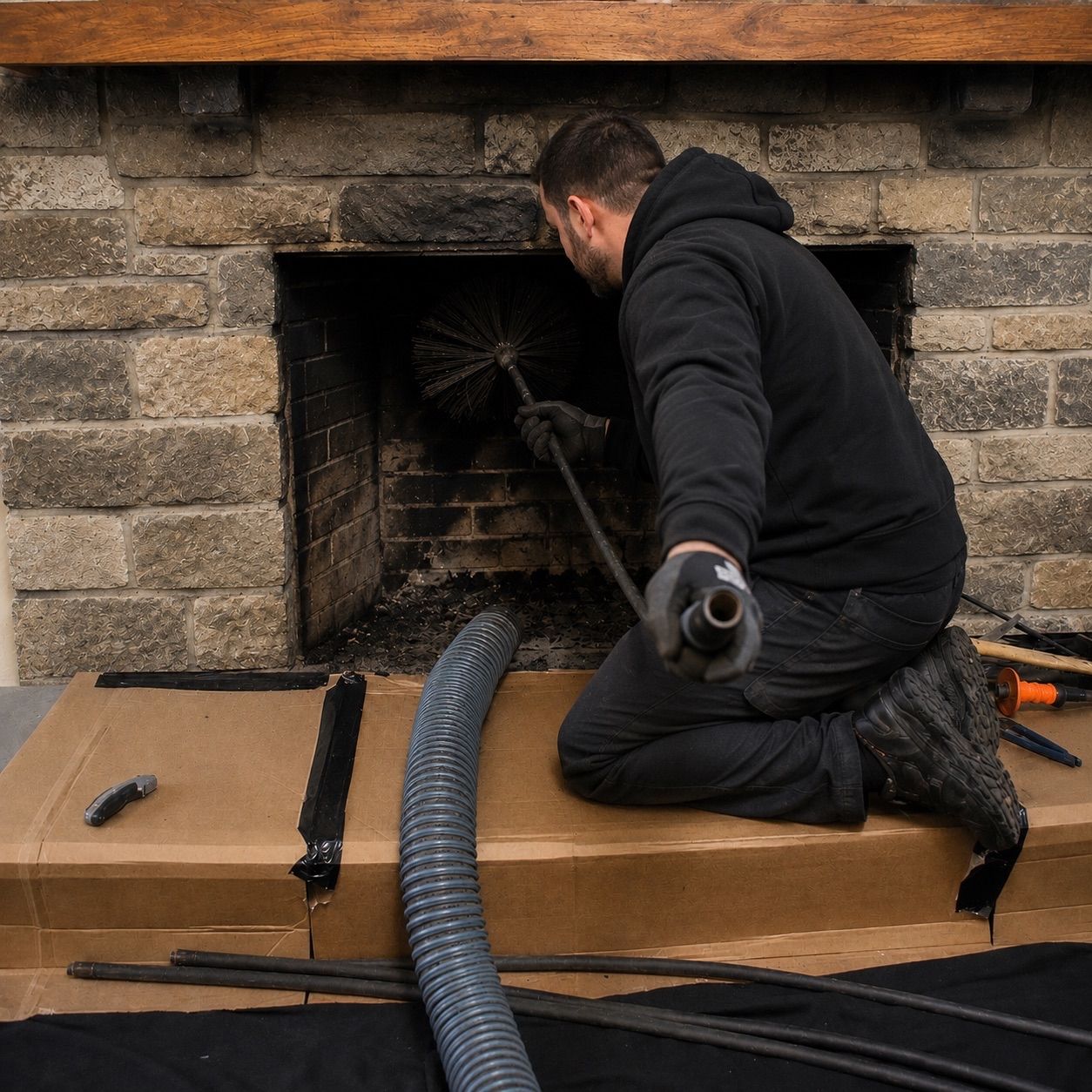
The fireplace opening is covered and sealed, and a vacuum runs behind that seal so dust drawn down the flue is pulled away rather than pushed into the room. Brushes sized to the flue work the full length, then the smoke shelf behind the damper is cleared by hand, because that ledge is where loosened deposit piles up.
Once the flue is clean it is possible to see its condition, so a cleaning is also the moment a cracked tile or an open mortar joint tends to be noticed. If one turns up, it is a separate question from the cleaning.
What sets the scope of a cleaning on a Burbank chimney
The variables are the deposit and the chimney, not the postcode: which form of creosote is present and how far up it goes; whether the flue is round, square or rectangular, which decides the brushes; whether there is a second flue for a furnace or water heater alongside the fireplace flue; whether the cap has to be unscrewed or cut free to reach the flue from above; and whether glazed deposit means a follow-up visit.