Usually not straight away. If the nest in your flue is active, meaning there are eggs or young birds in it, treat it as potentially protected under the federal Migratory Bird Treaty Act. The practical course is to keep the damper shut, leave the nest alone, and deal with it once the young have left.
An empty nest is a different matter. Once nothing is living in it, it is debris in a flue, and clearing it is ordinary chimney work. Most of this article is about telling those two situations apart and what each one allows.
Active or abandoned: the question that decides the timing
The legal concern attaches to birds, their eggs and their young. A nest with a clutch in it, or chicks being fed, is the case to leave alone. A nest the birds have finished with is, for practical purposes, twigs and grass sitting in the wrong place.
The signs of an active nest are fairly consistent. Chirping or chattering that comes in bursts, getting louder when an adult arrives. Birds diving into the flue top and leaving again a minute later. Fresh droppings or bits of nesting material landing on the smoke shelf, the ledge just behind the damper.
Silence on its own proves little. Young birds are quiet between feeds, and an adult sitting on eggs makes almost no noise. If you are not sure, the honest answer is to wait and watch rather than guess.
- Bursts of calling from the flue, especially when an adult flies in: likely active
- Adults entering and leaving the chimney top during the day: likely active
- No sound and no traffic for a sustained period after a noisy spell: possibly abandoned, get it confirmed
- A nest found during a routine sweep with no birds anywhere near it: usually abandoned
What the Migratory Bird Treaty Act means for a homeowner
The Migratory Bird Treaty Act of 1918 is a federal law administered by the U.S. Fish and Wildlife Service. It protects migratory birds, and that protection can reach their nests, eggs and young. It is not a chimney rule. It applies wherever a covered bird happens to nest, and a flue is simply one of the places some birds choose.
This page is not legal advice and does not try to list which species are covered or what applies in your case. The point for a homeowner is narrower: you cannot identify the bird from the living room, so pulling an active nest out of a chimney is a decision to make only after checking what applies. The Fish and Wildlife Service is the authority on that question.
The Act does not make the chimney untouchable forever. It shapes when the nest can be dealt with, not whether.
Which birds end up in Los Angeles flues
The bird most people have heard of in this context is the Chimney Swift, and it is probably not the one in your chimney. The Cornell Lab of Ornithology describes it as a common summer sight over eastern cities and towns, a bird that clings to the inside walls of chimneys. It also notes the species has declined sharply as chimneys fall out of use, which says something about how much it relies on them.
The western counterpart is Vaux's Swift. Cornell describes it as much like the Chimney Swift, but it roosts and nests communally in hollow trees in mature evergreen forests, and uses chimneys less often. So a swift in a Los Angeles chimney is possible but not the default assumption.
Other birds use chimneys too, sometimes nesting on the smoke shelf or on debris lodged in the flue rather than on the flue wall itself. Which bird it is matters for the legal question, and it cannot be worked out by sound alone. That is the reason to treat the nest as potentially protected rather than guessing in either direction.
If the noise sounds more like scratching than calling, it may not be a bird at all. The general guide to animals in a chimney covers squirrels, raccoons and the other usual occupants.
Tell us what you have noticed and request an estimate. Estimates are free.
What to do while the young are still in the flue
Close the damper and leave it closed. That keeps birds from dropping into the firebox and keeps the noise, smell and debris on the flue side. If the fireplace has glass doors, close those as well.
Do not light a fire, and do not try to smoke the birds out. Nesting material is dry fuel, and young birds cannot leave on their own however much smoke reaches them. Do not reach up through the damper to pull the nest down, and do not fit a cap or screen over the top while the nest is in use. A cap shuts the adults out and leaves the young to die inside, which trades a legal question for a smell.
The Cornell Lab's advice for Chimney Swifts is to keep the damper closed during summer and to schedule chimney cleaning before or after the breeding season. Whatever the bird in your chimney turns out to be, that is a reasonable way to plan.
Once the young have left: clearing what stays behind
An empty nest does not leave with the birds. The material stays on the smoke shelf, on the damper, or wedged in the flue, and it is exactly the sort of thing that catches from the first fire of the winter. Droppings and feathers come with it, and in a warm spell they are often what people notice first, as a smell from the fireplace.
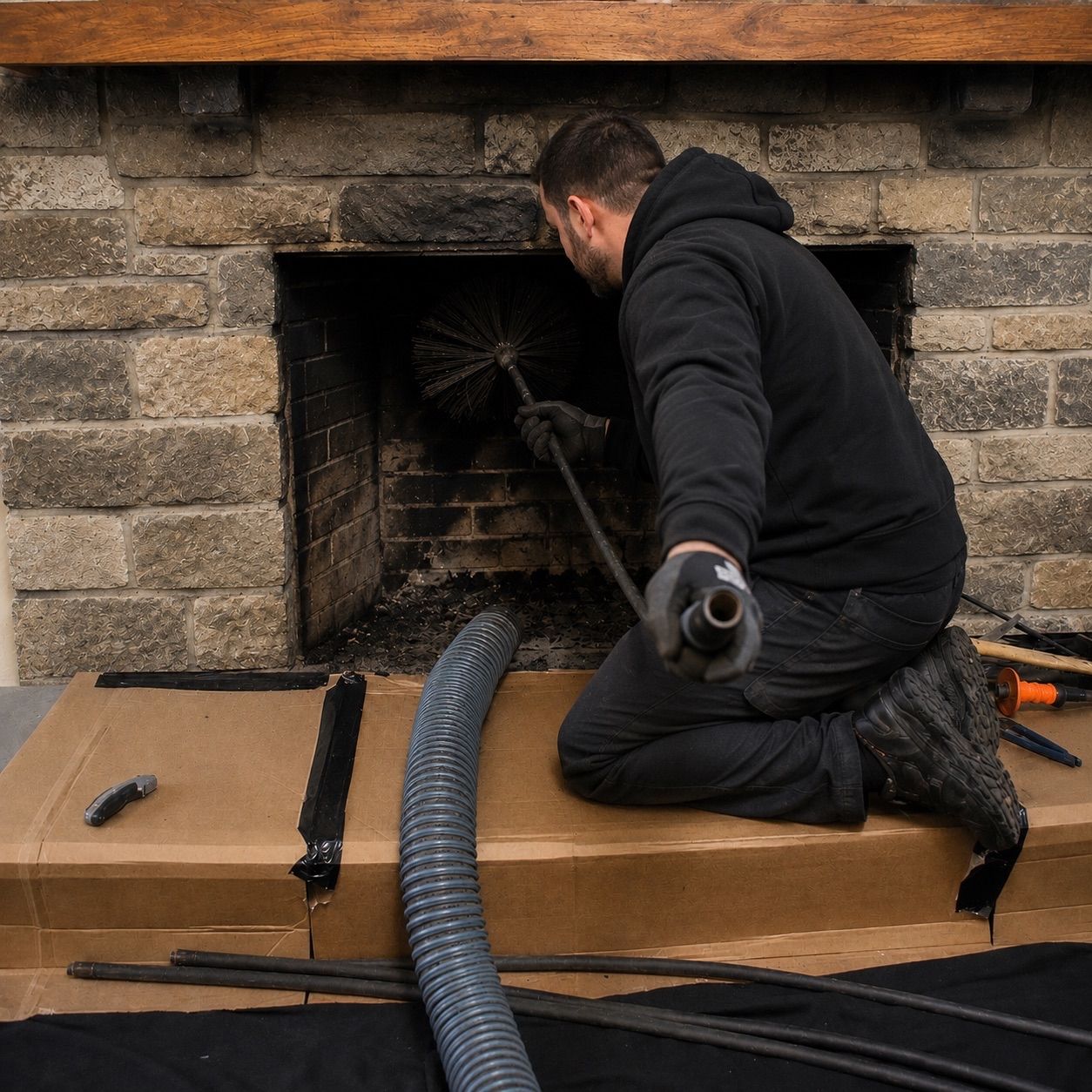
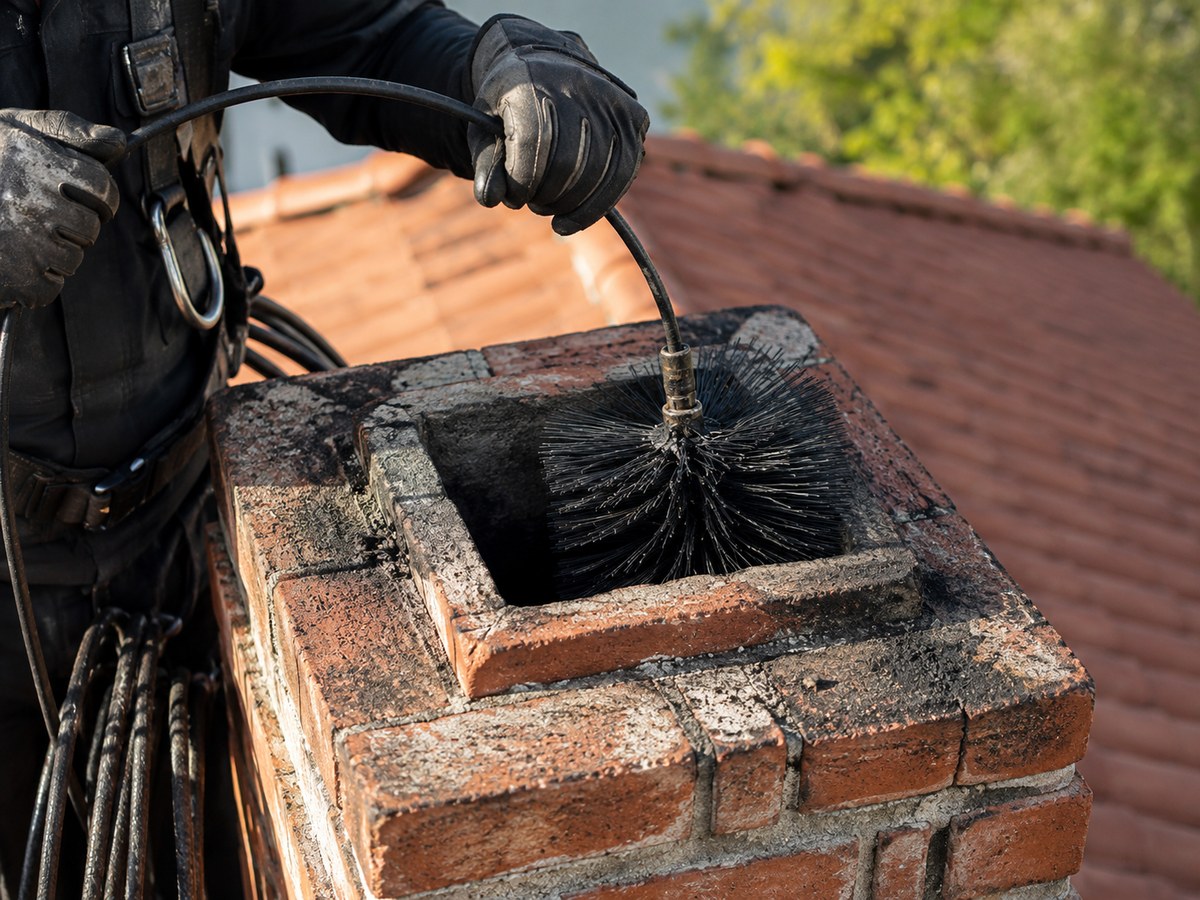
Clearing it is ordinary blockage work. The nest material is removed from above, below or both, the smoke shelf and damper are cleaned, and the flue is checked to make sure nothing is still lodged higher up. A camera or mirror look up the flue is how anyone can say it is actually clear rather than probably clear.
This is also the point to look at why the birds got in. An uncapped flue, a cap with torn or rusted mesh, or a cap that has worked loose all look the same to a bird.
Screening the flue before the next nesting attempt
The fix that stops a repeat is a securely fastened screen or cap with intact mesh, fitted while the flue is empty. Mesh sides let smoke and gases leave while keeping birds out, and the solid top keeps rain off the damper at the same time.
Timing matters more than the hardware. A screen fitted after the nest has been cleared and before birds return is the whole job. The same screen fitted a week too late, over a new nest, is the problem this article started with.
On a chimney that serves a wood-burning fireplace or stove, the mesh has a second job. California's residential code requires an approved spark arrester on chimneys attached to solid-fuel appliances and fireplaces, and a mesh cap often serves as both.
The code side of that, and what happens to mesh over time, is covered in spark arrestors and wildfire risk in Los Angeles.
When booking a removal now is the wrong move
If the nest is active, a removal visit this week is the wrong purchase. The honest advice is to wait, keep the damper shut, and book the clearing and screening for after the young have gone. The only exception is the appliance-flue case above, where waiting is not safe.
If the birds are sitting on the chimney top or on the cap and nothing is coming down the flue, nothing needs removing. Birds perch on chimneys all the time. What matters is whether the flue is open to them.
If the chimney already has a sound, fastened mesh cap and the noise is coming from the roof or the attic rather than the firebox, the chimney is probably not the problem at all.
Getting from a nest to a screened flue
The order is the same every time: wait for the nest to empty, clear it, check the flue, then close the top off to birds. Tell us what you are hearing and when it started, and we'll come back to you on the timing.
For a bird or animal still in the flue, start with chimney animal removal, which explains how nesting affects timing. An empty nest left in the flue is covered under clearing a blocked chimney. The long-term fix is a bird and animal screen for the flue, often fitted as part of a new chimney cap.
Sources & Further Reading
Service areas
Los Angeles and cities across the county, with the local conditions that affect chimneys there.
View all service areas →