Los Angeles County Service Areas · Chimney & fireplace services · Estimate requests online
Fireplace Insert Installation in Los Angeles
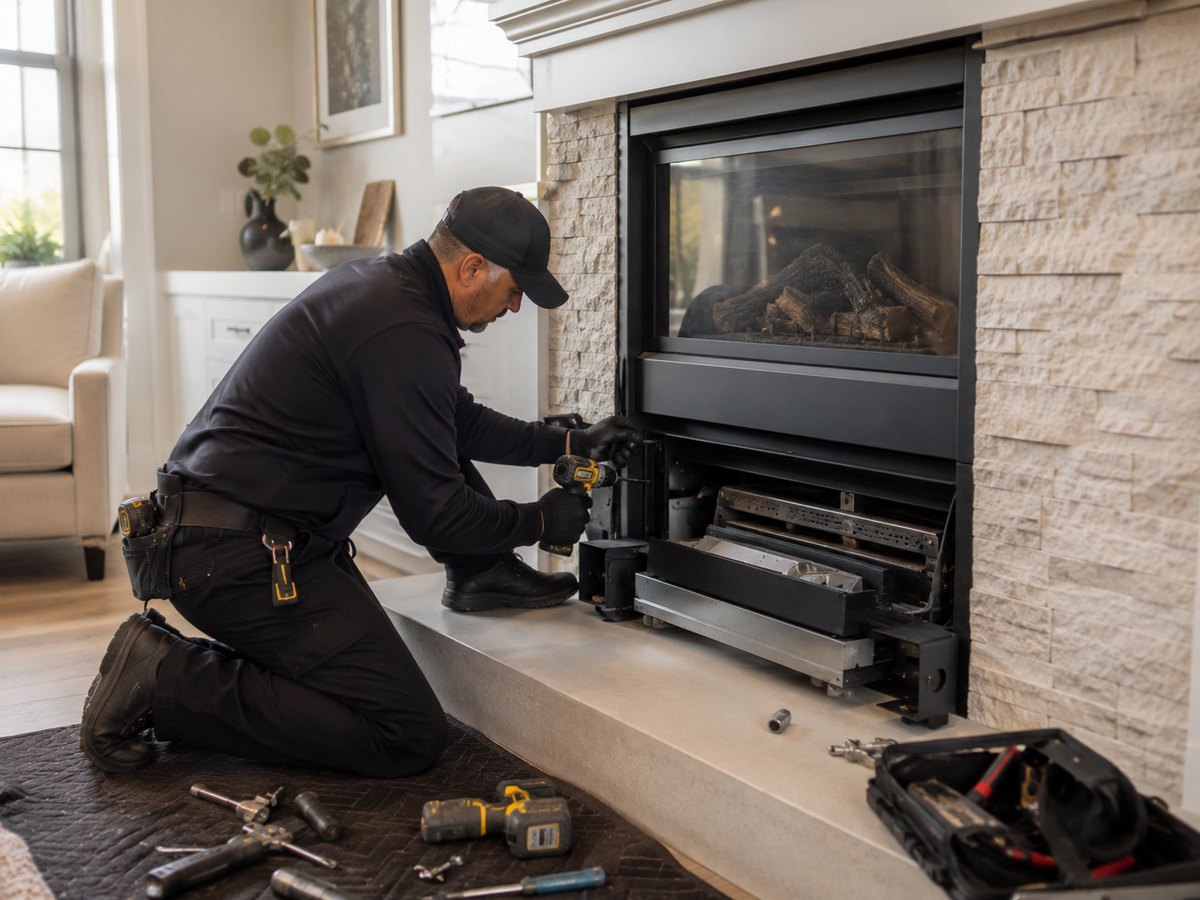
Fireplace insert installation puts a closed gas, wood or pellet appliance into an existing masonry fireplace, with a new liner run to the top of the chimney. It is the usual way to get real heat from a fireplace that already exists.
- Chimney & Fireplace ServiceCleaning, inspection & repair
- Los Angeles Service AreasCities & LA neighborhoods
- Free Estimates AvailableEstimates at no charge
- Easy to ReachCall or request online
An Insert Turns an Open Fireplace Into a Closed Appliance
A fireplace insert is a firebox in a steel or cast-iron body, with a glass door, that slides into the opening of an existing masonry fireplace. A surround panel covers the gap between the insert and the brick.
The gain comes from closing the opening. An open fireplace pulls room air into the fire and up the flue, taking heat with it, and most of what it does radiate comes off the front. An insert controls the air it burns and pushes heat into the room through its body and, on many models, a blower.
The masonry stays where it is, which is why an insert is usually less disruptive than building a new fireplace. The same fact creates the one requirement people underestimate: the old flue was built for an open fire, and an insert cannot use it as it stands.
Gas, Wood or Pellet: Three Kinds of Insert
All three go into the same kind of opening and all three need a liner. They differ in what else they need and in when you are allowed to use them.
| Insert | Installation needs | Day to day | No-burn days |
|---|---|---|---|
| Gas insert | A gas line to the firebox; a liner sized to the insert; often power for a blower | Switch or remote; no ash | Outside the no-burn restriction |
| Wood insert | Must be EPA-certified in the basin; a liner sized to the insert; a sound firebox and hearth | Loaded by hand; ash and creosote to deal with | May not be burned on a no-burn day |
| Pellet insert | A liner sized to the insert; a power supply for the feed and fan | Hopper-fed pellets; ash to empty | May not be burned on a no-burn day |
Gas fireplace insert installation is the version with the fewest restrictions in the basin, and the gas line is a job for a licensed gas or plumbing trade. Gas fireplace installation compares a gas insert with gas logs and direct-vent units.
Wood-burning insert installation means an EPA-certified model, which burns with a controlled air supply and a secondary combustion stage that burns off much of the smoke. It still produces creosote, so the liner above it needs sweeping as its condition requires. A pellet insert feeds compressed wood pellets from a hopper, which gives a steadier fire but needs electricity to run.
Every Insert Needs Its Own Liner to the Top of the Chimney
An insert needs a properly sized liner connected to its outlet and run the full height of the chimney. The original flue was sized for the large opening of an open fireplace, and an insert's outlet is a fraction of that.
Venting a small appliance into a large flue lets the exhaust slow down and cool on the way up. With wood, that cool, slow smoke is what deposits creosote; with gas, it is what condenses into acidic water inside the chimney. Either way the draft is weaker than the appliance was designed for. A liner matched to the insert's outlet keeps the exhaust moving and gives the chimney a clean, sealed path to the top.
The size and type of liner are set by the insert's installation manual. Chimney liner installation covers liner types and how a chimney is relined, and what a chimney liner does explains the job the liner is there to do.
An Insert Is Sized to the Firebox, Then to the Room
The firebox sets the limit. The opening's width and height at the front, the depth, and the width at the back (many masonry fireboxes taper) decide which inserts physically fit. The manufacturer lists the minimum firebox dimensions for each model.
Within the models that fit, heat output is matched to the room. An oversized wood insert gets run with its air turned down to avoid overheating the room, which is how it produces the most smoke and creosote. The manual also sets the hearth extension in front of the insert and the clearance to a wooden mantel, and an existing hearth that was fine for an open fire may not meet them.
The Chimney and Firebox Are Checked Before Anything Is Ordered
An insert covers the firebox and a liner runs up inside the flue, so both become hard to see once the job is done. Their condition is established first. A chimney inspection looks at the flue, smoke chamber, crown and cap; loose or cracked firebrick is covered on firebox repair.
If the fireplace has burned wood, the chimney is swept before the liner goes in. Once an insert is running, its own upkeep is different from an open fireplace's; see fireplace insert cleaning.
Insert or a New Fireplace?
An insert is the right answer when the house already has a sound masonry fireplace in the room you want to heat. The chimney provides the vent path, and the brick surround usually stays.
A new fireplace is the right answer when there is no fireplace in that room, or when the existing chimney is beyond economic repair. A direct-vent gas unit needs no chimney at all. Fireplace installation covers the options.
Which Inserts Los Angeles Air Rules Allow
Under SCAQMD Rule 445, a wood insert permanently installed in the basin has to be an EPA-certified wood heater or a pellet heater. Neither may be burned on a no-burn day; a gas insert falls outside that restriction. In a home whose construction began on or after March 9, 2009, no wood-burning device may be installed at all unless an exemption applies. What the rule allows in full is set out on the installation page, and EPA Burn Wise explains what certification means for a wood heater.
Considering an insert?
Tell us the fuel you want, whether the fireplace is brick or factory-built, and roughly how wide the opening is. A photo of the fireplace front helps.
What Drives the Cost
No price is published here. The insert is only part of the job, and the rest depends on the chimney it goes into. These are the variables.
Insert type
Gas, wood and pellet inserts are different appliances with different installation needs, before size and features are counted.
The liner
Its length is set by the chimney height, and a chimney with offsets or a tight flue takes more work to line.
Gas line or electrical
A gas insert needs a gas line to the firebox; blowers and pellet feeds need power there. Distance from the existing supply matters.
Masonry condition
Cracked firebrick, a failed smoke chamber or a damaged crown has to be dealt with before the insert goes in. This only shows once the chimney has been looked at.
Surround and hearth
The surround panel that closes the gap between insert and opening, and any hearth extension the insert's manual calls for.
Access and permit
Roof access for the top of the liner, and permit fees and inspections where the building department requires them.
Call or send the details, and ask for an estimate for the work.
When an Insert Is the Wrong Answer
When not to call us: if your fireplace is factory-built (a metal firebox, often with refractory panels rather than brick), it generally cannot take an insert unless its manufacturer lists one for that model. Check the label inside the firebox first. And if the masonry chimney is cracked, leaning or leaking, the chimney needs repair before any insert; start with chimney repair.
Related chimney & fireplace services
Part of Fireplace & Insert Installation — New fireplaces, gas conversions and inserts — what Los Angeles air-quality rules allow, what the flue has to do, and how an installation is scoped.
- fireplace installationFireplace Installation — New fireplaces and inserts — clearances, venting and what the flue has to do.
- fitting a gas insert or gas logsGas Fireplace Installation — Gas inserts, gas logs and direct-vent units, and the liner work they need.
- putting a new liner in an old flueChimney Liner Installation — Relining an unlined or failed flue, or lining it for a new insert — sizing, materials and scope.
- fireplace insert cleaningFireplace Insert Cleaning — Gas and wood inserts, including the liner run behind them.
- a safety check on the appliance itselfFireplace Inspection — The appliance rather than the stack — firebox, damper, burner and venting.
- establishing the condition of the flueChimney Inspection — Masonry, crown, cap, flashing, firebox and flue condition, and what it means.
Request an Estimate
Describe the fireplace and the fuel you want.
Quick check
Look inside the firebox. Brick walls and a masonry chimney mean an insert is likely possible. Smooth metal or panel walls and a metal label mean a factory-built unit, and the label decides.
Fireplace Insert Installation Questions
There are more answers on the Los Angeles homeowner FAQ.
Tell us what your chimney is doing
Call, or send a short description and request an estimate. Estimates cost nothing.