Los Angeles County Service Areas · Chimney & fireplace services · Estimate requests online
Chimney Damper Repair in Los Angeles
Most stuck dampers are rusted at the pivot or warped by heat, and many can be freed rather than replaced. Where the plate or frame has failed, a top-sealing damper is often the simpler fix than rebuilding the old one.
- Chimney & Fireplace ServiceCleaning, inspection & repair
- Los Angeles Service AreasCities & LA neighborhoods
- Free Estimates AvailableEstimates at no charge
- Easy to ReachCall or request online
The Damper Is a Metal Plate That Opens and Closes the Flue
Chimney damper repair deals with that plate and whatever moves it. In most masonry fireplaces it is a throat damper — a cast-iron or steel plate on a pivot, sitting just above the firebox in the opening to the smoke chamber, the tapered space that funnels smoke into the flue. A handle, poker rod or rotary knob moves it.
Open, it lets smoke out. Closed, it stops warm room air escaping up the chimney and cold air and smells coming down. It sits where it takes the full heat of every fire, and in an uncapped chimney it also takes whatever rain comes down the flue, so the two usual failures are a plate warped by heat and a pivot seized by rust.
How Can I Tell If the Flue Is Open or Closed?
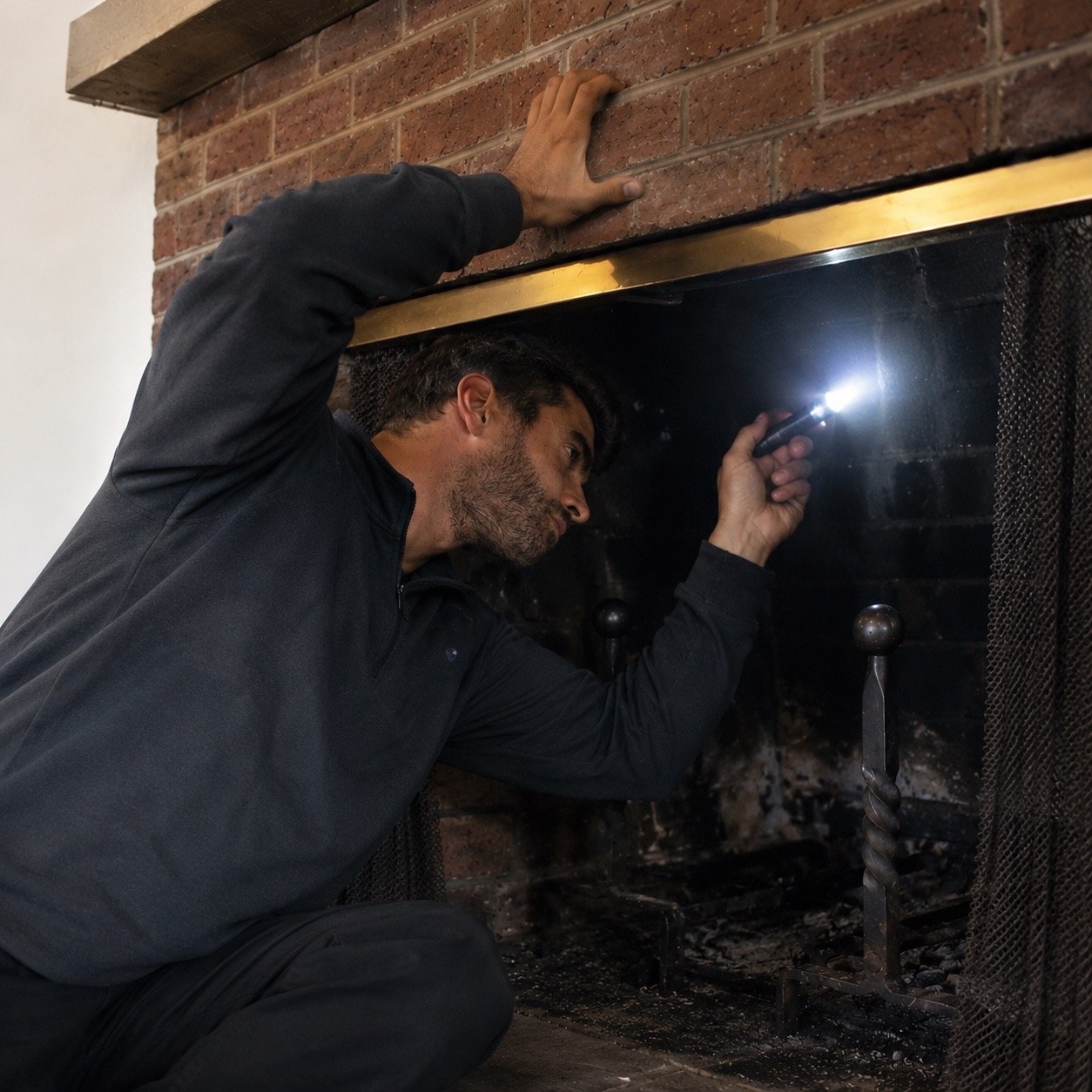
Look, with the fireplace cold. Shine a flashlight up past the top of the firebox opening. If you see the dark inside of the flue, or a patch of daylight in a straight chimney, the damper is open. If you see a flat metal plate a short way above the opening, it is closed.
With a top-sealing damper there is no plate to see near the firebox. Its handle or cable bracket is mounted on the firebox wall, and the handle position shows whether the lid at the top is held open. You can also feel for it: on a cold day an open flue usually moves air you can feel with the back of a hand.
If the handle moves freely but the plate does not, or the plate stops partway, the linkage or the pivot has failed. Do not light a fire until the damper opens fully.
Damper Symptoms and What They Usually Mean
| What you notice | Likely cause | Where it is covered |
|---|---|---|
| Damper stuck open; will not close | Rusted pivot, warped plate, broken linkage | This page |
| Damper stuck shut; handle will not move | Rust, or debris resting on the plate | This page; if debris keeps falling, blockage removal |
| Handle or chain loose, broken or missing | Worn control hardware | This page |
| Cold draft from the fireplace with the damper shut | A plate that no longer seals against its frame | This page — often a top-sealing damper |
| Rust flakes or water on the damper after rain | Water coming down the flue | Cap installation |
| Smoky or musty smell from a cold fireplace | Air moving down the flue over old deposits | Odor removal |
| Smoke into the room with the damper fully open | Not the damper — draft, smoke chamber or flue | Smoke coming into the house |
Fireplace Damper Repair: Throat Dampers and Top-Sealing Dampers
The two designs fail differently and are repaired differently, so it helps to know which one you have before describing the problem.
| Throat damper | Top-sealing damper | |
|---|---|---|
| Where it sits | Just above the firebox, at the smoke chamber opening | On top of the flue at the crown |
| How it seals | Metal plate against a metal frame; rarely airtight, less so once warped | Lid closes onto a gasket |
| How it is worked | Handle, poker or rotary knob in the firebox | Cable down the flue to a bracket on the firebox wall |
| Typical failures | Seized pivot, warped or rusted plate, broken handle | Worn gasket, stretched or detached cable, damaged spring |
| When shut | Flue above it stays open to rain and animals | Also closes the top of the flue |
A top-sealing damper covers the flue when closed, but whether it takes the place of a cap depends on the unit and on how many flues share the crown. The chimney cap page covers what a cap does on its own.
What Damper Repair Generally Involves
The order matters: the cheapest fixes come first, and damper replacement only makes sense once they are ruled out.
- 1
The damper and frame are looked at first
Whether the plate is seized at the pivot, warped, rusted through, or simply sitting on debris decides everything that follows. A flashlight from the firebox shows most of it.
- 2
Seized or dirty dampers are freed
Soot, rust scale and fallen mortar on the frame are cleared and the pivot is worked loose. A good share of stuck dampers need nothing more.
- 3
Broken controls are replaced
Handles, poker rods, rotary controls, chains and cables wear or detach. Replacing the control is usually simpler than replacing the damper.
- 4
A failed plate or throat damper is replaced where it can be
Throat dampers are often built into the masonry at the top of the firebox. Where the frame is sound, a plate can sometimes be replaced; where it is not, a like-for-like swap may mean cutting into masonry.
- 5
Or a top-sealing damper is fitted at the top of the flue
The unit mounts on the flue tile or crown, closes against a gasket, and is worked by a cable running down to a bracket in the firebox. The old throat damper is then left open or removed so it does not fight the new one.
If the frame is loose because the brick around it has failed, that is firebox repair or smoke chamber work first. If a fireplace insert is going in, the damper is usually dealt with as part of lining the chimney.
Gas Logs Can Require the Damper to Stay Open
Some decorative gas log sets installed in a wood-burning fireplace are meant to be run with the damper open, and their installation may include a clamp or stop that keeps the damper from closing fully. The reason is simple: the burner produces combustion gases, and a closed damper would send them into the room.
Follow the log set's instructions. If yours has a damper clamp, a cold draft through that fireplace is not a damper fault to be fixed by closing it. Ask about other ways to deal with the draft instead, and see gas fireplace repair for burner problems.
If you smell gas, do not touch the damper or the controls. Leave the house and call your gas utility's emergency number from outside.
Repair, Replace, or Leave It Alone
Repair when the plate is sound and the problem is a seized pivot or a broken handle.
Damper replacement when the plate is rusted through or badly warped. Where the old throat damper cannot be replaced without opening masonry, a top-sealing damper is often the more practical route.
Look further when the damper works but the fireplace still smokes or draws badly. That points to the smoke chamber, the flue liner, or the house itself, and a new damper will not change it.
When not to call us: if the damper is stiff rather than seized and frees up once soot and rust scale are brushed off the frame, that is housekeeping, not a repair — a fireplace cleaning covers it. And if your gas-log fireplace has a damper clamp, the damper is doing what it is supposed to do; leave it open.
What Drives the Cost of Damper Repair
No price is published here. Freeing a pivot and fitting a new damper at the top of the chimney are not the same job, and these variables decide which one you have.
What has failed
A seized pivot, a broken handle and a rusted-through plate are three very different jobs. The first can be a small one.
Throat damper or top-sealing damper
Repairing a throat damper happens from the firebox. A top-sealing damper means roof work, a unit sized to the flue, and a cable run down the chimney.
How the throat damper is built in
Some frames lift out; others are mortared into the masonry, and replacing one means opening the area around it.
Flue size, shape and height at the top
Top-sealing dampers are made to fit particular flue sizes and shapes. An unusual flue, a flue tile set low in the crown, or several flues close together change the options.
Condition of the surrounding masonry
A crumbling smoke chamber or a cracked crown affects whether a damper can be fitted and sealed properly.
Roof access
For top-mounted work only: roof pitch and height affect the setup. Throat damper work is done from inside.
Send the details of the issue and request an estimate for the specific work.
Chimney Dampers in Los Angeles
Where a masonry fireplace is original to an older house, it may still have its original cast-iron throat damper, and a damper that has sat in one position through decades of wet winters is a likely candidate for a seized pivot. An uncapped flue speeds that up.
NFPA 211 recommends annual inspection of chimneys and fireplaces, and damper operation is one of the simplest things to confirm at that point. The CSIA homeowner resources cover general fireplace and chimney safety.
Damper stuck, loose, or letting in cold air?
Tell us what the handle does, whether the plate moves at all, and whether the fireplace burns wood or has gas logs. A photo taken up into the firebox with a flash helps.
Related chimney & fireplace services
Part of Liner, Flue & Damper — The inside of the chimney — the liner that contains combustion products, and the damper that controls what moves through it.
- chimney liner repairChimney Liner Repair — Clay tile and metal liners — cracks, gaps, deterioration and relining.
- what a chimney repair actually involvesChimney Repair — The hub page: brick, mortar, crown, flashing, liner and how scope is set.
- putting a rain cap on an open flueChimney Cap Installation — Fitting a cap where there is none, and choosing a material that lasts in LA.
- fireplace repairFireplace Repair — The hub page: firebox, refractory, damper, draft and appliance faults.
- chimney blockage removalChimney Blockage Removal — Nesting material, fallen masonry, debris and obstructions cleared from the flue.
- tracing a chimney smell to its sourceChimney Odor Removal — Smoky, musty or rotten smells from a fireplace — what causes each and what clears it.
Further reading: Sealing a Chimney You Don't Use: Options and Trade-offs
Request an Estimate
Describe what the damper handle and plate are doing.
Quick check
Fireplace cold, flashlight pointed up past the opening. A flat plate means the damper is closed. Dark flue or daylight means open. A plate hanging at an angle that the handle will not move means it has seized.
Chimney Damper Questions
Not the question you had? The full FAQ covers more ground.
Tell us what your chimney is doing
Call, or send a short description and request an estimate. Estimates cost nothing.