Los Angeles County Service Areas · Chimney & fireplace services · Estimate requests online
Dryer Vent Repair in Los Angeles
Dryer vent repair is for a duct that is wrong in itself — crushed, disconnected, made of the wrong material, or too long for the dryer. Cleaning a defective vent only resets the clock; it clogs again.
- Chimney & Fireplace ServiceCleaning, inspection & repair
- Los Angeles Service AreasCities & LA neighborhoods
- Free Estimates AvailableEstimates at no charge
- Easy to ReachCall or request online
A Dirty Vent Needs Cleaning; a Defective One Needs Repair
A dirty vent is a sound duct with lint in it. Clear the lint and it works again for a long time. A defective vent is a duct that restricts airflow or leaks even when it is clean — and because it restricts airflow, it fills with lint far faster than a sound one.
The giveaway is how quickly the problem comes back. If a run was cleaned and the dryer is slow again within a few months, the duct is the likely cause. Routine dryer vent cleaning usually turns this up, because a crushed section or a loose joint shows itself when the run is opened.
What Goes Wrong With a Dryer Duct
Most dryer vent repairs fall into one of six problems. What you see usually points straight at which one.
| What you see | What it usually is | Typical repair |
|---|---|---|
| Lint, damp or a musty smell behind the dryer or inside the closet | Disconnected dryer vent — the duct has slid off the outlet or pulled apart at a joint | Reconnect and clamp; check the wall side of the joint |
| The hose behind the dryer is flattened or kinked | Crushed dryer vent at the transition | Replace the transition hose; leave room behind the dryer |
| White plastic or thin foil accordion duct | Duct material the dryer was not designed for | Dryer duct replacement with metal |
| The run clogs again within months of being cleaned | Too long, too many bends, or a hidden crush | Shorten or reroute the dryer vent |
| Flap missing, broken, painted shut, or a screen over the opening | Failed or unsuitable termination | Dryer vent hood or cover replacement |
| Duct sagging between supports in an attic or crawl space | Unsupported run that collects water and lint at the low point | Re-support, and replace any section that has collapsed |
If the run is fully closed up right now — two cycles to dry, a hot cabinet, a burning smell — deal with that first on clearing a clogged dryer vent. A disconnected joint inside a wall also deposits lint where nobody can see it, which is worth knowing if you are finding lint in odd places — where lint collects covers the normal pattern.
Why Plastic and Foil Dryer Duct Cause Problems
Flexible plastic or vinyl duct — the white accordion kind — and thin foil duct share three weaknesses. The ridged walls hold lint in every fold. They crush and kink easily, often out of sight. And plastic duct softens with heat and burns, which is the last thing you want wrapped around a lint deposit.
Dryer manufacturer installation instructions typically call for rigid or semi-rigid metal duct. Rigid duct is smooth-walled sheet metal, used for the fixed run through walls, floors and ceilings. Semi-rigid duct is metal that bends by hand and holds its shape, used for the short connection behind the dryer. Smooth walls move more air and hold less lint, which is why a dryer duct replacement often shortens drying times on its own.
The Transition Hose Is the Easiest Part to Damage
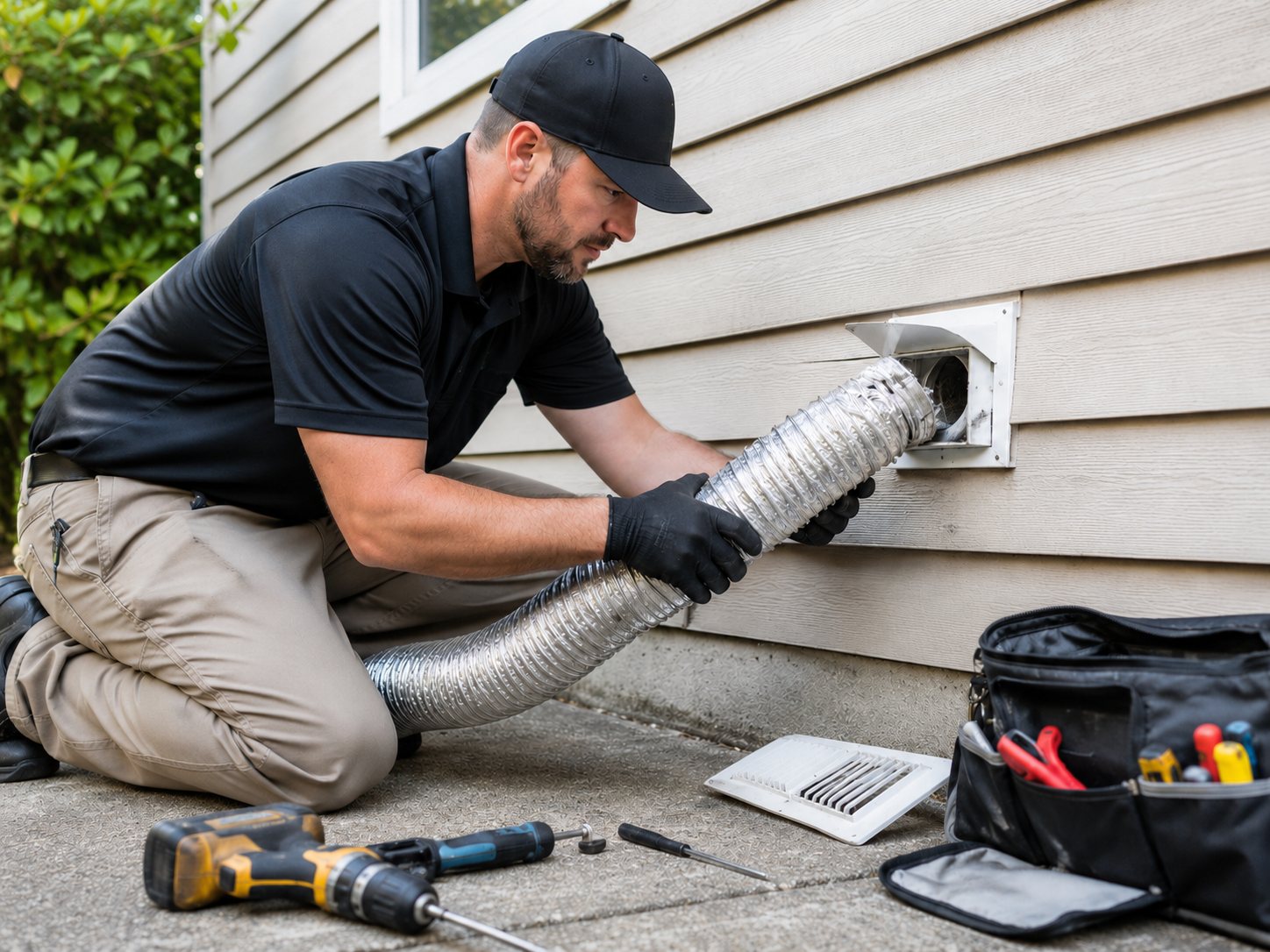
The transition hose is the short flexible section between the dryer outlet and the duct in the wall. Every time the dryer is pushed back, the hose takes the load. A hose squashed to half its width halves the opening at the one point every bit of exhaust has to pass.
It also comes loose. A hose held on by tape or a worn clamp slides off the outlet when the dryer is moved, and the dryer then blows lint and moist air into the closet or the wall cavity. Replacing it means a new length of semi-rigid duct, clamped at both ends, with the dryer set far enough from the wall that the hose is not compressed. Recessed dryer vent boxes, set into the wall behind the dryer, exist for exactly this problem where space is tight.
When a Dryer Vent Is Too Long, Rerouting Shortens It
The dryer manufacturer's installation manual sets a maximum equivalent length for the vent, and every bend counts against it. Equivalent length means the straight duct plus an allowance for each elbow, because a turn slows the air as much as a stretch of straight pipe would. A run can be well within the limit on a tape measure and over it once the bends are counted.
To reroute a dryer vent is to rebuild the path so it is shorter or straighter. That can mean a new exit through the nearest exterior wall instead of a long run to the roof, replacing two sharp elbows with gentler ones, or taking out a loop that was added only to reach an old opening. Sometimes moving the dryer a few feet does more than any change to the duct.
Where a run genuinely cannot be shortened, some installations add a booster fan made for dryer exhaust. It is a fix with its own upkeep — a fan in a lint stream needs cleaning too — and it is worth asking whether a shorter route exists before relying on one.
Roof or Wall Termination: Which Is Better?
A wall termination is usually the better one. The run is shorter, lint does not have to be lifted, and the hood can be checked and cleaned from the ground. Its weakness is debris: a low hood behind shrubs collects leaves and is an easy target for nesting birds.
A roof termination is sometimes the only route out of an interior laundry room. It means a vertical rise, where lint falls back toward the dryer, and a cap that nobody sees until it fails. A roof cap designed for a bathroom fan rather than a dryer often has openings or a screen that catch lint.
Either way, a dryer vent hood or cover replacement is due when the flap is missing, cracked, painted shut, or covered with mesh. The replacement should have a damper that opens under the dryer's airflow and falls shut when it stops.
When not to call us: if the duct is sound and simply full of lint, it needs cleaning, not repair. And if the only problem is a crushed or loose transition hose behind the dryer, you can usually replace it yourself: a length of semi-rigid metal duct and two clamps from a hardware store, and move the dryer out far enough that the new hose is not squashed.
What Drives the Cost of Dryer Vent Repair
No price is published here: replacing a hood and replacing a duct inside a ceiling are not comparable jobs. These are the variables that move an estimate.
Where the duct runs
A duct you can see in a garage or a laundry room is quick to reach. A duct inside a finished wall, above a ceiling, or across an attic is not, and access is often the largest part of the job.
Whether drywall has to be opened
Replacing a concealed section can mean cutting an access opening. Patching and painting it afterwards is often separate work by another trade, so ask how the opening will be closed before it is cut.
Length of the run
More duct means more material and more joints to seal and support. Rerouting to shorten the run changes the scope again.
The termination
Replacing a wall hood at ground level is a small job. A roof termination needs roof access and has to be flashed so it does not leak, and a new wall opening means cutting through the exterior finish.
Getting to the dryer
A stacked washer-dryer in a tight closet has to come out before the connection behind it can be reached.
Call or send the details, and ask for an estimate for the work. A photo of the connection behind the dryer and of the outside hood answers most of the first questions.
Long Dryer Duct Runs in Los Angeles Condos and Apartments
Where a condo or apartment has its laundry in an interior closet, the vent cannot go straight out. It travels through a ceiling or a chase to the nearest outside wall or up to the roof, and in a stacked building that can mean a long run with several bends that nobody in the unit has ever seen. Those are the runs most likely to be over the dryer's maximum equivalent length, and the hardest to check from inside the unit.
The same applies to houses where the laundry was moved from the garage to the middle of the house during a remodel. The duct had to get longer to reach an outside wall, and it was not always done in metal.
In a condo, find out who is responsible for the duct before anything is opened: the section inside the unit and the section in common walls or the roof are often treated differently by the association. Buildings with many units on similar runs, and shared laundry rooms, are covered on multi-unit and commercial properties.
Duct crushed, loose, or clogging again already?
Tell us what the duct is made of, where it runs, and where it comes out. We can help you work out whether it needs cleaning, repair, or a new route.
Related chimney & fireplace services
Part of Dryer Vent Services — The other duct in the house that fills with something flammable. Same access equipment, same failure mode, very different appliance.
- dryer vent cleaningDryer Vent Cleaning — The full duct run from the appliance to the exterior vent.
- dryer vent blockage removalDryer Vent Blockage Removal — Full blockages — crushed duct, bird nests, and the symptoms that give them away.
- why lint accumulates where it doesDryer Vent Lint Removal — Where lint collects, why it collects there, and what it does to airflow.
- commercial chimney servicesCommercial Chimney Services — Multi-unit, HOA and commercial properties, where access and scheduling differ.
Request an Estimate
Tell us what the duct is made of and where it runs.
Quick check
Pull the dryer out and look at the hose behind it. White plastic, a flattened section, tape instead of clamps, or lint on the floor around the connection all mean the duct needs fixing, not just cleaning.
Dryer Vent Repair Questions
Have a question this page does not cover? Try the chimney and fireplace FAQ.
Tell us what your chimney is doing
Call, or send a short description and request an estimate. Estimates cost nothing.