Los Angeles County Service Areas · Chimney & fireplace services · Estimate requests online
Dryer Vent Lint Removal in Los Angeles
Dryer vent lint removal clears the fibers that get past the lint screen and settle in the duct. They collect in predictable places, and knowing those places is most of the job.
- Chimney & Fireplace ServiceCleaning, inspection & repair
- Los Angeles Service AreasCities & LA neighborhoods
- Free Estimates AvailableEstimates at no charge
- Easy to ReachCall or request online
A Clean Lint Trap Does Not Mean a Clean Duct
The lint trap is a screen, and a screen fine enough to stop every fiber would also stop the air. So it is built to catch most of the lint and let air through, and the finest fibers go with the air into the duct. Emptying the trap after every load is worth doing; it does nothing about what has already passed it.
That is why lint buildup in a dryer vent happens in houses where the trap is cleaned religiously. The trap handles the lint you can see. Lint in the dryer duct is the part you cannot, and it accumulates load after load until something changes in how the dryer behaves.
Where Lint Collects in a Dryer Vent
Lint drops out wherever the exhaust slows down or changes direction. On most runs that means these six places.
The lint trap housing
The slot the screen slides into. Lint that slips around the edge of the screen builds up in the slot and below it. A long, narrow vacuum attachment reaches the top of it; anything deeper inside the cabinet is appliance work.
The transition hose and first elbow
The air turns sharply as it leaves the dryer, and a hose squashed against the wall turns it again. This is often the first place lint packs, and the easiest one to check.
Vertical rises
Where the duct climbs through a ceiling or up to the roof, the air has to lift the lint as well as carry it. Some of it falls back and settles at the bottom of the rise.
Sags and low points
A horizontal run that dips between supports collects the moisture that condenses out of the exhaust. Wet lint turns to a paste that sticks, and the next layer sticks to that.
Joints fastened with screws
A screw tip that pokes into the duct catches fibers and starts a clump. Dryer manufacturers' instructions generally call for clamps or foil tape at joints for this reason.
The exterior hood and flap
The air slows as it pushes the flap open, so lint drops out right at the exit. A hood fitted with a screen or cage over the opening traps lint even faster.
If lint is building up at the exterior vent while the dryer still dries normally, the hood is the first thing to clear. If the flap will not open at all, the run may already be closed — see clearing a clogged dryer vent.
Why Some Dryer Vents Load With Lint Faster
What goes in the dryer. New towels, fleece, bedding and anything carrying pet hair shed far more than cotton shirts. A household that dries a lot of them fills a duct faster than the number of loads suggests.
How the run is built. Every bend, rise and joint is another place for lint to settle, and a long run gives the exhaust more time to cool and drop its moisture. A duct with ridged walls — the foil and plastic kind — holds lint in every ridge. When the run itself is the reason it keeps filling up, replacing or shortening the duct does more than cleaning it again.
The state of the screen. A screen that is torn, bent at the frame, or coated in softener film lets more lint past it. Check it against the light and replace it if the mesh is damaged.
Lint Buildup Cuts Airflow, and Airflow Is What Dries the Clothes
A dryer dries clothes by moving heated air through the drum and carrying the moisture out. Heat alone does very little if the wet air cannot leave. As lint narrows the duct, less air moves, the drum stays humid, and the cycle runs longer — or the moisture sensor keeps it going because the clothes are still damp.
Longer cycles mean more heat for longer, in a cabinet next to a duct lined with a material that burns easily. That is the dryer lint fire risk in one sentence. The US Fire Administration identifies failure to clean as the leading factor in home dryer fires; the figure and the source are on the dryer vent cleaning page.
How Lint Is Removed From a Dryer Duct
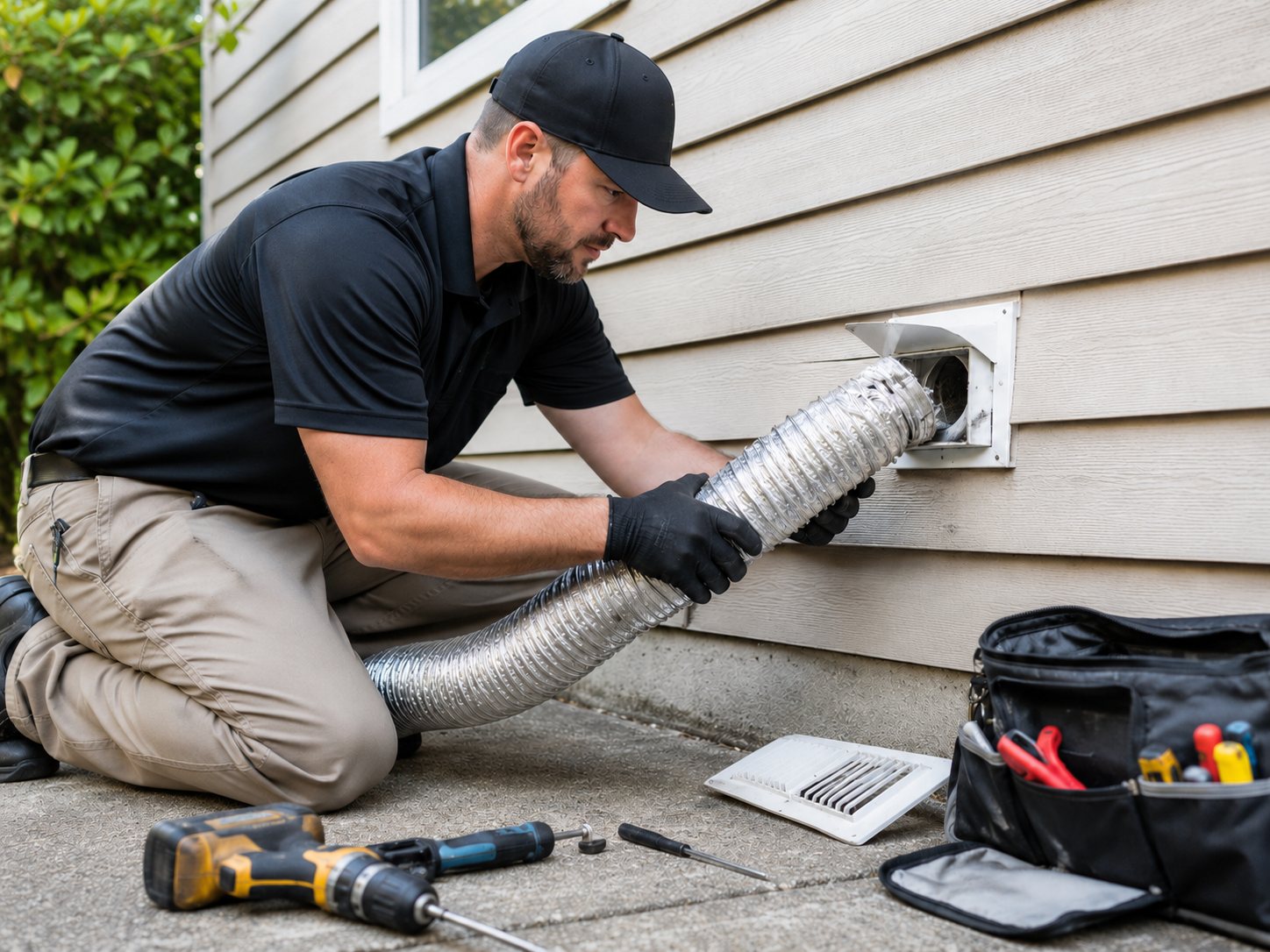
Lint stuck to the duct wall has to be broken loose before it can be taken out. A rotary brush on flexible rods does that, working through each bend rather than stopping at the first one. The loose lint is then pushed out through the exterior hood or drawn back with a vacuum.
The places a brush does not reach are cleared by hand: the lint trap housing is vacuumed, and lint matted around the hood flap is picked out so the flap swings shut when the dryer stops.
If airflow is still weak, the lint was not the whole story. A crushed section or an over-long run shows up this way, and a full dryer vent cleaning with an inspection of the run is the step that finds it. Send the details of the issue and request an estimate for the specific work.
The chimney has its own version of this problem, and how the two ducts compare is worth reading if both are due.
When Lint Removal Is Not Needed
When not to call us: if the lint you are finding is only in the trap, the exterior flap opens freely, and you can feel a strong stream of warm air at the hood while the dryer runs, the duct is doing its job. Keep cleaning the screen and check the hood now and then. There is nothing to remove yet.
Lint Removal in Los Angeles Homes
Where the dryer sits in an attached garage and vents straight through the wall, the run is short and most of the lint ends up at the hood, which is easy to reach and easy to clear yourself. Where the laundry was moved inside during a remodel, the duct usually got longer and gained bends, and lint has more places to settle out of sight.
Exterior hoods at ground level also collect leaves, dust and plant growth from the outside. A hood behind a hedge or under a planter is worth checking from the garden side as well as from the laundry.
Lint piling up somewhere it should not be?
Tell us where you are finding it — behind the dryer, at the outside hood, or only in the trap — and how long a load takes to dry.
Related chimney & fireplace services
Part of Dryer Vent Services — The other duct in the house that fills with something flammable. Same access equipment, same failure mode, very different appliance.
- having the dryer run cleaned outDryer Vent Cleaning — The full duct run from the appliance to the exterior vent.
- clearing a clogged dryer ventDryer Vent Blockage Removal — Full blockages — crushed duct, bird nests, and the symptoms that give them away.
- replacing crushed or disconnected dryer ductDryer Vent Repair — Crushed, disconnected or badly routed duct, and failed exterior hoods — repair and replacement.
- what an annual chimney cleaning coversChimney Cleaning — Creosote, soot and debris removed from the flue, smoke shelf and firebox.
Nearby Service Areas
Request an Estimate
Tell us where the lint is collecting.
Quick check
Pull the lint screen and run a little water over it. If the water beads on top instead of passing through, the mesh is coated and lint is going around it. Wash it, dry it, and check again.
Dryer Vent Lint Removal Questions
Other things homeowners ask are covered on the FAQ page.
Tell us what your chimney is doing
Call, or send a short description and request an estimate. Estimates cost nothing.