Los Angeles County Service Areas · Chimney & fireplace services · Estimate requests online
Gas Fireplace Installation in Los Angeles
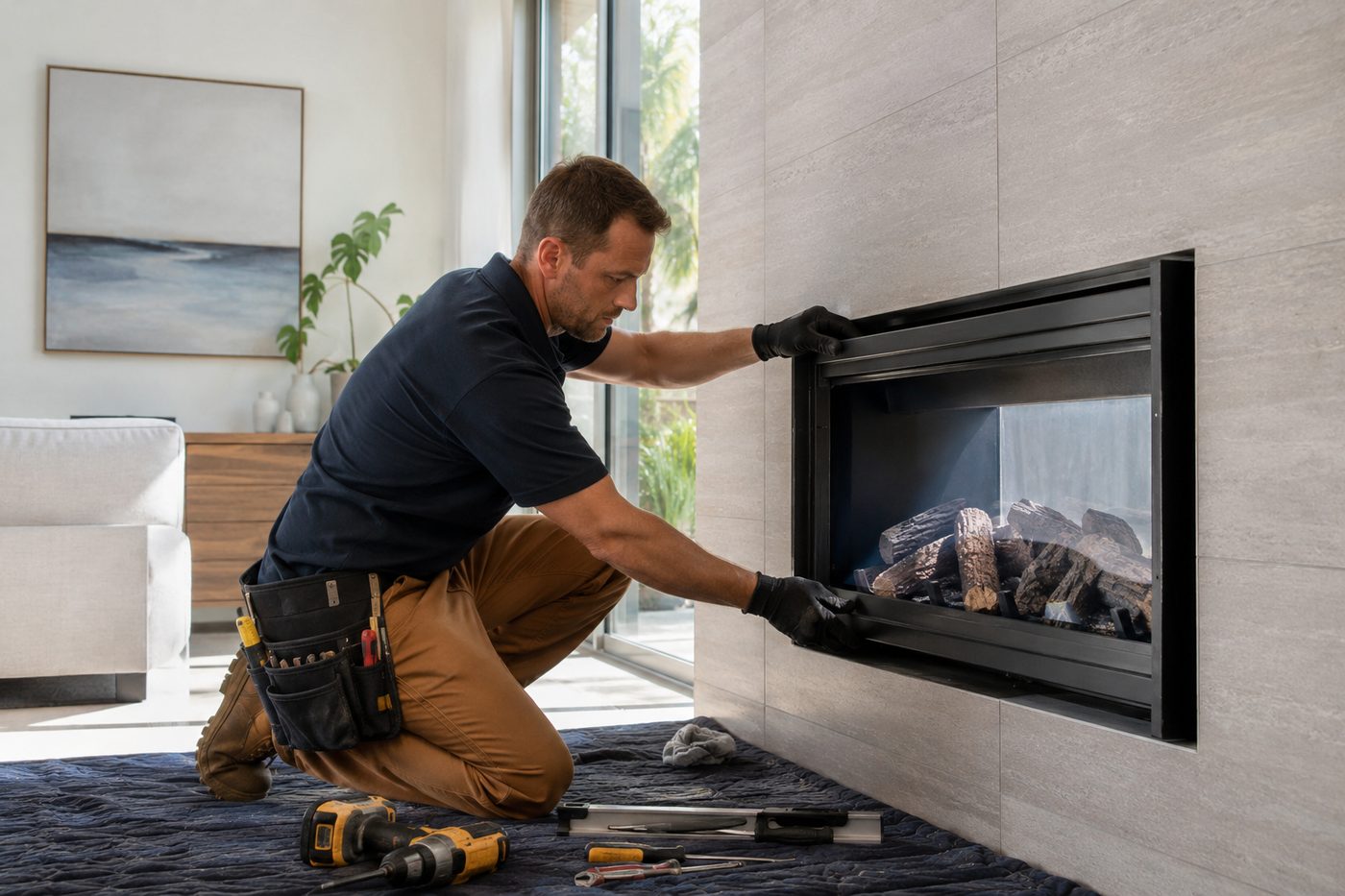
Gas fireplace installation takes one of three forms: a direct-vent unit that needs no chimney, a gas insert in an existing fireplace, or a gas log set. Which one fits depends on whether there is a chimney and how much heat you want.
- Chimney & Fireplace ServiceCleaning, inspection & repair
- Los Angeles Service AreasCities & LA neighborhoods
- Free Estimates AvailableEstimates at no charge
- Easy to ReachCall or request online
There Are Three Ways to Get a Gas Fire
The house decides more of this than the showroom does. A room with no chimney can only take a direct-vent unit (or an electric one). A room with a working masonry fireplace can take any of the three.
| Option | What it needs | Heat | Usually fits |
|---|---|---|---|
| Direct-vent gas fireplace | An exterior wall or roof within the vent length the manufacturer allows; a gas line; framing and finish | Sealed firebox, so most of the heat stays in the room | Rooms with no existing fireplace |
| Gas insert | An existing masonry firebox in sound condition; a liner run to the top of the chimney; a gas line | Closed appliance, so the heat stays in the room rather than going up the chimney | Existing wood fireplaces where heat matters |
| Gas log set | An existing working fireplace and chimney; a gas line to the firebox | Vented logs are mostly for looks; much of the heat leaves through the open flue | Existing fireplaces where the look matters more than heat |
Inserts have their own page: fireplace insert installation covers sizing an insert to the firebox and the liner it needs. For a gas fireplace that is already in and not working, gas fireplace repair is the relevant page.
Converting a Wood Fireplace to Gas
A masonry wood fireplace can usually be converted to gas, and the first step is checking the chimney, not choosing the unit. A wood-to-gas conversion reuses the existing firebox and flue, so their condition decides what is possible. A chimney inspection establishes whether the flue tiles, crown and firebox are sound.
If heat matters, the conversion is an insert. The insert is sized to the firebox opening, a gas line is brought to it, and a liner sized to the insert is run to the top of the chimney. The original flue is usually too large for a gas appliance, and a flue that is too large lets the exhaust cool and condense on the way up. Chimney liner installation covers why.
If the look matters more, the conversion is a log set. Ceramic logs sit on a gas burner in the existing firebox, and the chimney stays as it is. It is the smaller job, and the fireplace stays an open fireplace with the heat loss that comes with it.
Before converting, have the chimney swept if wood has been burned in it. Creosote left in the flue does not go away because the fuel has changed.
A Direct-Vent Gas Fireplace Needs No Chimney
A direct-vent gas fireplace is sealed from the room. It draws combustion air from outside and sends exhaust back out through the same vent, a pipe within a pipe, which is why it can go on an exterior wall of a house that has never had a fireplace.
The limits are set by the manufacturer: how long the vent may run, how many elbows it may have, and how far the termination must sit from windows, doors and the ground. Those figures are in the installation manual, and they decide where the fireplace can go before the room layout does. Because the room air is not used for combustion, a direct-vent unit does not draw warm air out of the house the way an open fireplace does.
Vented or Vent-Free Gas Logs
Vented gas logs burn in an open firebox with the flue open, and their exhaust goes up the chimney. They produce a tall, yellow flame that looks like wood, and give comparatively little heat. Many vented sets require the damper to be fixed open with a clamp, so it cannot be closed while the logs are in place.
Vent-free (ventless) gas logs are designed to burn cleanly enough to run with the damper closed, so the heat stays in the room. The trade-off is that their combustion products, including water vapor, stay in the room too. They carry an oxygen depletion sensor that shuts the gas off if the room air runs low.
Whether vent-free logs are allowed, and in what size of room, is set by local codes and by the manufacturer, and some jurisdictions do not allow them in homes. Ask the building department before buying a set. For a fireplace that is going to be used often, a sealed insert is usually the better answer to the heat question.
Running a Gas Line to a Fireplace Is Its Own Trade
A new gas line to the fireplace is work for a licensed plumbing or gas contractor, and it normally needs a permit and a pressure test before the appliance is connected. The line has to be sized for the total gas load in the house, not just the fireplace, so adding an appliance can mean upsizing a run that was fine before.
A shutoff valve should be within reach of the appliance. If the house has no natural gas service, propane is a separate question with its own tank siting rules, and electric may be the simpler answer.
Safety After Installation: CO, Venting and the Damper
Put a carbon monoxide alarm on the same floor as any gas fireplace. If it sounds while the fireplace is running, turn the fireplace off, get everyone out of the house, and call your gas utility or 911 from outside.
If you smell gas, do not operate the fireplace or any switch. Leave and call the gas utility's emergency number. That is their call before anyone else's.
Never close the damper on a gas log set that requires it open; the log set's instructions govern, not habit from the wood-burning days. And have the vent termination checked each year for nests, debris and damage. NFPA 211 calls for annual inspection of chimneys, fireplaces and vents, gas included.
Gas Is What Los Angeles Air Rules Favor
Under SCAQMD Rule 445, a dedicated gaseous-fueled fireplace is one of the four device types that may be permanently installed in the basin, and gas appliances are outside the no-burn restriction. For many homes, particularly those whose construction began on or after March 9, 2009, gas is the only fuel-burning option. The full rule, and what it means for wood, is set out on the fireplace installation page.
Thinking about converting to gas?
Tell us whether there is an existing fireplace, whether the house has natural gas, and whether you want heat or mainly the look. That settles most of the route.
What Drives the Cost
No price is published here, because the three routes are different jobs. These are the variables that move the number.
Which of the three routes
A log set in a working fireplace, an insert with a new liner and a direct-vent unit in a newly opened wall are different amounts of work before the appliance itself is counted.
Vent route
For an insert, the height of the chimney sets the liner length. For direct-vent, the distance to an outside wall or roof and what the pipe has to pass through.
Gas line
How far the fireplace is from the existing supply, how the line gets there, and whether the line or meter needs upsizing for the added load.
Electrical
Blowers, electronic ignition and some remote systems need a power supply at the firebox.
Chimney and firebox condition
A conversion that uses an existing chimney may turn up cracked flue tiles or a failed firebox that has to be dealt with first.
Surround and finish, and the permit
Wall opening, surround, hearth and mantel work; plus permit fees and inspections where the building department requires them.
Call or send the details, and ask for an estimate for the work.
When Gas Is the Wrong Purchase
When not to call us: if you want the look of a fire and never the heat, an electric insert or wall unit may be the better purchase. It needs no gas line, no vent and, as a plug-in, usually no permit. The electric vs gas fireplace comparison sets out what each one is bad at.
Related chimney & fireplace services
Part of Fireplace & Insert Installation — New fireplaces, gas conversions and inserts — what Los Angeles air-quality rules allow, what the flue has to do, and how an installation is scoped.
- what a new installation involvesFireplace Installation — New fireplaces and inserts — clearances, venting and what the flue has to do.
- fireplace insert installationFireplace Insert Installation — Gas, wood and pellet inserts set into an existing masonry fireplace, and the liner they need.
- a gas fireplace that will not lightGas Fireplace Repair — Pilot, thermocouple, valve, ignition, burner and gas-log problems.
- putting a new liner in an old flueChimney Liner Installation — Relining an unlined or failed flue, or lining it for a new insert — sizing, materials and scope.
- fireplace inspectionFireplace Inspection — The appliance rather than the stack — firebox, damper, burner and venting.
Further reading: Can You Burn Wood in Los Angeles? SCAQMD No-Burn Rules
Request an Estimate
Tell us whether there is an existing fireplace and gas at the house.
Which route?
- No chimney: direct-vent.
- Chimney, want heat: gas insert.
- Chimney, want the look: gas logs.
Gas Fireplace Installation Questions
There are more answers on the Los Angeles homeowner FAQ.
Tell us what your chimney is doing
Call, or send a short description and request an estimate. Estimates cost nothing.