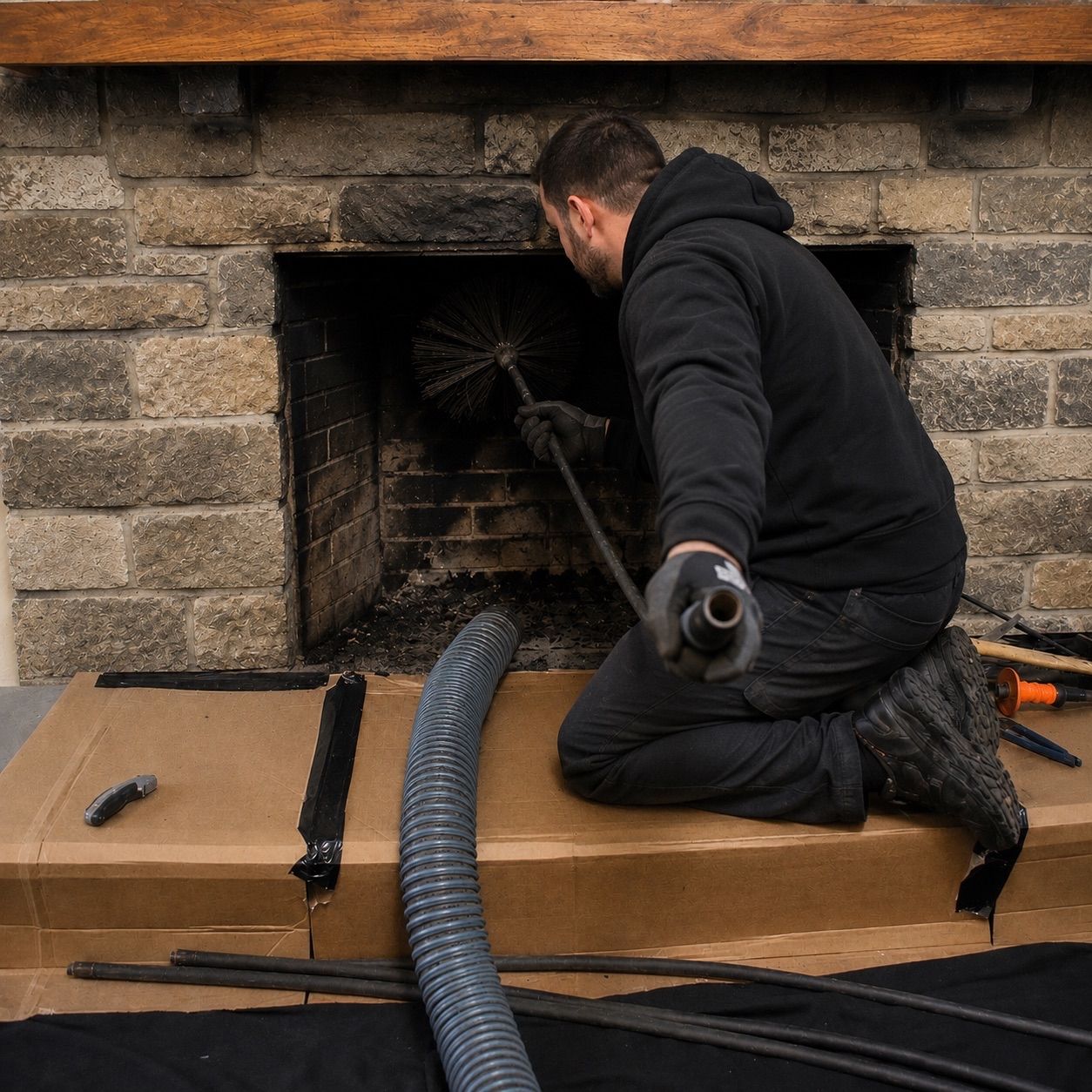
Mortar grit, tile shards and what they point to
Most debris is harmless. A few kinds are signals.
- 1Fine, sandy grit: mortar from the flue joints or smoke chamber breaking down.
- 2Curved pieces of fired clay: broken flue tile, meaning the liner has a gap.
- 3Twigs, feathers and nest material: a missing or damaged cap.
- 4Rust flakes on the smoke shelf: a corroding damper or cap.
Cleaning clay-lined and unlined flues in older Culver City houses
Where a Culver City house dates from the early decades of the last century, the flue may be clay tile or, in some cases, may have no liner at all.
Clay tile tolerates a brush well but not a hard-edged rotary head run carelessly. An unlined flue is brushed more gently still, because the mortar joints are the only lining it has, and any loose mortar in the debris is watched closely.
Glazed creosote in an older flue is usually softened with a chemical treatment and then brushed out. Aggressive mechanical removal on old tile risks cracking it.
If tile fragments turn up, the job changes. A flue with a broken liner should not be used until the liner has been looked at with a camera, and that applies to gas logs as much as to wood.
Tell us whether the fireplace burned wood before any gas conversion, and anything you have found in the firebox, and we'll come back to you. A short description, and a photo if you can take one safely, is a good start to an estimate request.
Damp Westside air and a flue that sits idle
Where moist marine air reaches a Culver City house, an idle flue holds that moisture, the old deposit gives off more odor, and the damper plate starts to rust.
Cleaning removes the deposit. A cap on the outlet and a damper that closes properly are what keep moist air out afterwards, and without them the smell tends to return.
What sets the price of cleaning a Culver City flue
History matters here: how long the flue burned wood, and what has happened to it since.
- 1How long the flue burned wood, and whether the old deposit is loose or glazed.
- 2Whether a gas log set has to be moved to reach the smoke shelf.
- 3An unlined or fragile flue that needs a gentler method.
- 4Nesting material or a blockage that has to be pulled out.
- 5A camera check if tile fragments appear.